You might recall the strain of conversation about Maw and Caw our resident ravens. I just want to say that they are So Cute! Well, a little more: they love each other and you can tell it- constantly fretting about one another and this time of year gazing at each other, playing follow the leader and other games. They are well enough fed to have lots of spare time and they fill it with fun. If you travel downhill and along the coast, you find Other Farm Ravens, and not in isolated pairs…big playful troupes of them, paired, yes, but 20, 30, or 50 strong groups – noisy tribes hopping up and down flushing grasshoppers or something just like our two but more. Somehow, they seem smaller, too. I hope someone one day helps us find where our two nest.
Other Farm Wildlife
We’ve got Western Bluebirds in fine spring regalia in and out of the nest boxes already setting up shop. I think I’ll not mention the cacophony of blackbirds much – only to say that they are still noisy and beautiful.
What we don’t have are foxes or coyotes or skunks or racoons. I heard that there is distemper spreading through the predator community nearby- can anyone confirm?
This year had the driest January and February on record in many places around us- San Francisco for instance. Maybe not here, but maybe so. Bob Brunie was digging a hole to plant a new tree and found the soil dry to two feet depth. That’s weird for this time of year- very weird.
Winter Farming
Bob was planting a new peach tree- number 7 in the group of one day 8 on Citrus Hill. If someone wants to donate a nectarine or two, we’ll plant those, too. Whatever we do, we must set up irrigation to start running Soon for the orchards.
It has become mowing and weeding time- 2 Dog Crew has been tidying up the Chardonnay grapes so now the vineyard looks so neat and tidy.
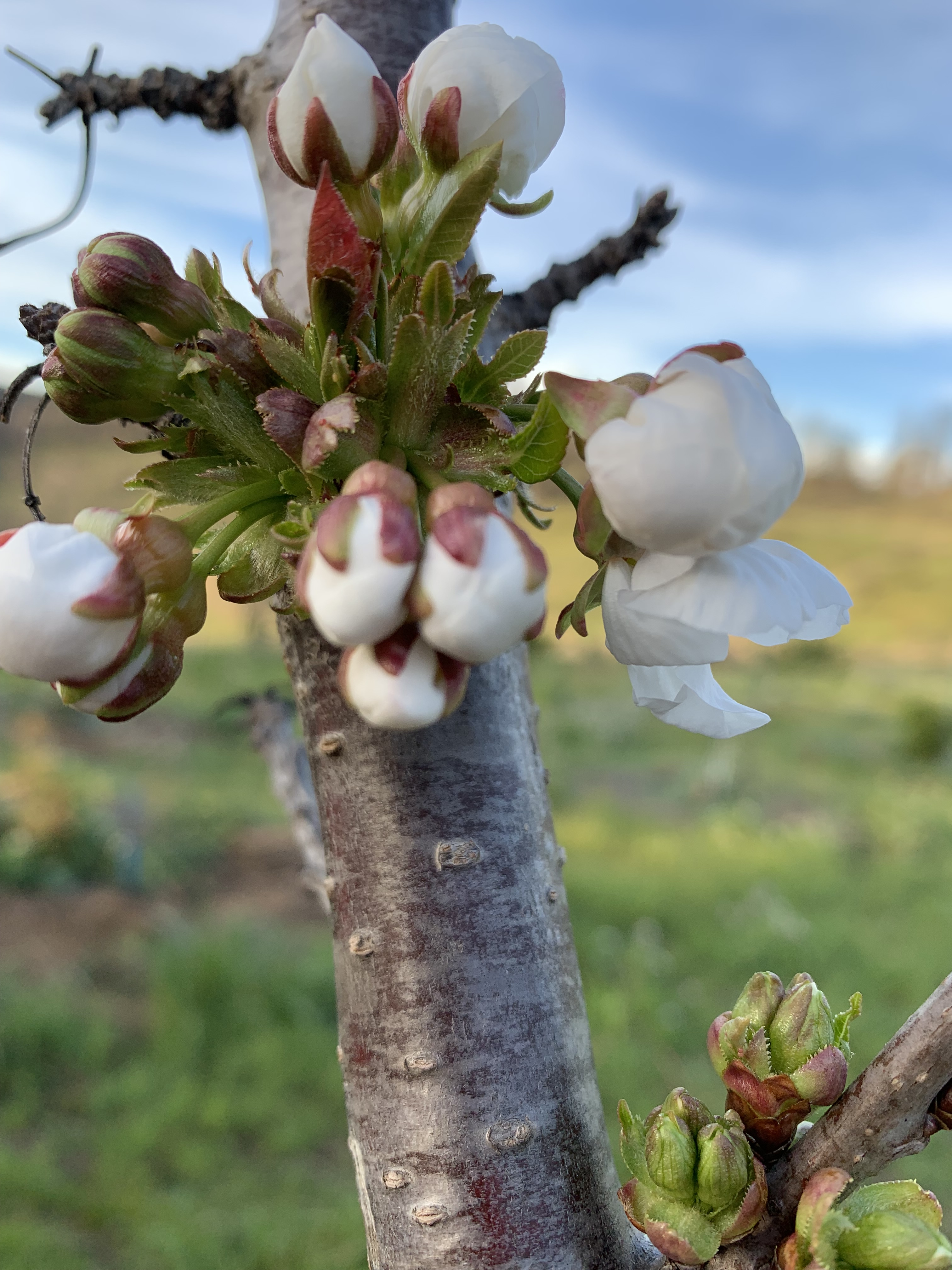
The first cherry blossoms are emerging on the few trees that the fire spared. Maybe we’ll get a bunch of cherries this year!
Lapins Cherries – Starting to Bloom!
Around the Edges: Wildflowers
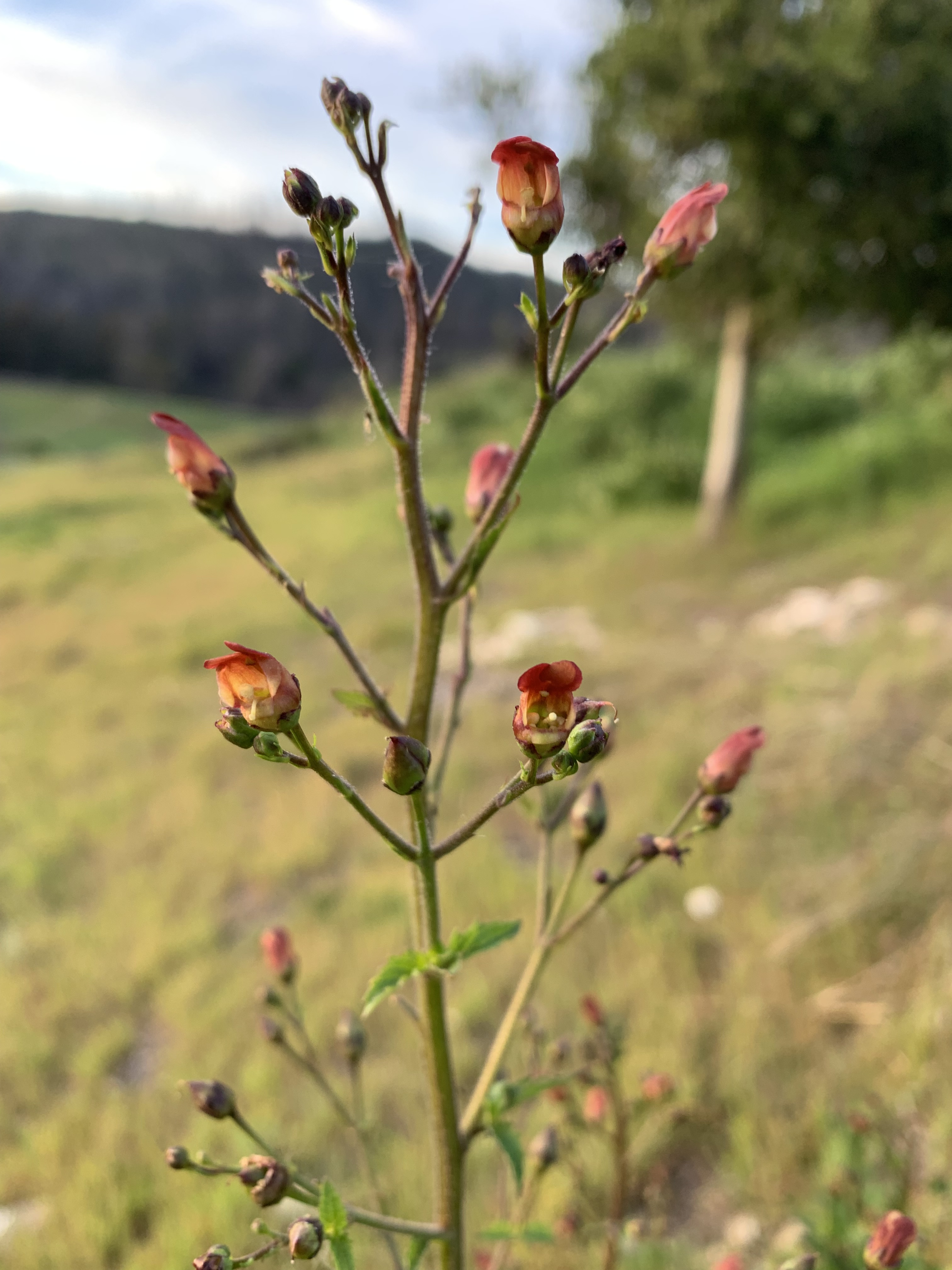
In the wild places of the Farm flowers are blossoming. A common plant is called bee plant, a Scrophularia with flowers some say are like Micky Mouse – a pair of upright petals are like Mickey’s ears. The flowers are carrion colored red-brown and attract meat “bees” – really wasps. But, honeybees and hummingbirds have figured out those flower cups are filled with nectar, so the plants get lots of visitors right now…meat bees haven’t come out yet. Wild radishes have sprays of light flowers like sea foam across the fallow fields. Across the steep hillsides near Molino Creek, trilliums and other native bulbs are starting to flower as the forest produces more and more spring flowers.
Beeplant- a nectar rich native perennial
this post from my regular blog at Molino Creek Farm’s website. I am a partner in that collectively owned farm in northern Santa Cruz County, California.
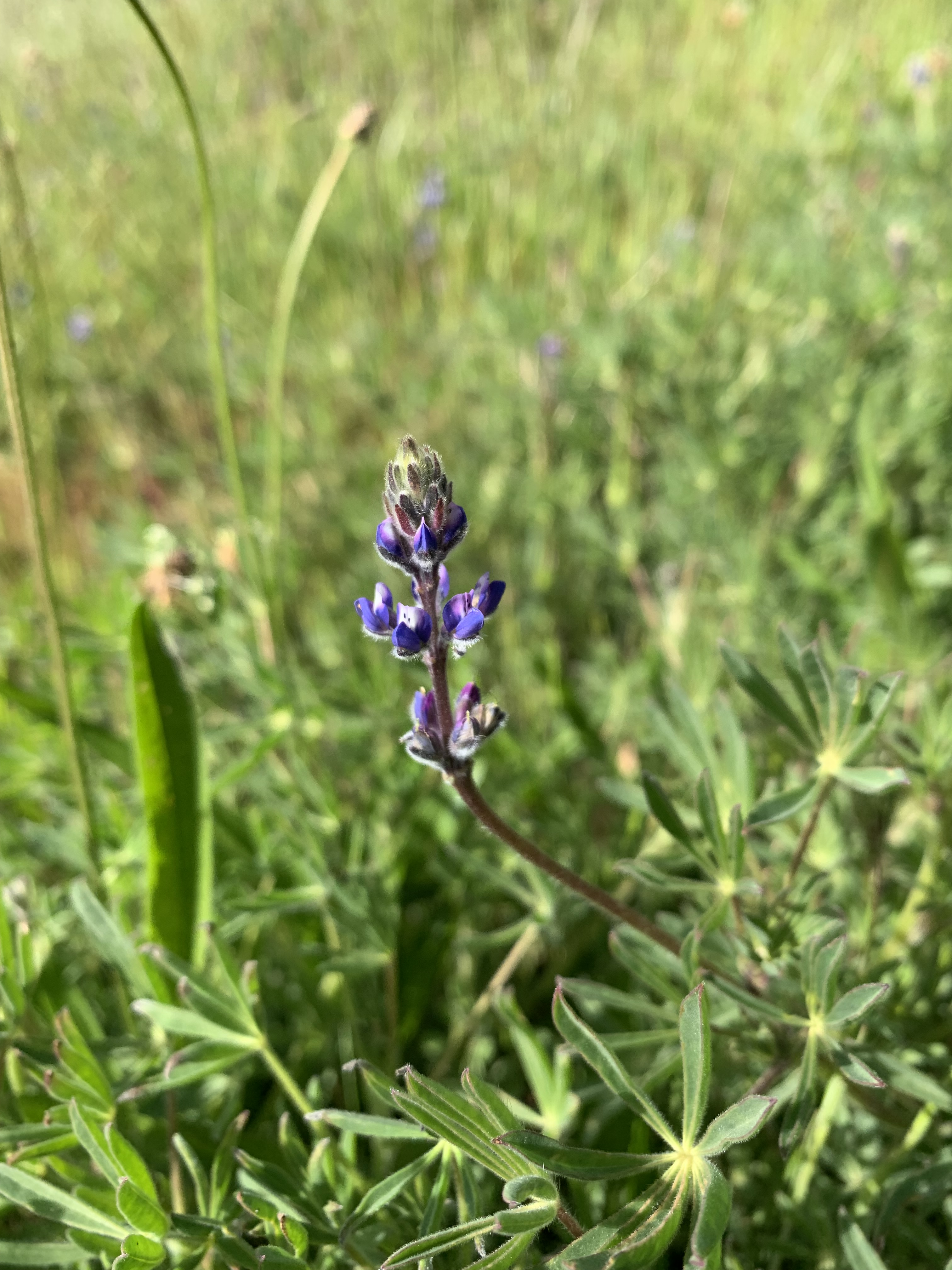
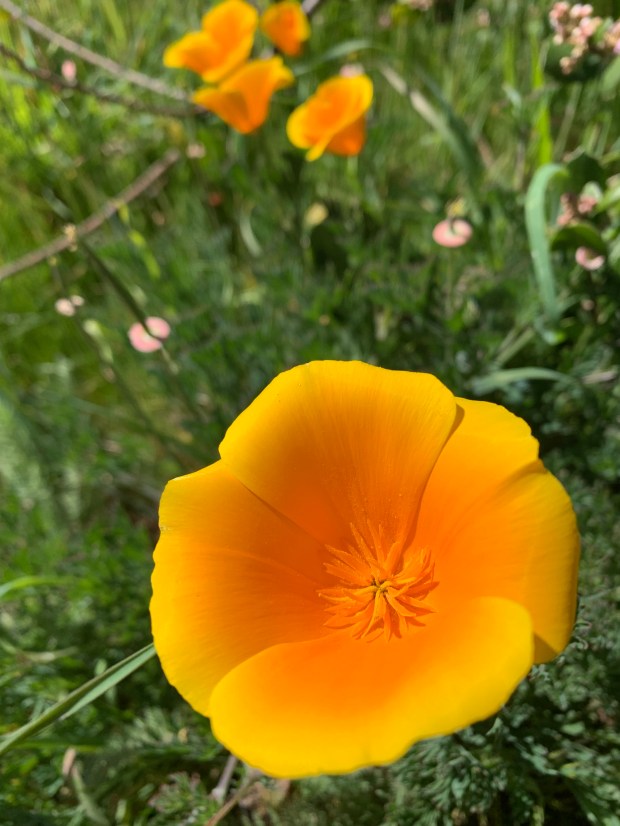
Right on time, the first tulip-sized California poppies have opened. Unusually, and a month early, the sky lupines have started blossoming, as well. The habitat areas, field margins, the hedgerow, and the orchard are starting to fill with Spring blooms. We hope for the return of rain before Spring’s beginning date arrives.
Lupinus nanus Sky Lupine Too early, but still nice
For a few nights, the air has carried a winter scent, like snow; frost decorates leaves in the grassy areas and wild radish leaves wilt from cold damage. We check the margins of avocado and citrus leaves to see if they are damaged. But, its only been evaporative frost- we still haven’t hit critical freezing temperatures! The cool temperatures are helping some fruit trees to sleep well, but others are waking up. The Santa Rosa plum popped into bloom – it only needs 250 accumulated hours of temperatures below 45 degrees Fahrenheit. Other stone fruit trees are budding and/or blooming in the orchard.
Juicy Santa Rosa Plums start with brilliant flowers
The semi-cacophony of blackbirds continues, and other birdy things are happening, too. The blackbirds mostly gather in one tree but as you look around, the party has outliers as bicolor blackbirds court one another away from the crowd. I watched for a while as one outlier male bicolor blackbird did his thing: the trilling scree song while bowing slightly, wings shrugged out, flashing his bright red wing patches. A few feet away, a female watched in rapture…it was just this pair alone at the top of an isolated tree, though they kept glancing towards their flock in the tree nearby. Buzzing by, not entirely oblivious to the blackbird antics…hummingbirds, up to their own shenanigans.
Somewhere, I heard that the blossoming of the flowering currants triggers estrous in hummingbirds. Allen’s hummingbirds returned with those blooms from somewhere Way South. I’m not sure how the year-round resident Anna’s hummingbirds like them. Bright flashing throats and aerial sparring is constant around our yards and up and down the hedgerow. Flowering currant isn’t common in the wild around here, though you can find other, less showy species in that genus in the forests surrounding the farm- the hummingbirds like those, too. With the early nesting of hummingbirds under way, it is time to closely inspect any brush we are clearing before chopping it down. There never seems to be enough time to cut out brush for fire safety, especially when being careful with nesting birds.
The farm fields are sleeping…the cover crops have slowed down with so little rain. The soil surface is dry, road traffic makes dust again. Limes are ripe, tangerines and oranges have color but no sugar, yet. Meyer lemons are hanging heavy and ready to go into lemonade or pie.
The Molino Creek Canyon has changed so much since the fire of August 2020. Big trees and many burn damaged redwood branches have crashed down across the hillside around our farm’s beautiful wintertime waterfall, which is flowing and noisy still. It is difficult to hike there, but we’ll open up the paths again soon with chainsaws and muscle. I’ve been exploring Molino creek, which was heavily scoured by the big rains in December. Now, it is so much easier to walk by the creek- no vegetation and a rocky sidewalk of a path alongside the clear running stream. There are potential dunking holes for the summer and wide rocky beaches. The large expanse of sandstone bedrock has accumulated a covering of redwood seeds. Last year, the redwoods made an Epic Cone Crop, with cones much larger than anyone had seen before. The branches were heavy with cones. For the last month, those seeds have released from the opening cones: dropping and scattering onto the ground. Now there is a red-brown scattering of the delicate seeds. In moist cracks, the seeds are germinating: a new crop of redwoods, just as their mother intended- a rare sight as redwood seedlings only ever get going on bare ground following a fire.
Such a negative connotation, the term “Dead Wood.” The phrase makes you think about useless things that get in the way, and, in the terrible capitalist production context, unproductive people. Now, turn your mind away from this type of meaning and think instead of the dead wood of forests or the logs floating along in streams or lakes, log rafts in the ocean, or driftwood piled up on the beach. Dead wood in those contexts is what this essay is about. Why might dead wood be ecologically important or how can it be dangerous, and what should we do about it?
Presenting Food for Woodpeckers and Bears
For some, dead wood is promising. Up on the North Coast, I’ve been hearing the cackling calls of “Woody” (aka pileated) Woodpecker, here on the southern end of its range along the coast. Pileated woodpeckers have been well fed since the Lockheed Fire and are about to have great feasts and lots of homes as a result of the CZU Lightning Complex Fire. And, it’s not just the pileated woodpeckers- round here there are also hairy, downy, Nuttall’s and acorn woodpeckers that will also benefit from lots of standing Dead Wood. Flickers will also enjoy lots of pecking space in the dead trees where millions of insects are burrowing through trunk and branch or gathering just under exfoliating bark.
How much wood would a woodpeckers peck if the wood were specked upon the ground? Not much. But, if we had bears, they would tear that wood apart pronto. There are big, greasy, tasty grubs deep inside decomposing trees, whether they are standing or fallen over, and bears have the nose to sniff them and the paws to get at them. In bear country, you’ll often see shredded dead trees where bears have been foraging.
Home is Where the Hole Is – Life in the Big Brown Pole
Dead Wood is home to many critters other than the bugs that feast on it. The insects, fungi, and bacteria make the dead wood soft enough to excavate into nest cavities for birds. The list of local nesting birds that need Dead Wood cavities to nest is long (at least 22 species as follows): Western bluebirds, owls- barn, Western screech, Northern saw-whet, Northern pygmy, and spotted… Northern flickers, woodpeckers- hairy, downy, Nuttall’s and acorn…American kestrels, swallows- both violet green and tree…purple martins, ash-throated flycatchers, chestnut backed chickadees, nuthatches: both white-breasted and pygmy…and finally wrens: winter, house, and Bewick’s. Competing with those native birds for nest cavities are the increasingly burgeoning populations of house sparrows and European starlings. Each of these species has their own particular type of hole, varying in size, habitat, orientation, depth, etc. While the birds are nesting, other critters like cockroaches proliferate amongst the dank nesting material in the hole. After the birds have nested, mice or bats move in.
Dead Wood for Woodpeckers – a roasted large Douglas Fir awaits beneficial reuse
Home is Where the Hole Is – Life in the Rotting Log
Once the log is on the ground, animals scurry to claim it as territory. My favorite find in a rotting log is a rubber boa, a plain brown snake with an unusually wrinkly skin and blunt head. They really like snuzzling into the crumbliest of rotting wood. Another score when exploring rotting wood is the California salamander, an orange and brown bug-eyed friend that squinches into the spaces between bark and wood on fallen timber. Under the logs, there are still more species of snakes, salamanders, and much more. Back inside especially rotten logs, you can find mouse nests- piles of shredded bark, leaves, or grass tucked away to make an excavated tunnel cozy.
Wish we had bears…. photo by J Gilardi
Wood Made Fish Holes
“Logjam” is another term with an unnecessarily unpleasant connotation, somewhat related to “Dead Wood.” Logjams in streams and rivers back up sediment and create waterfalls that carve downwards, creating cooler, deeper pools that fish love. More than that, these chunks of Dead Wood block up streamflow and force flow-carried sediment out of the stream to storage areas in the floodplain. Dead wood moves streams about to scour oxbow pools that are important for frogs, turtles, and salamanders.
Logs a’Hoy!
If that Dead Wood isn’t permanently trapped along the stream or river, it ends up in the downstream lake, estuary, or ocean. Picture the line up of Western pond turtles on a log jutting out into a freshwater lake: that’s their favorite place, basking in the sun ready to drop into the water if they feel unsafe. Logs scattered around an otherwise mud-banked estuary might serve as the solid substrate necessary for oysters and other estuarine organisms. Rafts of logs in the ocean or on rivers are boat hazards before they wash up on beaches. Once on the beach, Dead Wood gets its first nice nickname: ‘driftwood.’ Driftwood on the beach diversifies dunes, creates rare shade and shelter, and captures rafts of seaweed for huge compost piles, fueling insect abundance for foraging shorebirds. I like sitting on driftwood to keep my bottom from getting sandy or wet. Unfortunately, people like to burn up all the driftwood as if it had been just waiting for their bonfires, which create a pall of stinky saltwater smoke downwind.
Burning Log a’Fire
Throughout the fire-scarred forests of California, there are millions of big brown poles waiting to add fuel to the next fires. In the footprint of the Lockheed Fire where the CZU Fire burned, the heat was tremendous, the fire stoked by the Lockheed fire’s Dead Wood. Maybe after a few 10-year interval fires, the Dead Wood will be all cleared out and a forest can regrow more safely. Meanwhile, my hypothesis is that Dead Wood is mostly fuel for the next fire, at least around here.
Michael Uhler illustrating a post fire ecology with Dead Wood a’plenty in the background: future fuel for future wildfire
Smokey the Bear
Now, what if we had bears? Would the log-shredding bears help with the decomposition process and at least somewhat reduce wildfire danger? Maybe that’s what made people think up Smokey the Bear to begin with.
Goldilocks and the 3 Bears
What’s just the right amount of dead wood? None of the native cavity nesting birds I mentioned are common enough to say we have enough standing dead wood, anywhere. In the streams and rivers, not enough logjamming is a problem for fish; too many logjams in the wrong places are a worry for human infrastructure (bridges, roads). Boaters don’t want any floating logs, at all. My friends the rubber boas need some rotting logs to replace the burned up ones in the CZU fire scar. Is there anything we can do to make sure we have the right amount of dead wood in the right places? Sure there is.
What are We to Do?
Wouldn’t it be nice if society supported more scientific inquiry? When was the last time you heard this question for a Congressional candidate: ‘How will you work to support funding for ecological science?’ A good answer would include federal funding for the National Science Foundation. Would you consider supporting the candidate with the best answer with your donations and your vote? We need better answers to the Dead Wood questions…and support for organizations like the Coastal Commission, CAL FIRE, parks agencies, land trusts, and state and federal wildlife agencies that integrate the Dead Wood answers into their decision making. Its not what you thought it was: we all need Dead Wood.
-this post reprinted from my weekly column at Bruce Bratton’s online blog Brattononline.com
Heat waves and chilly nights, hills drying in what is becoming one of the driest February months on record…after an extremely wet December. After the orchard workparty last Saturday, we stood on a hillside overlooking the farm to be intermittently chilled to shiver and warmed as if by a nearby fire. There were alternating breeze directions ushering in big pillows of air with vastly different temperatures.
To our human senses, the world sometimes seems upside down and the same is true for non-human organisms. Living things share the same genetic structure, allowing us intergenerational memory and the potential for adaptation. Global weirding isn’t just about climate disruption, it is a symptom of human disfunction, feeding psychological malfunctions, creating disequilibrium, mayhem and chaos.
Fire’s lessons
Organic farms like ours rely on creativity. Instead of turning to the newest synthetic chemical pesticide, one of the many creative tricks we use is conventional breeding and plant selection to select stronger plants, taking advantage of the creativity of DNA. Our orchard is planting trees bred for disease resistance.
Once the plants are in the ground, we provide them everything they need for maximum health, creatively experimenting with new foods, including concoctions that feed the ecosystem that supports the crops.
As much as organic farmers creatively produce food, we live in evolving natural systems and we are challenged to constantly adapt. What can we learn from Nature?
One of many burn pile remnants – what would have fueled wildfire now fertilizes a mulch field
Lupines
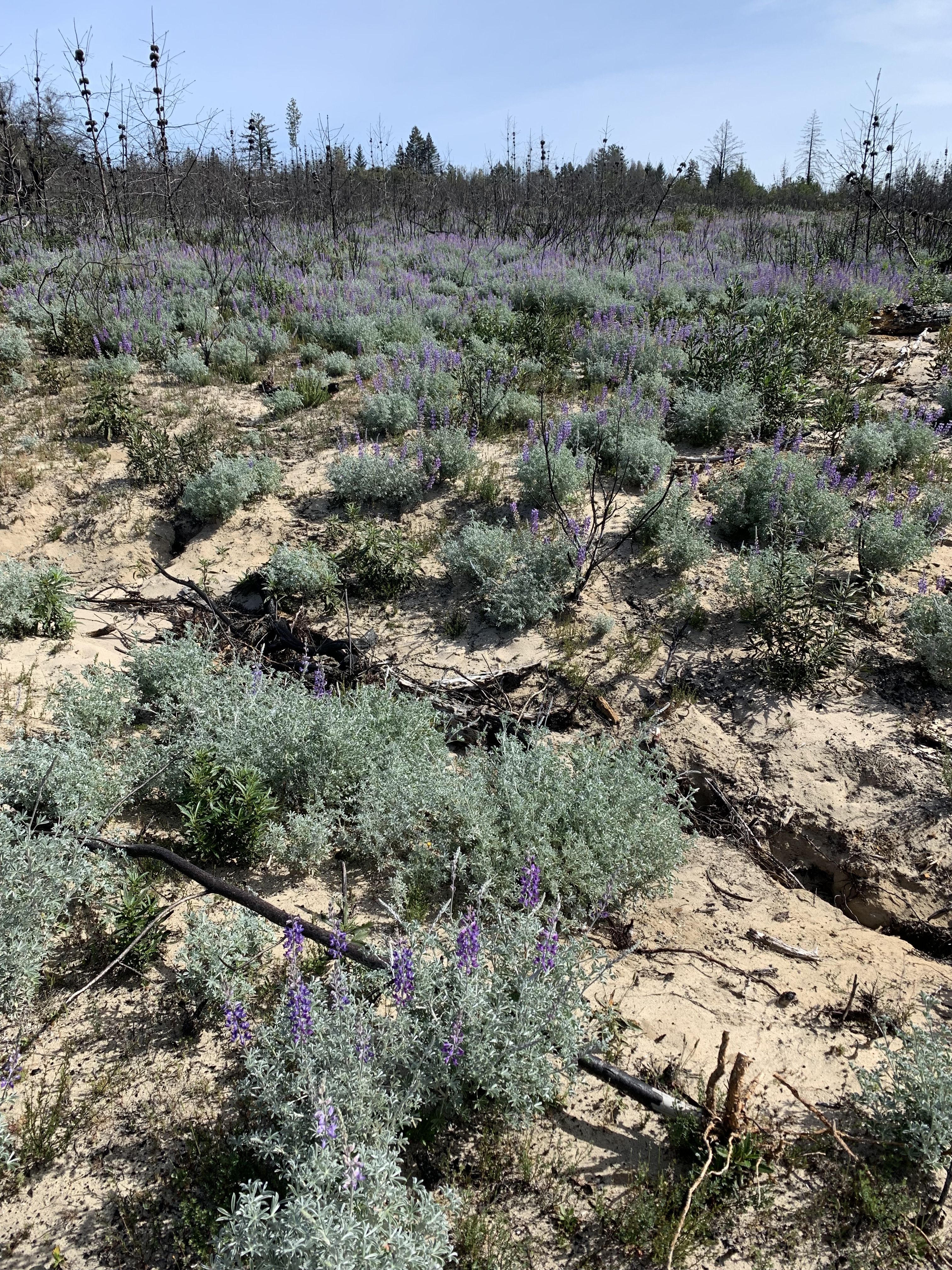
The wildfire triggered germination of thousands of lupine bushes in the habitat areas we steward around our farm. Years ago, two of our members requested that we nurture these bush lupines, mowing and clearing around them. This was one instance of these partners’ contribution to the pool of collective creativity, nurturing beauty that turned out also to be post-fire habitat, pollinator support, and erosion control.
Just now, we are seeing an eruption of tussock moths that love to eat bush lupine leaves. The moth caterpillars will feed Western bluebirds and many other beautiful, feathered friends. The frass that the caterpillars drop will feed other wildflowers and native grasses, diversifying the hillsides.
Bush lupine became tussock moth fodder, opening up sun to a newly fertilized understory
Learning from Nature
From fire to lupines, from lupines to pests, and then from pests to birds and fertilizer…these are a few of Nature’s cycles. What might we learn from these cycles? Because farmers must be keen observers of nature, we tap into this type of ancient wisdom. As co-owners of a beautiful property, our collective is also learning the creativity necessary for evolving and adapting as a group. Cooperatives and organic farms are amazing experimental grounds for solutions to the root causes of the climate crisis.
To tap into the deep potential for creativity embedded in the DNA we inherited from millennia of experimentation, we must turn away from potential-destroying toxins. We must embrace stewarding diversity in the face of the tempting and ‘easier’ monocrop, lest tussock moth-like sieges take place. And, when the pests do erupt, instead of hiding behind toxins, we must invest in deeper contemplation and more complex negotiations, as evolution has long taught us. Until recently, we were taught evolution meant survival of the fittest, but now we understand that cooperative relationships are the key to success. Mutualism. Symbiosis. We have so much to learn.
-originally posted on Molino Creek Farm’s web page as part of my regular blog at that site.
If you are observant, the forest’s meandering and dappled light is just now illuminating the beginning of spring’s wildflowers. Patches of bright blue, pure white, pale pink, and startling yellow are the first of the sequence of forest understory flowers that bloom now through August in the Central Coast’s many types of forests.
Hound’s Tongue’s Leaves and Flowers
Perhaps named for the pink, in-rolled first leaves emerging from damp leaf litter, hound’s tongue provides the forest’s tallest and brightest blue bouquets. This is a perennial wildflower most commonly found in sunnier patches in forests with oaks and Douglas firs. It must taste bad because I never see it browsed by deer or rodents. A California wildflower book from 1897 says that ‘in the old days’ people thought you could put the leaves under your feet in your shoes and then dogs wouldn’t bark at you. Many gardeners are familiar with a near look-alike relative, borage. The healthiest plants make many flowers, widely spaced on a branching two-foot-tall inflorescence. Today, I saw bumble bees, honeybees, and hover flies visiting the flowers. Bumble bees were especially numerous, and when they latch onto the flowers, which are much smaller than they are, the whole plant bobs and waves, drawing attention from other pollinators. One plant in a hundred produces light purple-pink blossoms instead of the normal blue. This makes me wonder if we are witnessing the blue era of hound’s tongue…maybe one day eons from now, this species will evolve purple or red flowers.
Hooked Fruit
If they get pollinated, each hound’s tongue flower will make a cluster of 4 fruit that hang tight to the stem until they snag on a passing animal. Starting late Spring, a forest walk will make you clean your clothes, and in that mass of messy seeds pinched from your socks, you might encounter these wild borage seeds. The seeds are oval and fat with just enough hooks to grab onto someone’s fur. These hitchhiking seeds are the species’ way of establishing new patches, reducing competition with the parents. This might be especially useful when new colonies might establish in post fire areas.
Cynoglossom grande, Hound’s tongue, a bright blue understory wildflower
Catapulting Seeds
Another plant starting to bloom in the forest understory catapults its seeds for dispersal. Once ripe, the fleshy pods explode when touched, sending seeds into the air and many feet away. Since I’ve introduced this surprising behavior to many botanists, I’m guessing you’ll also be surprised about which plant has this trick: redwood sorrel! Yes, a plant with which many people are familiar performs this little-known novelty. You’ll have to get good at recognizing a ripe seed pod before you can experience it.
Sparkling Sorrel
With the recent dry, warm weather, redwood sorrel has started to carpet the redwood forest understory with beautiful pink to white blossoms mixed with its lush medium green, 3-leafleted leaves. Come Saint Patrick’s Day, you might purchase sorrel or see it displayed, but you’ll never find a 4-leaved redwood sorrel (really, shamrocks are clovers, and it is possible to find a four-leaved clover!) In full sun on a hot day, redwood sorrel leaves fold down to keep from roasting. But, in the more typical cool dark understory, each leaflet tilts and turns, orienting independently to maximize light capture with the passing sun rays. The flowers open above the leaves and soon there will be so many redwood sorrel flowers that the forest floor will sparkle like the many stars of the night sky.
More White Forest Flowers
Another white to pink early spring forest flower is in full bloom right now, growing on the edge of patches of redwood and out into Douglas fir and oak groves. Milk maids is a relative of cress and has bright 4-petaled flowers, normally quite white (but ones near my house are quite pink). The description of this plant from the aforementioned 1897 book by Mary Parsons ‘The Wild Flowers of California’ deserves quoting:
“What a rapture we always feel over this first blossom of the year! – not only for its own sake, but for the hopes and promises it holds out, the visions it raises of spring, with flower-covered meadows, running brooks, buds swelling everywhere, bird-songs, and air rife with perfumes”
Milk maids is attracting a beautiful butterfly that matches its white flowers. The mustard white butterfly is the earliest butterfly you’ll see…besides the overwintering Monarchs…and you’ll almost certainly see it if you find a big patch of milk maids, upon which it lays its eggs. When the eggs hatch, the larvae will grow up feeding on milkmaid leaves. Once the larvae have pupated and grow into butterflies, they sip nectar from and pollinate milkmaid flowers. In this way, milk maids and mustard white butterflies have a close partnership.
Violá Violets!
The forest violets have started blooming including my favorite, redwood violet, which makes carpets along banks and on steep slopes in many places near Bonny Doon. Redwood violet has bright yellow flowers that, like redwood sorrel, peek up well above a dense mat of leaves. If you look closely, you’ll see tiny dark red lines in the throat of the flower that lead pollinators to seek rewards inside of the flower. Redwood violet leaves are nearly round, except when you find the telltale sign of the butterfly that feeds on them.
Redwood violets with their vivid yellow blossoms bedecking the post fire understory
Violet Feeding Silverspot Butterflies
Silverspot butterfly larvae carve out semi-circular scallops in redwood violet leaves and, when you see those bite marks, that is likely the only hint that this butterfly larvae is around, because they feed at night! Arboretum Director Ray Collett alerted me about these silverspot butterflies 30 years ago. He had met a butterfly collector who pointed out Bonny Doon silverspot butterflies that matched the endangered Callipe Silverspot previously known only from San Bruno Mountain in South San Francisco. With that tip, a conservation geneticist friend of mine recently hunted our local one for a while but only caught one, which looks promising to be at least closely related to the endangered one, but more work needs to be done. Meanwhile, later in spring, we can be on the lookout for these mysterious and rapidly flying orange butterflies with silver spotted underwings that feed late at night on the beautiful yellow violet carpets of Bonny Doon.
The Parade of Spring
These early spring wildflowers are just the beginning of the succession of wildflowers brightening the shade of our forests. As the days get warmer and longer, each week will bring a new suite of species into bloom. The flowers are stewarded by pollinators in conjunction with mountain lions which chase around the deer enough so not every flower is munched. Human stewardship is helpful, too. We can help not only by controlling invasive forest species (forget-me-not, French broom, periwinkle, etc) but also by not planting what might be new invasive species, one day. In the future, perhaps we’ll appreciate the native wildflowers enough to propagate them for our gardens. With these native species come a wealth of pollinators including butterflies that rely on native wildflowers for their larval stages. Planned correctly, your forest garden will have a natural succession of flowers, bringing different colors to every season without any additional water and with little need for tending.
this story brought to you via my column the prior week in Bruce Bratton’s weekly blog at BrattonOnline.com
Let’s hope for a repeat of the last couple of years where March and even April have brought us additional important rain. The shallow soils are drying out on the grasslands nearby, but the creeks are still running.
Since last we posted this news blog, back in November, there have been deluges and droughts, cold and heat…Molino is a land of extremes! December was unbelievably wet with heavy storms intermingled with endless mists and drizzles. January came and someone turned off the tap, then no rain expected in February, normally our wettest month. It was 75F today and the sun felt very hot. But, in total this winter, we’ve had lots of cold nights…we’ve burned more firewood to keep warm than in recent memory.
Calling Critters
The most noticeable wildlife is the mixed flock of blackbirds. If you were hard of hearing, you might think it was our ancient bulldozer squeaking and rattling across the hills. Better hearing can make out the seemingly multidimensional mélange of starlings, brewer’s blackbirds, and bicolored blackbirds singing together. Mostly the song is brewer’s blackbirds, but the others are in there, too. 80 birds exchanging, at their own tempo without any evident coordination, low-to-high crescendo-Ing whistles combining to near dizzying cacophony. If you walk by, the song shockingly and suddenly stops and up goes the flock in a vibrating dark cloud. The bicolor blackbirds land again in downward arks like windblown leaves. Then, a few brewer’s blackbirds make clicks, like drumsticks on the edge of a snare drum…but not keeping any pace or rhythm: Chek…chek……check…chek chek…chek….then one, then ten, then suddenly all 80 birds erupt in their whistling joy once again. The whole farm reverberates with this chorus, which is particularly loud this winter.
The other wildlife calls are much more subtle. In the last 2 months, I’ve heard a single fox yawl and a single female lion cry, but the coyotes are keeping quiet. Every night there is but one great horned owl hooting. The red shouldered hawk, a friend that still needs a name, hasn’t been scree-ing as much, but is still omnipresent as is a kestrel and recently a pair of red-tailed hawks. A single peregrine falcon comes by once or so a week to scream terrifyingly at the Molino prey.
Winter Crops
In this climate, we harvest all year round. Gleaning 2 Dog peppers was over in early January, but now we are starting to get a fair harvest of Persian limes with Meyer and ‘real’ lemons on their heels. Venturing out in the cover crop, there are pea shoots to forage. Kale has done well this winter in the home gardens.
Peas in the cover crop – a forager’s delight
Orchard Tending
Not much to do in the row crop fields, but the orchards have needed tending, especially recently. A few weeks back, Bob Brunie and I started up the backpack sprayer and sprayed most of the apple orchard with a mix of ground up kelp and fish along with living beneficial microbes to foster tree microbiomes for maximum health. Small groups and individuals have also been pruning, fertilizing, and assembling/burying water lines. The early winter planted cover crops germinated, but then have only been growing very slowly due to cold and lack of rain. The Robins have been enjoying late afternoon feasting on orchard cover crop vetch.
Cherry buds are swelling…like so many of the fruit trees in our orchards right now
The Storms
This story would not be complete without some notes about the storms of December. That month brought one rainy front after the next with a few days’ pause between storms, so that our solar arrays recharged batteries and the soggy grasses bent back upwards. Lake Molino resprouted and (glug glug) drowned the Bottomlands Field cover crop. For nearly three weeks we had that big pond, but no ducks showed up this time.
This massive rain and all of the fire damage must have sent some debris flow into action along Molino Creek. If you walk down there now, it’s a massively changed scene. Instead of lush Creekside vegetation, now there’s a twice-as-wide scoured rock bed with pummeled banks. Upstream, there is a series of small granite waterfalls into clear pools where once there was just mud, logs, and a few ferns.
The downpours, however, produced very little damage to the Farm. We had some rills on the road, which needed some maintenance anyways. The winds broke oaks apart along our fence lines, those damaged by the fire or some prior issue. In the hills around us on the more recent rainless windy days you can hear tree after tree cracking apart and falling with big bangs and low thuds. Zephyrs are taking down the burned trees and its not safe walking in the forest on blustery days.
The Coming Spring
The first orchard trees are about to bloom. Plums are breaking bud. Early peaches are unfurling leaves. Citrus blossoms are filling the air with sweet perfume. Avocado blossom clusters are unfurling. The fields and field margins are massing with weedy Calendula and oxalis color. And…it is just the beginning!
The biggest show will soon be poppies and then LUPINES. For whatever reason, this is a Huge Lupine Year. Bumble bees are going to be very, very happy and the returning swallows will be feasting on them before too long.
We hope you are enjoying these (too) wonderful days.
Whorls of lupine leaves form an understory to the flowering wild cucumber of Molino’s restored grasslands
Imagine you are a mountain lion, a badger, or a burrowing owl making your way around our region. Curiously, people often say, ‘I can’t imagine,’ but I contend that our imaginations are more powerful than that. We can imagine a lot if we have enough information to work with and give our minds the room to roam. We can put ourselves in the place of other species if we want, but only if we can face the pain that such empathetic contemplation may bring. We have left wildlife so little, but we have the power to restore healthy populations of wildlife for future generations.
Big Clever Cats
We have the great fortune to share this landscape with wild lions. To put yourself in the lion’s mind, imagine being a young male learning to walk from Aptos to Scotts Valley, getting across roads, keeping away from people, trying not to make their dogs bark, and staying under constant cover of forest. That young lion will also be learning, by scent, where girl lions are and where other murderous males have claimed territory.
Cat Map
Lions know how large to guard territories against one another to keep sufficient food for their families. Fresh deer are needed, one a week for each mature lion. A human hunter would be challenged to keep that pace up; it takes a lot of roaming. Mountain lions move under cover of trees, they shy away from moving around in the open if they can help it. They travel tree filled canyons, wooded ridges, and trails through the forests. To them, those places are like our road network- they must make mental maps as quickly as their young minds can do it, and those maps must keep receiving layer after layer of new information – especially where other lions prowl.
Badger
Two weeks ago, I was very pleased to find many badger-dug burrows in grasslands along the North Coast. Badgers look at the landscape in the opposite way that a mountain lion might. Where lions see woodlands as their comfy place, badgers prefer grasslands – maybe in part because of the lions in the forests! To imagine moving around the landscape like a badger, think about walking from the grasslands above Watsonville to the grasslands along the North Coast by staying mainly in grasslands, each night digging a burrow to sleep in, finding enough gophers and ground squirrels to eat along the way, getting across roads and never being seen by a human. That’s some tough going!
Burrowing Badgers
The burrows I saw were not fresh, and I couldn’t find a den. The badger foot tracks had been washed entirely away by a prior pouring rain. Probably this was a wandering individual, who kept moving after staying for a few weeks. Males disperse widely – even through forests. Someone was surprised to see a photo of a badger on their wildlife camera in a north coast redwood forest a few years back. I haven’t heard of anyone finding a badger burrow in a forested area.
Like vampires, badgers must be underground by daylight. Digging burrows is best done in sandy soil. And so, badgers’ mental maps include not only the network of grasslands, but also the subset of grasslands with homey sandy places where they can easily dig for food or make burrows.
Santa Cruz Badgers: Gone
There used to be badgers near Santa Cruz, not that long ago. They still occasionally happen through. When UCSC’s Chris Lay compiled local badger sightings and analyzed this species’ local disappearance, he concluded that roads explained badger demise. Roads are a big challenge to badgers. The frequent median barriers popping up on local highways have been important in saving human lives, but to badgers they are sure death. Conservationists in Great Britain, where badgers are held in perhaps higher esteem than here, have gone to great lengths to make sure badgers are now able to cross highways – laying down fences to guide badgers to the safety of underpasses.
Burrowing Owls
Burrowing owls probably see the landscape much like badgers- their homes are also in grasslands. Unlike badgers, though, burrowing owls navigate landscapes on the wing, so maybe roads aren’t so lethal. These wide-eyed, cute, bobbing, yellow-legged owls also used to frequent the meadows near Santa Cruz, but the last nesting colony was paved over by the administrators of UCSC. Now, burrowing owls are wintertime visitors only, travelling from their summer nests in inland grasslands. I wonder if burrowing owl families that once nested along the coast remember their coastal habitats and have been leading one another back to the warmer coastal grasslands each year?
Owl Trip
To imagine a burrowing owl flight to the coast, you’d be starting probably in the grasslands east of San Jose. As the nights get chillier and shorter, something in your burrowing owl mind makes you want to fly towards the coast. One long flight across the buzzing Silicon Valley city scape blanketed by nasty air pollution and you might land in one of the few remaining grasslands on the east side of the Santa Cruz Mountains…. or you might keep flying all the way to the coast. This flight would be different than most of your flights all summer long, which have been much shorter. While you are taking this long flight, you keep alert to the increasing threat of peregrine falcons…listening for the alarm calls of other birds. As you get towards the coast, you feel anxiety as each year the available habitat has been reducing: will you find a place with good cover for the winter?
Coastal Burrows
A month or so ago, I went to UCSC’s East Meadow to see burrowing owls but couldn’t find any sign of them. I looked for the owl’s wintertime homes, but they were gone: the many ground squirrel burrows in the East Meadow are gone and I couldn’t find any. In fact, there were no ground squirrels AT ALL! Anyone know what happened to them? Please let me know if you do. Long ago, UCSC administrators destroyed the last burrowing owl nesting area in the County, and more recently they destroyed the burrowing owl wintertime burrows at Terrace Point, so I’m suspicious about this new loss. Now, the UCSC wintering owls must join their friends to hide in culverts or pipes along the North Coast for their winter homes.
Linkages
“Progressive” Santa Cruz is working on its first project expressly acknowledging the need for wildlife movement across this landscape, but much more is needed, and we can all help. Informed by much science, the Land Trust of Santa Cruz County is working on creating a wildlife tunnel near Laurel Curve on Highway 17. To work, the land on either side of the tunnel must also be wildlife friendly. This corridor is in a wooded area and designed especially for mountain lion movement…maybe badgers can find it, too! Further South and East, groups are making great progress at protecting the wildlife movement corridor between the Mount Hamilton Range and the Santa Cruz Mountains through the Coyote Valley. This corridor relies on existing bridges under Highway 101 and also envisions some improved crossings over the Monterey Highway, which has median divider in many places. Badgers need this corridor to get to our region, but many other wildlife species could use this corridor- maybe even tule elk! These efforts need our financial support. We can also help wildlife movement by supporting better planning for protected wildlands, such as opposing the Homeless Garden Project’s newly hatched plan to move into the Upper Main Meadow of the Pogonip…or the seemingly continuous push to increase the numbers of trails crisscrossing parks. I hope you will take some time to imagine how your favorite species of wildlife travels across what’s left of this highly fragmented landscape… and how you can help restore the landscape we all need.
This essay reprinted from the one I original published via Bruce Bratton at BrattonOnline.com
Essay originally published in Bruce Bratton’s weekly online blog BrattonOnline.com.
Many of us are drawn to mountain tops if not physically at least visually, some even spiritually. Botanists go to see the unique flora. Some botanists are “peak baggers” along with many others. There is no “bagging” Loma Prieta, but the flora around it is very special. And the peak has been sacred to some but has been defiled by others, now buzzing with communications towers that make you want to stay far away.
At 3,790’ Loma Prieta towers above Santa Cruz, the highest peak of the Santa Cruz Mountains. The mountain is near the Santa Clara/Santa Cruz County Line and looks over the nearby San Andreas Fault. More people know the name of the peak from 1989 Loma Prieta Earthquake – the epicenter was just west of the mountain.
Recharge
It snows up there almost every year and the rain falls in torrents because the highest peaks catch the most rain. There is little soil near Loma Prieta, but lots of well drained rock. There are patches of sandstone surrounded by a massive amount of mudstone. Craggy dark sandstone outcrops accent the slopes near Loma Prieta. Roadcuts reveal fascinating patterns formed by the nearby faulting. The mudstone and sandstone rocks were created by sediment washed into the Pacific from ancient California’s rivers, laid down in layer after layer, with different layers of slightly different colors, textures, and thicknesses. Tectonic movement has pitched those layers this way and that, sometimes in great undulating waves, other times tilted this way and that. The roadcut rock is fascinating mosaic art.
Rain soaks through these fractured stones, bubbling out below to form the headwaters of streams that provide drinking water for hundreds of thousands. Looking out from the mountain, you see the steep and thickly wooded Soquel Creek canyon or turn towards the other side and look down Uvas Creek that leads to the Uvas Reservoir and onto the Pajaro River, or gaze north into streams headed to the Lexington Reservoir.
Views
I try to visit the area’s peaks once a year to get my bearing and appreciate this place. And, I can see most of those peaks from Loma Prieta: Mount Diablo, Mount Hamilton, Fremont Peak, Devil’s Peak, and Ben Lomond Mountain are visible from there. A while back, I would visit Loma Prieta to get a good view of the region’s fireworks on July Fourth. Back then, the shoreline of the Monterey Bay was lit by many displays and there were many displays in towns all the way to San Francisco and beyond. It is a delightful place to see the entire Monterey Bay and a huge expanse of the sparkling Pacific Ocean. But really, I go for the plants.
This Chaparral’s Shrub Diversity
My favorite plants to visit up that way are two subspecies of at type of manzanita that is normally found a long ways north, but which have outlying patches on sandstone near Loma Prieta. The Hoary (A. canescens ssp. canescens)and Sonoma (A. canescens ssp. sonomensis) are beautiful silvery shrubs with smooth red bark so dark it is almost black. I visited last weekend and it was just starting to blossom, some shrubs had pure white and others very pink flowers.
This is a very shrub diverse area. In a short distance, in addition to the above, you can find three other manzanitas: Santa Cruz manzanita (A. andersonii) and brittle leaved manzanita (A. crustacea ssp. crustacea) and Rose’s manzanita (A. crustacea ssp. rosei). And, the ceanthus that normally accompany manzanitas are equally diverse with 5 species also occurring in close proximity to Loma Prieta: warty leaved ceanothus (C. papillosus); blue blossom (C. thrysiflorus var thrysiflous), wavy-leaf ceanothus (C. foliosus var. foliosus), buck brush (C. cuneatus var. cuneatus) and Jim brush (C. oliganthus var. sorediatus). More shrubs still include 3 species of silk tassel – bear brush (G. fremontii), silk tassel (G. eliptica), and ashy silk tassel (G. flavescens), mountain mahogany, pitcher sage, chaparral pea, bush poppy, coffee berry, coyote bush, and on and on. With this menagerie of chaparral shrubs, the scents are awesome as the sun warms the millions of resinous leaves.
…and Tree Diversity
Trees are super diverse up there, too. It is surprising to see a rare local conifer California nutmeg emerging from the chaparral. The canyon live oaks are everywhere in multi-trunked patches resprouting from multiple fires. There is also interior live oak, foothill pine, and knobcone pine. Some trees are odd: the madrones have paler orange bark than normal, the bay trees have more flakey bark, and the tanoaks have longer and or smaller more toothed leaves. The patches of trees are especially thickly festooned with beards of mosses and dense carpets of lichens.
Clearing the Shrubs – the March of Weeds
With the exception of a few patches managed by public parks, most of the area is privately owned, and it shows. A County Planner has told me on many occasions that the County’s policy is to not allow clearing of this rare chaparral type. And yet, you can see the expansive clearing from Highway One. There are immense mansions and squalid trailers, many with massive fire clearance zones. And, there are acres and acres of vineyards and horse corrals as well as sprawling greenhouses.
This network of development and the roads that serve them has badly fragmented this beautiful chaparral, especially in the last 15 years. Human incursions are made evident by aisles and acres of weeds: jubata grass, Scotch and French broom, and acacia are the most evident.
Even with all of the clearing but especially with the influx of flammable weeds along the roads, this area seems likely to burn badly one day.
A History of Fires
Many areas around Loma Prieta have not burned in a long, long time; but there have been recent fires. North and West of Loma Prieta, there are some of the oldest, largest knobcone pines I’ve ever seen, evidence that it has been a long time since fire. South and East of Loma Prieta, are miles of skeletons of trees and shrubs that belie more recent fires. The 2008 Summit Fire (4,200 acres), the 2009 Loma Fire (435 acres), and then the 2016 Loma Fire (4,470 acres) all have scorched areas around Loma Prieta, and all were human caused.
How to Visit
You can visit patches of this unique chaparral in a few parks. Some of this type of chaparral is at Mount Madonna County Park. The more shrub-diverse type is found in the Sierra Azul Preserve managed by the Midpeninsula Regional Open Space District at Mount Umunhum, the next peak north of, and not far from, Loma Prieta. The top of Santa Clara County Park’s Uvas Canyon County Park touches the shoulder of Loma Prieta south of the peak. This type of chaparral gets less interestingly diverse but still remains expansive in the upper areas of Nisene Marks State Park, say along the top of Aptos Fire Road.
This is another reprint from my weekly column at BrattonOnline.com, to which I recommend you subscribe, especially if you live near or love Santa Cruz California and want to learn more about what’s happening.
I was going to write this week about a native plant community, but someone made a comment recently that led me to change course, to focus rather on a very dominant ecosystem in our area: row crop agriculture. They said, ‘There are no animals killed in making a meatless burger.’ The statement took my breath away. Apparently, it is time for me to put my thoughts into writing on this subject, long stewing on my back burner.
Sacrifices for Veggie Burgers
Meatless burgers contain agricultural products grown on farms that have killed and are killing animals as an inherent part of their practices. The original clearing of agricultural land caused the greatest outright slaughter of animals. Many animals were crushed by the first land-clearing bulldozers or burnt alive when the natural vegetation was ignited. Some furry critters fled at first only to starve later when they were driven from one already-occupied territory to the next. Perhaps a few lucky larger quick and mobile vertebrate refugees survived. The many smaller, less mobile animals not outright crushed or burned were eventually chopped up with the plough.
After the clearing, crops are planted every year thereafter, and farmers trap, poison, or shoot ‘pests.’ In some cases, farmers fence, net, or otherwise ‘deter’ pests…sometimes entangling animals but always driving wayward animals onto roads or into the mouths of smart predators that take advantage of deterrence methods with their hunting regimes. Farmland becomes a hazard for wildlife, effectively removing agricultural lands from anything classifiable as ‘wildlife habitat.’
Yummy Bananas
Many of us have heard the tropical horror stories related to agricultural expansion. Giant farms have been expanding, destroying tropical forests, the most diverse of ecosystems, especially to produce soybeans and palm oil. Many areas have already been cleared, and the ongoing tropical agriculture is regularly killing thousands of species that are dwindling by the day. A friend told me of his first job on a tropical banana farm in the 1970’s. As a teenager trying to earn money to support his family, he took the closest job he could find as a laborer on one of the giant banana farms in Central America. His supervisor gave him small plastic cups to suspend from the banana trees and told him to fill the cups with a viscous liquid poured from a large bottle he was told to carry with him. He was told to return each day to refill the cups. Returning to those cups, he clambered over piles of a diverse array of dead bats that had ingested the poison liquid he was placing in the cups. This method of reducing the fruit pollinating bat claw marks (just aesthetic damage) on the bunches of bananas has since been replaced by covering the bunches with protective plastic bags impregnated with pesticides. But banana farms are still sprayed with deadly chemicals and are devoid of even the shadow of the tropical life found in natural systems.
Shade Grown
Even though we might turn to purchasing organic bananas and even certified organic, fair trade locally roasted coffee, those organic crops are grown on lands where tropical wildlife is largely obliterated. Organic coffee and bananas are grown in full sun, the rainforest cleared to make way for the farms. “Shade grown” coffee certification is largely a sham without defensible standards for conserving tropical forests and associated birds, except for the Smithsonian’s bird friendly coffee certification which is effectively unavailable in stores in Santa Cruz and so must be ordered over the internet.
Ranching to Vineyards
Locally, the story is little different. Agriculture is expanding in our area mostly from conversion of grazing land to vineyards, a process that does not trigger environmental review because both activities are considered agricultural. Oak woodlands and old growth grasslands that supported free-roaming wildlife and sequestered carbon are being converted to vineyards where wildlife is commonly fenced out and wildlife inside the fences trapped and killed. Tilling the converted grazing land releases long-sequestered carbon, adding to global warming.
The Local Veggie Farming Slaughter
Once agricultural land is in production, routine practices actively kill or deter wildlife and passively degrade wildlife habitat. Driving through the Pajaro or Salinas Valleys, look for the upside-down white plastic Ts at the field edges: those are poison bait stations with poison designed to kill small animals that venture into the fields. Traps or poisons are used to kill any animals once they find their way further into fields. Organic farmers often use traps for gophers with regular trap patrols as part of their daily operations. Passive forms of wildlife killing may seem a little less aggressive. In both conventional and organic agriculture at any scale, the mowing and tilling of crop areas leaves mutilated (hopefully quickly killed) critters in the wake of tractors: snakes, toads, frogs, lizards, salamanders, birds, mice, moles, shrews, and voles are all decimated. Polluted runoff from both organic and conventional agriculture is another issue. Agricultural irrigation runoff into Elkhorn Slough has the highest levels of fertilizer in the US, equivalent to dumptruck load of fertilizer a day, causing terrible contamination of the state’s second largest estuary.
Ranching Conservationists
In contrast to the impacts of these cropping systems, I look to coastal prairie fed, pasture raised cattle that are managed in such a way to restore local ecosystems and provide food for those who would eat it. I’m not arguing against the need to reduce the amount of meat the world’s population eats: clearly, there is a lot of animal agriculture that is terrible. However, many ranchers locally are doing a world of good for wildlife and plant diversity with their coastal prairie stewardship. Globally, ‘abandonment’ of grazing in Spain, France, Britain, and other places with diverse grasslands has caused species loss and ecosystem degradation. Humans have been learning how to manage livestock to mimic evolutionary disturbance regimes that maintain wildlife and keep grasslands diverse and healthy. Most ranchers I know are enthusiastic about the wildlife they steward; many are working with conservationists to co-manage for biological diversity. This situation makes the contrast between veggie and beef burgers a little more interesting.
Wildlife Friendly
There is real potential for cropland management to be more sensitive to wildlife. One day our lettuce won’t come with such a legacy of wildlife displacement and death. There are only two wildlife-friendly food certifications that I know about: the Smithsonian’s certification of Bird Friendly Coffee and the relatively new Audubon Society’s certification for bird friendly beef. Taking its normal laudable step beyond the Federal guidelines for organic standards, Santa Cruz-based California Certified Organic Farmers (CCOF) requires its certified members to maintain a conservation plan to address habitat stewardship. But CCOF lacks an ecologist to review or advise on such plans, so this effort mostly falls quite short of what is needed. Let me know if you know other attempts to address these gaps! Meanwhile, what are we to do?
Ask a Farmer
The thing to do is ask the farmer who you support about their conservation practices. Already you probably understand the importance of supporting farmers directly by shopping at a farmer’s market. When you buy from them, you might ask how they take care of wildlife on their farm. The answer should take longer than either you or the farmer wants to take; shorter answers are probably insufficient and will be quick evidence that the farmer isn’t practicing wildlife friendly agriculture. Sensitive management of irrigation, runoff, ponds, hedgerows, cover crops, fallow fields, roads, and non-crop areas should almost all be part of any wildlife-friendly farmer’s skill base. And, they would have to explain a little about what ‘sensitive management’ means in each case – the stories aren’t too complex if someone knows their stuff, but the telling will take a little time. We need those stories. We need those conversations. Future generations will depend on farmers who integrate nature with their crops.