Land Ethic

Have you formed ethical standards for your relationship with Earth? Most people teach ethical standards to children in what behaviors are ‘right’ and how best to treat other people. As we grow, we learn through experience how to build on those ethical standards to be good people. But, few people I’ve met have taught their children the ethics of their relationship outside of the human world. How would you answer questions about how to act ethically with the natural world?

Aldo Leopold wrote possibly the most influential modern treatise on this subject, which was published in his Sand County Almanac and entitled The Land Ethic. I suggest you read that 14 page essay first and this second, as I supply a framework for how his thoughts apply in our shared place, the central coast of California.

We Hold These Truths…

Are these statements true to you?

  • Our food, air, and water are products of Nature
  • Nature is very, very complex: there is wisdom in considering the precautionary principle when considering impacts to the natural world
  • As citizens of this particularly ecologically rich place, we have a particularly high level of responsibility for nature conservation.

Land as Economic

As Leopold suggested was normal throughout the USA in 1949, so it is today…we citizens of central California are continuing to commodify nature. We treat our agricultural lands as short-term profit-making properties; most are barely cover cropped so that soil is washing away at tremendous rates, many agricultural properties are awash with fertilizer and chemical pesticides that have had too little human health and environmental impact study. Our conversations around property circle around what ‘rights’ we are afforded, not what duties we have: even knowledgeable people lack the information to well manage private property. Land Trusts commodify land that they hold, managing negatively impactful agriculture, grazing, and other uses and expanding recreational use with little idea of its impacts. Public parks are even more guilty of commodifying nature for highly exploitive, barely planned/monitored recreational uses that are rife with negative impacts on soil and wildlife. Economic interests drive these types of nature commodification, those interests are embedded in even local politics, yet few people vote for candidates based on these types of issues.

Aldo’s Land Ethic

A thing is right when it tends to preserve the integrity, stability, and beauty of the biotic community. It is wrong when it tends otherwise.” – Aldo Leopold

What would happen if we all used Leopold’s land ethic when weighing proposals on natural lands around the Central Coast? For instance, how would application of that ethic affect how you feel about the development of the Homeless Garden Project in the middle of Pogonip Greenbelt’s main meadow? What about the way proposals have been made for the new trails at Cotoni Coast Dairies? What would you think about the plans for post-fire re-building of Big Basin State Park’s visitor center?  How do your feelings on those proposals compare with how you think about applying Leopold’s Land Ethic to the planned wildlife tunnel under Highway 17…to restoring the Scott Creek Marsh on the North Coast?

Is Education Enough?

Most people with whom I discuss the Land Ethic emphasize a problem Leopold anticipated: they focus on a perceived need for more education before it will be possible to apply the Land Ethic. I have spoken with leaders and practitioners of environmental education around the Monterey Bay, and they all reiterate the primary need for education until a more ethical approach to Nature can take hold. And yet, almost none of these educators are familiar with well-established tools to change human behavior towards the environment. I wonder how many would be able to help others by describing what a Land Ethic might be?

The same goes for most staff whose jobs entail environmental protection. Parks law enforcement staff rarely give tickets for environmental destruction, preferring ‘education.’ Municipal planning agency personnel rely almost entirely on education in hopes that it will serve to protect nature in the Central Coast. The personnel responsible for protecting whales and other marine mammals in the Monterey Bay also entirely rely on education to accomplish their mission. With the many interactions I’ve witnessed with these individuals, none have ever tried to help elevate awareness of the ethics of caring for Nature. I have heard political decision makers cite anything like the Land Ethic very, very few times.

The Central Coast has a large variety of environmental organizations focused on environmental education. I hope that they will incorporate the Land Ethic in their curricula, including the many available local case studies to further illustrate lessons.

A Place for Science?

We are lucky to have the California Environmental Quality Act (aka CEQA) as a potential to start the conversation about portions of Leopold’s suggested Land Ethic. For instance, lead agencies using CEQA might ask ‘How does the proposed project affect the integrity of the biotic community?’ What if this question were posed about the numerous wetlands that will be obliterated along the proposed Rail Trail on the North Coast? I would anticipate that the lead agency would pick scientist-consultants to outline a restoration program somewhere along the coast that would ‘improve’ the integrity of wetlands in the project vicinity…checking that box in CEQA…and proceeding with the project. The ‘improved’ wetlands would likely have some attention for restoration for 3 years, but with no long term proposal for management or monitoring. It is very likely that the more correct answer to the Land Ethic-informed question would be ‘the proposed project negatively affects the integrity of the biotic community.’ But, even in the unlikely possibility that the lead agency received that answer from their paid consultants, they would likely proceed with a “statement of overriding considerations” and proceed anyway…because there is no chance that anyone would be held accountable during their election to political office. In short, there is a lot of demand for consultant-scientists to create plans that appear to address the Land Ethic but which in fact are just the excuse a project proponent needed to proceed with their destruction of Nature.

The Solution?

Any decision maker in our region whose work impacts the environment should have access to the smartest ecologists around, so that they receive the best information possible to make excellent decisions to conserve nature. For a while, this happened in the Santa Cruz County Planning office. That model could expand. There are certainly a very many well respected biologists in our region who we might learn from!

-this originally published in Bruce Bratton’s weekly blog BrattonOnline.com

Transitions Between Light and Dark…Day and Night

Each evening there’s a dancing art show: swallows soar and weave higher and higher, snapping up insects, following the intersection of sun and shade as the sun slowly dips behind the ridge across Molino Creek. The disappearance of the sun takes more than an hour to make its way across the farm; the last light glows a deepening gold from the west-facing ridges studded still with many tall black spires of the trees burned by the 2020 wildfire.

Evening

I sit at the end of the days watching sunset transitions, noticing the many familiar but always fascinating evening routines. The world slows down and the stage provides each actor enough time. The raven pair trade an intermittent ‘caw’ tracking one another’s whereabouts as if to say ‘almost time’ before following one another with noisy slow powerful wingbeats, as they sneak off to their mysterious and distant night roost. Clouds of tiny beetles dance silently in dense clouds on the cooler sides of shrubs, backlit by the sun, lighting shiny wings. The flicker family swoops in for one last drink at the bird bath. First one, then the next and soon a hundred crickets are chirping- more when its warmer than cooler. With the increasing crickets, more and more stars shine. The western sky glows long after the sun has set.

Padrones

The long days are fueling burgeoning crop production. The peppers and tomatoes are deep dark green with suddenly stout stems and elongating root systems pushing farther out in the rich, dark, beautiful soil. Two Dog Farm’s padrone peppers have fruit and are lighting up with constellations of bright white star-shaped flowers.

Two Dog Farm’s Padrone Peppers- getting ready to start picking!

The warm days have been followed mostly by cool nights. Plants that wilted slightly during the day return to vigor as the sun rides lower in the sky. At night, those same plants are tall upright and luxuriant. Apples are still small, now 1 ½ inch across; the plums are growing quickly and starting to color. The tops of these trees rise up into the warm summer air; under the trees it is cool and slightly humid, no scent yet from any of the fruit- its too young! As its too soon to have enough food to take to market, Judy’s delivering the season’s first zucchini in neat small paper bags to farm neighbors, and we welcome these tasty treats as the first sign of summer. It’s cool enough to still have some sweet garden lettuce to be combined with geranium and salvia blossoms, baby kale and other greens, for a wealth of home-grown salads.

Comice Pears: Brought to you by a community of Orchardists

Thank You, Friends

We have deep gratitude for the various skilled community members that help our Farm along. Most recently the incredibly talented duo from the Last Chance community, Steve Barnes and Ian Kapostins, have been piecing together a bunch of new water tanks- 30,000 gallons worth- to replace some we lost in the fire. Their artistry and skill combine with nice equipment to create a much-needed bank of drinking and firefighting water. These guys have been sweating out the days with pipe and saws, glue and wrenches, on the side of a hot hill and in and out of dirty dusty trenches. How lucky we are that they are willing to help us way out in the country in less than favorable conditions! It takes a community to afford us the possibility of living and farming in this beautiful place. Thanks, guys…we really appreciate your work!

Dawn

The sunrise dawn chorus has been mysteriously quiet: is there a hawk near the yard? At 3000’ in the Sierra last weekend, I awoke on several mornings to a signature dawn chorus filled with sweet, almost liquidy flycatcher song, so different than our sometimes sharp-peeping orchestra. Each place has its song. There, the chorus was short- half an hour before and up to dawn then quickly quieter. I’m hoping that our dawn chorus song returns soon.

Over to You

I’m hoping you step outside, leave your windows open, turn off anything noisy, and immerse yourselves in these long transitions of dawns and dusks. What is unfolding around you? Whose watching you listen for them? Are there repeating themes in your part of the world?

-post copied from the Molino Creek Farm website where I also publish regularly

Save the Bees!

As the fields of lupine blossom at higher and higher elevations, other flowers follow in wave after wave of color and design, and the bees dance and hum celebrating each new unfolding.

Bees! There are so many types of bees: mason, bumble, leaf cutter, long horned, orchard…For each of those, there are many species. For instance, there are 10 species of bumble bees in Santa Cruz County. As with most species on Earth, all those bee species are in decline.

Flower Pollination

Bees pollinate flowers. Sure, there are other types of pollinators such as butterflies, moths, and flies. Even some types of mosquitoes and ants pollinate flowers…as do hummingbirds. But, bees are the most important pollinators in general.

Evolutionarily, bee (and other) pollination gives plants the advantage of shaking up the genetics, helping populations of plants be more resilient to change in climate, disease, and even fluxes in pollinator communities.

Invasion of the Honeybee

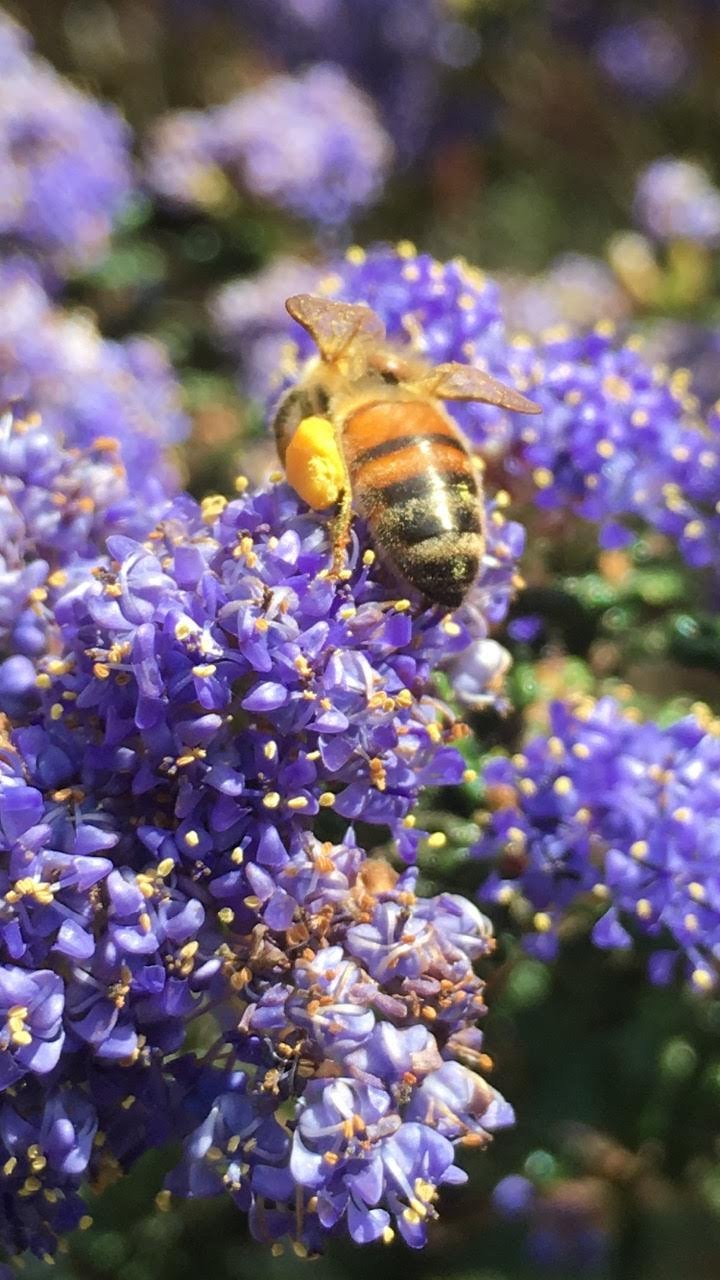
Honeybees are not native to our area, and yet they are everywhere. They were introduced in the late 1600’s to the United States and then moved around more easily in portable hives in the mid-1700’s. In California, beekeepers earn money by strategically moving large numbers of hive boxes into agricultural areas to perform pollination services. When they aren’t doing that work, they must find areas to put those boxes where there are enough flowers to feed the bees and keep them healthy. Especially in wintertime, coastal areas in California are prized by beekeepers because it is not too cold for flowers; something is bound to be in bloom year-round. At the same time, honeybees have escaped into the wild, becoming naturalized. Swanton’s Jim West has documented a honeybee colony year after year in an old redwood tree for most of his 74 years of life.

Honeybee on Ceanothus; nonnative bee on native shrub

The Good Honeybee

Most of us know about all the good honeybees can do from pollination to honey and wax production. Almond growers in California’s Central Valley have been particularly worried about the ongoing problems with honeybees as they have been reliant on imported bees to pollinate their early-flowering trees so that they will make nuts. With the mysterious Colony Collapse Disorder, honey and beeswax prices have increased, making us appreciate even more honeybee production.

The Bad Honeybee

Most people I talk to are unaware of the problems honeybees can cause, including competition with native pollinators, plant community changes, invasive plant species proliferation, and disease vectoring. I was lucky to attend UC Santa Cruz at the same time as the brilliant Dr. Diane Thomson who has studied honeybee and native bee interactions in our area for decades. Her research adds to a growing body of scientific evidence warning us about the negative consequences of honeybees to native bees, with whom they compete. That science has suggested that 20 honeybee boxes rob the food from 2 million native bees. This competition can cause some plant species to be pollinated and not others, shifting the composition of plant communities. And, because honeybees can pollinate some invasive species more than native bees, they can cause bad trouble, like adding momentum to thistle problems. Oh, and by the way….honeybees carry diseases and parasites that can negatively affect native bees. For example, there is a virus that causes bumble bees to have deformed wings – honeybees carry it!

In the last few decades, Randall Morgan documented the diversity of bees in Santa Cruz County.

The Good Native Bees

Native bees are important for pollination, contributing to crop production for humans and food production for wildlife. Dr. Claire Kremen and others have shown that California farms that have a good amount of native bee habitat around them have better crop pollination. Native bees are also essential for pollinating native species of plants, which produce fruit that are important for wildlife. For instance, native bumblebees pollinate manzanita flowers, which produce fruit that is eaten by native foxes and many bird species. Likewise, native bees pollinate coffeeberry bushes that produce fruit eaten by lots of birds, including band tailed pigeons as well as foxes and coyotes. There are many other examples of the natural fruit that is wildlife food made possible by native pollinators.

What You Can Do

You can help conserve native pollinators by helping do the right thing with nonnative honeybees. The first thing to do is help spread the word about these issues. To learn more, read this publication by The Xerces Society for Invertebrate Conservation. That paper has good details about where it is, and isn’t, appropriate for raising honeybees. This caution caught my attention: don’t put hives within 4 miles of “habitats of special value for biodiversity and/or pollinators:” I suggest that this covers most of Santa Cruz County, which has special habitats full of rare pollinators throughout. The plethora of native bee habitats throughout our area would also suggest good potential for gardens and farms to be visited by enough native pollinators to perform enough pollination for the fruits we desire. Besides not placing more honeybees near native habitat, there are other things you can do.

If you know a beekeeper who wants bees, you might point them in the direction of harvesting bee swarms out of native areas and exporting them to urban or agricultural areas where they can do some good and avoid impacts to native pollinators. Also…read below about avoiding bug zappers and darkening night lighting. Finally, reducing or eliminating pesticide use is also important. One of the biggest threats to native bees (and honeybees!) is neonic pesticides; to learn more and write a letter to California’s decision makers, see this Natural Resources Defense Council webpage.

Bug Zappers

I’ve recently heard about people in our area using ‘bug zappers’ that attract insects to ultraviolet light and then electrocute them with a grid of electrified screen. Anyone buying one of these devices has been scammed: they do not work against biting insects. Instead, they kill a broad range of native insects that might have otherwise performed pollination, controlled pests, or fed birds. On top of that, the owner destroys their own nighttime peace with obnoxious electrocution noise and light. Oh…and speaking of light-

Night Lighting is Bad

Turn off outdoor lighting! Darken your windows. Anything you can do to make for a darker nighttime world will help conserve native insects and pollinators. Find out more with the International Dark-Sky Association. Urge local decision makers to reduce light pollution.

-this post originally posted in Bruce Bratton’s online blog at BrattonOnline.com

Twilight, Calming Wind

The long persistent crazy wind continued along the coast this past week, but calmer nights are full of black field cricket chorus. Chip-chip-chip, chip-chip-chip, chip-chip-chip. So tireless and repetitive as individuals and as many together mesmerizing.

Lingering twilight as the wind calms

A long twilight with glowing colors and the calming of the wind closes each evening. Then, a big moon rises and brightens the farm in soft tones of silver and gray. Offshore, the night glows from the bright light lures of fishing boats. On the windy days, the ocean turns turquoise dotted with white caps that we glimpse from the farm. The rain has ended, but we get touched by moist fog and dew still hangs heavy on the still green grasses in the morning. Chilly legs and cold feet…wet pant legs and soaked shoes for us early morning field walkers. The damp morning air carries the early summer sweet earthy scent from the farm fields.

Grass has grown as much as it will – time to mow to prepare for fire

Mowing

It is heavy duty mowing time- the last mowing of a drying spring. I drove the brush mower over a ground wasp nest but didn’t get stung. I’ve become adept at recognizing the patterns of angry wasp flight, luckily especially evident silhouetted against the black body of the mower. There the mower sat for an hour while the wasps calmed down, and I snuck back to (heart pounding) grab the mower handle, shift it to neutral and drag it downhill rapidly away from the nest hole. Now I’m scouting more for the nests before I mow.

Rare Birds

Yes, there are no deer. Instead of those common beasts, we are surrounded by rarities. Storey heard the elusive and uncommon house wren on the farm and she and others have been watching a group of purple martins probably settling into nest holes in a dead tree near our property line. Downhill, at the gate by the highway, crowds have gathered to see a waif scissor tailed flycatcher.

Mother Hens

We have many a wary quail, fretful probably as their eggs are hatching and there are soon to be little clutzy puffball babies following them around. Nearby, there are new baby turkeys with watchful mothers herding them and showing them how to forage.

Adolescent tomato plants- much promise for the season

The Plantings

Tomatoes are getting bigger- the once weak looking seedings have settled in and want to start seriously growing. Likewise, spry onions are getting robust. When the fire came in 2020, we had just begun the Conservatory of Passion, an arbor with passionfruit vines with hope for hops. Those all needed to get replanted and we put in our first McGregor hops a few weeks back. All those vines are settling in and starting to look really good. We need to set up some strings for the hops to climb! The 2020 and 2021 avocado plantings are growing profusely. The earlier batch will get overhead this year as giant bushes and the trees from last year will turn less lanky soon.

-this is one of many of my weekly posts at the Molino Creek Farm website

Swishing

Our main old apple orchard and the hillsides around it recovering from the August 2020 fire

On a recent breezy day, I lay down, nestled into the 3’ tall drying grass and watched amazing clouds tearing apart and scudding across the bright blue sky. The grasses around me were singing, swishing with waves of delightful whooshing. The whooshing would rapidly approach, ruffle my hair and chill my skin then pass me to dance across more distant meadows. The breeze carried the scent of sweet fresh grass and the freshness of salty ocean air. In circles around me, between the grasses, and during lulls in the wind, beige California ringlet butterflies were skipping and fluttering – a welcome sign of grassland spring.

It has been exceptionally windy and cold for nearly an entire week straight. The wind has been more than annoying, it has been nearly prohibitive to being outside. The temperature differential between the cold cranium and the warm brain makes for a very specific head pain. We put on winter jackets and wool hats. The barn swallows above the front door complain about leaving their cozy warm nest too early on cold mornings, so I don’t want to disturb them but still must go out.

Last Sunday, an unpredicted series of showers pelted down sometimes very big powerful raindrops from ominous giant patches of fast-moving clouds, and then there was sun. No matter, I thought, I’ll keep mowing…and then it rained again so hard that water was pouring off of the brim of my hat!

Birds

The barn swallows are getting so friendly that they brush past me and I can hear their wing beats. They chatter “chui chui chui chui chui…” chasing one another, expertly turning to capture bugs. I don’t know why but one sometimes will sit in the middle of the road looking around at the others flying by. Nadia our neighboring land’s Forester tells me that the Purple Martins have returned- their homes are in a ridgeline tree up above our new tank complex. Purple martins are a rare thing around here.

Two great horned owls were hooting from the roof the night after yard mowing: a promising feast of newly uncovered rodent runs. They fly silently but you can make out their weight when they land on the peak of the roof: a gentle but solid…wump! When the winds pick up, the turkey vultures play around the eddies and updrafts around the Farm. They tilt their bright red heads to follow the movement of the others in what seems like playful chase, giant wings arching acrobatically.

On the other side of the size spectrum, many chestnut backed chickadees are chick-a-dee-deeing in the trees and shrubs along the field edges. A very bright bird caught my eye as it flitted into sight, staring right at me: oh! The lazuli buntings have returned! What a treat- this one a bright blue breeding plumage male with a nice neat orange bib. I could go on and on about birds…the Spring Bird Show is going strong.

Slithering towards the Leaping

The dust on the roads and trails reveals the movement of snakes…many big snakes. The 2020 fire has opened up acres of new weeds and grasses where there used to be shrubs. The herbaceous post fire world is rodent heaven…and therefore more snakes! Someone reported a rattlesnake near downtown Davenport. No reports from Molino…yet. We have gopher snakes wending their sleek long bodies silently through the grass, shiny skin and wary eyes. Their bellies push and flatten long wavy patterns through the fine road dust.

Many tiny tawny harvest mice have been leaping away from the mower this spring. This is the dominant small mammal and there never were so many. Snake snacks. Below ground, the gophers tunnel and store food. Digging a hole for a new table grape planting, the soil gave way and out came a softball sized cache of gopher groceries: a ball of grass and weeds stowed for future consumption. Gopher hay!

People Food

The orange trees are hanging heavy with fruit and we keep trying them to see if they’re ripe. Juicy – check! Tasty – well…just okay. Sweet – no! For all that juice, you’d hope for sugar, but we have to wait longer. The limes are great, though. Not enough lemons this year: maybe next year. The one remaining mature Bacon avocado tree has maybe 50 fruit on it that are just starting to hint about getting ripe, maybe a month from now. And that’s about it for farm food except for a few sprigs of arugula or kale, snacks on nasturtiums and perhaps some nettles for the industrious chefs. The apples have set fruit that is growing rapidly while still the same tree is in flower. We hope that the prolonged flowering means a prolonged fruiting season as well!

Gala apple with fruit and flowers at the same time!

Plantings

Our hard working Two Dog Farm partners are doing just that as another season ramps up. Headlights rake the hillsides, shockingly cutting through deep dark pre-dawn; off they go to start a new farming day. Long rows of new peppers and onions are settling into the fluffy brown soil of their Roadside Field. Mark Bartle (bundled up!) was recently steering back and forth, back and forth to seed this year’s crop of winter squash into beautifully formed seed beds. He is an artist with a tractor and his sculpture grows!

Two Dog Chardonnay
Two Dog Farm new pepper planting

-this originally and simultaneously posted at Molino Creek Farm’s website blog

Surprises

The winds come and go, the nights are still chilly, and the days are getting warm again. Today it was in the 70’s. The whole world seems sparkly, extra vivid and alive. Critters are zipping about and the breezes sporadic and then, some days, ripping. The sky has been mostly clear but then suddenly fog will creep up the canyon or giant puffy clouds peek over the ridge above the farm. Many little birds are cheeping and carrying on midday, but there are occasional surprising quiet moments. Once this past week…zoom – the vultures not lazily but energetically were sweeping across the farm, chasing one another, riding a sudden new and steady afternoon wind. Some nights it has been so breezy that the house shakes, but then there was a recent night that was so quiet that you could hear a million crickets near and far.

Surprises and Singing Friends

Yes, crickets are singing at night, and many birds sing all day long. Song sparrows are making the most constant melodious songs. I flushed a snipe from the Avocado Bowl this early evening…what a surprise – for both of us. It yipped and I yelped: it was almost under foot. Off it went downhill off the farm. They say it is passing through- lots of migration happening these past weeks.

Bizarre Black Birds, redux

A while back, bicolor blackbirds changed their social behavior. Towards the end of winter, bicolors joined the Brewers blackbirds and starlings in the leafless walnut trees, raising a cacophonous symphony but somehow breaking into a hypnotic melodious chorus (and sometimes with soloists, other times with jazzy subgroups, and always with startling punctuated pauses). Then, the Brewers left the stage. The starlings took to their own flocks. And, the bicolors broke off in small groups. Now, bicolors are exhibiting undecipherable and very different behavior. As is normal, males continue puffing up with their extraordinary epaulettes. The males and females have intricate chases or face offs; I have seen very alert females clustered together, I have also seen the females apparently chasing males, and I have seen males chasing ravens, swallows, and even hummingbirds. Those guy bicolor blackbirds seem proud to bravely chirp at me staying as close as they dare – showing off?

Sneezing Time

The grasses are turning tawny even with the late rains and pollen is flying thickly. Ten minutes outside fill the corner of my eyes with dust that starts immediately itching. Before my nose fills and congests from the pollen, there is a sweet grassy scent blanketing everywhere. I want to keep smelling that but it is subtle and my nose reacts poorly to the pollen filled air. It is, unfortunately for me, indoor time lest my lungs seize and my neighbors too serenaded by the loudest of continuous sneezing until my throat is chaffed and my eyes water to streams of tears. Oh, those N95 masks are serving another purpose!

Gophers and Snakes

Meanwhile, in the soil…hundreds of gophers are tossing up small piles of earth across the farm – crumbly mounds, the fresher excavations dark and moist for a little while, sprinkled with a mess of critter cut hay. A meadow vole was midday sunbathing in some short grass next to the solar panels the other day, not even moving when approached. I got to see how tiny its ears were, folded up against its head: un-mouse like. Shortly thereafter, I was startled by the biggest gopher snake I’ve ever encountered – around 5’ long and 2” thick. This snake was almost under foot and I found myself emitting another involuntary yell, body levitating up miraculously and seemingly sky high, arching up and up before touching down and happy not to have squinched it. Yesterday, there was yet another gopher snake, this one a ’mere’ 3’ long, near the citrus orchard about to cross the road. It is a good year to be a snake and a good time for accenting the need to be present when walking, so as not to tread on them serpents.

Ursi’s Bouquets

This is the time of year that roadside wildflowers are at their most diverse. When I visit farm partners Bob and Ursi at their beautiful downtown home, this time of year there are the most beautiful bouquets of wildflowers from that roadside: lupines and poppies, deep blue globed bulb flowers, monkeyflowers…and many more. They so appreciate that beauty and it has been increasing because of their attention. They are the ones who requested that the roadside mowing crews avoid the once few lavender bush lupines. We did. Those few spread and then after the fire erupted in giant patches of color and quick cover for so many creatures. Bob and Ursi are profoundly appreciative of natural beauty and share their observations easily with bright eyes and kind smiles.

Newly planted tomato plants – off to a hard start but promising much in the long term

Crop Planting, Orchard Production

A variety of neighbors have been pitching in to plant the Molino Creek Farm crops this year. The first tomato plants are in the ground as of today! Onions went in a few days ago. The sad but promising rows of new crops are settling in, a hard transition from the nursery but they will soon adjust.

In the orchard, the limes are getting so ripe to be dropping from the trees, but the oranges don’t have sweetness yet. Nearly every apple tree has set fruit, and those tiny fruits are growing fast in large clusters. The cherry trees have few fruit, fewer still the prunes and apricots: late rains might have pummeled the tiny fruit or perhaps the wind? It will be a big apple year if the pests don’t get too many; there are very few jays as of yet.

The farmed and natural worlds of Molino Creek Farm change by the day, as does the world around everyone. Catch it while you can! Enjoy the changes!!

A bud grafted Lapins cherry on the Colt Rootstock that survived the fire to resprout. Thanks, Drake Bialecki for making this magic!

-this post simultaneously posted at Molino Creek Farm’s website.

A Celebration of Grass

A sometimes mysterious and much underappreciated plant family – grass. We eat it, weave it, build with it, wear it, make fuel out of it, livestock depend on it, it blankets lawns and playing fields, holds roadsides and hills in place, serves as winter cover crop in agriculture, and waves about in the prairie breeze providing bison food, grassland bird nesting habitat, and forage for the many small creatures that feed predators – wolves, coyotes, eagles, and bears.

What’s a Grass?

Grasses are all in the family Poaceae and are set apart from similar-looking plants by having a hollow stem. The rhyme goes: sedges have edges, rushes are round, and grasses like asses have holes in their stems. Patrick Elvander taught me that- he was an inspirational botany professor at UCSC who died too young. That rhyme deserves some decoding. Sedges mostly have triangular stems and leaves, with 3 edges to their leaf blades. Most rushes have round leaves and stems, both are solid, filled with a pith. Grasses have hollow stems like a straw.

There are more than 500 species of grass in California; around half are introduced. There are more than 200 varieties of grass in Santa Cruz County, so there’s lots to learn locally just with this group of plants!

Blue wild rye, Elymus glaucus, sending up its wand-like inflorescences

Food from Grass

Corn, rice, sorghum, barley, wheat, oats, and rye are the commonly known human food grasses. You might have a hard time telling barley, wheat, oats, and rye seeds apart when they are whole…but corn, woa- what a different looking seed! Corn is a New World grass, the others are from the other side of the world. Rice is pretty different looking (New World wild “rice” isn’t related). Each of these grasses has distinct flavors.

Grain species have been bred into varieties for different uses. For example, corn has varieties divided into: flint, flour, dent, pop, sweet, and waxy. Wheat has seven such varieties. And so on.

Native peoples ate native grasses, but we’re not sure all of the ones they used. European wild oats spread so quickly that when Old World ethnographers first encountered native peoples in northern California, they had already incorporated them in their dietary repertoire.

Holding the Soil in Place

Beyond food, grasses are useful for soil conservation. Have you ever stood in a parking lot or listened to the rain on a roof during a rainstorm?  It is noisy! That same heavy downpour falling on a grassland is quiet. The flexible grass blades intercept raindrops, lowering them gently to the ground, springing back up to catch the next one. If the rain is very heavy, the soaked blades fall over, protecting the soil.

People have long appreciated the erosion control utility of grasses around California. In Santa Cruz County, there was for a time a specific County-government mandated erosion control seed mix that was mostly grass seed. Alas, the well-meaning County had prescribed a host of species that were non-native and quite invasive, so I’m hoping no one uses it anymore. At about that same time a similarly poor policy was widely implemented across the state: seeding nonnative invasive annual rye grass seed after wildfires. There was concern about the species’ invasiveness, but the practice was only halted after scientists documented slope failure caused by the unnaturally weighty grass biomass and increased fire danger from tons of fine, flammable dead grass the next summer.

California brome grass, Bromus carinatus, a fine looking easy to establish native perennial grass

Other Uses

You probably know many interesting and useful grasses: lemon grass for Thai cooking and bamboo for stir frying new shoots and use of older shoots for plant stakes and buildings. A local woodland species, vanilla grass, has been grown in plantations for the flavoring of pipe tobacco. Many species have been woven into baskets. Broom corn, a type of millet, makes natural brooms and some midwestern towns were economically supported by this industry in the early 1900’s.

Then there is chicken scratch, cattle and horse pasture, silage for dairies, grains in the feedlots, and bales of hay in the barn: the many ways that grasses feed livestock.

Evil Grasses

Not all grasses are welcomed by livestock. Interestingly, a terribly invasive toxic perennial grass is being sold for seeding horse pastures: tall fescue. This grass easily gets infected by a fungus that is mutagenic and causes horses to miscarry! And, people seed pastures with rye grass despite its tendency to mold and cause something called ‘the staggers’ with poisoned livestock wandering around like they are drunk, losing weight and seeming quite sick.

Besides some species poisoning horses and cattle, other grasses have been bad problems. Some suggest that the collapse of the Mayan civilization was due to the invasion of their agricultural systems by uncontrollable weedy grasses (and drought). Modern agriculture is also plagued by grassy weeds. Some were enthusiastic about using herbicides for grass weeds and even genetically engineering the crops to be resistant to herbicides. Very soon, strains of Italian ryegrass became resistant to herbicides and the presence of that species on farms vastly devalued the resale value of the land.

Achoo!

Italian ryegrass has more notoriety: it is the most allergen filled plant known to humankind. The species proliferates with the nitrogen raining down from air pollution, and so lines highways and takes over meadows around the Bay Area. When it blossoms, everyone gets sick- even people who don’t know they have grass allergies report sore throats and coughing for the 2 weeks of its peak bloom. So, invasive non-native grasses are a health hazard – and grassland restoration and management is important for human health.

Invasion

Walk in a California grassland and 80% of what you step on is non-native, mostly invasive grasses. Each year, new invasive species show up in the grasslands introduced accidently through global trade or purposefully through the nursery or turf grass industries. Once naturalized, new species evolve to become better fit and can be even more invasive.

Moseying Grasses

Did you know that bunchgrasses move around? Many of our native perennial grasses are called bunchgrasses because they grow in clumps, without runners. And yet, the stems of each clump might die on one side and new ones might sprout on the other side, so the grass clump can move around. Long term studies have monitored meters of movement in bunchgrasses over decades.

Soil Carbon and Perennial Grasses

There has been a lot of bogus hand-waving about the differences between native perennial grasses vs. non-native annual grasses. I have been hearing a lot recently that native perennial grasses have much more extensive, deep, carbon-storing root systems in contrast to exotic annual grasses. These distinctions miss the troubling invasion of non-native perennial grasses into our coastal prairies…some of those species are more robust than native perennials. Also, native perennial grasses come in many sizes with many different morphologies- some are teeny tiny (Blasedale’s bent grass, an endangered grass of Santa Cruz’ North Coast), others are very medium sized (meadow barley). I would wager that an annual exotic oat grass on rich soil would have a larger root system and sequester more carbon than the native perennial meadow barley growing alongside it.

This hand waving seems to me to be unnecessary jingoism for soil carbon sequestration via restoration of a very few species of big, burly native bunchgrasses. This is dangerous because our prairies are so much more rich than those few species of large, common native perennial grasses. Planting/stewarding just a few native grasses will cost us a wealth of other species diversity and potentially the resilience of the prairie ecosystem as a whole.

-this article originally appeared in Bruce Bratton’s BrattonOnline.com blog.

The Long Return of Winter

The wintery weather continues if only with some clouds, cool air, and gusty breezes. The days are noticeably longer and the sun has some heat to it, but it has been chilly sweater weather in the mornings. What’s left of the ridgetop trees have been ‘talking’ – a groaning wind has been pushing across the ridges and dancing across the grasses on our hill-protected farm. The giant sets of waves send roaring echoes up the canyons and white caps make a mess of the surface of the ocean. Is it winter leaving or are we headed to more weeks of weird deja vu for weather that should have been, but wasn’t, in January?

Would seem to be post-winter storm, but this is April!

Excited by Flowers

The bees know it is Spring with swarm after swarm landing in the beehive traps. The apple trees buzz with honeybees, the lupine fields bob with bumbles; avocado flower clusters rustle and whine with a myriad of flies, butterflies flit from calendula to radish and onto flat-topped yellow lizard tail flower clusters. Flower biomass is at its peak here and across the hills- especially if you count grasses (achoo!). The farm fields have long sported weeds and cover crops in bloom, and now the wildlands have erupted in color. Monkey flower, weedy brooms and vetches, colorful native bulbs and paintbrush, lupines and honeysuckle – all in bloom from the oak groves to the steep brushy hills. Grassy fields are 100 shades of green, oak groves are turning a dark green as the leaves settle in, and all else is adorned with patches of yellow and orange, lavender and blue…with accents of red or bright white – an astounding naturally artistic landscape.

Critter Escapades

Recently, I mentioned in this newsletter the entrepreneurial two lithe deer. I thought they were just passing through, but they settled in nearby the farm, but are still quite shy. These two are graceful and thin and healthy and golden brown and jumpy. Great new additions to the community of playful farm creatures. April is normally reptile month: earlier it seemed to fit, but later in the month the reptiles have been interested but barely able to move. Huge alligator lizards drop lazily out of mulch piles as we move them. A massive momma lizard sat immobile in the road waiting to warm in the midday sun. Snakes are hiding somewhere for warmer times. The gophers and mice celebrate the cold predators- there is more rodent herbivory than anytime recently. If there were more rabbits, they would be getting well fed- we just have a handful after last year’s sudden dearth. I found a giant dead mole (stinky) just lying on the ground next to a tree I was weeding. The persistent truck beeping backup noise of the local pygmy owl is incessant, from the nearby forested canyon.

Greens

The final set of deciduous trees on the farm are leafing out. The so light spring green of the black walnut trees is always magical, set off more so from the dark brown bark background. The winter skeletons of those trees, so prominent across much of the farm is now being lost to a summer of seemingly subtropical canopy.

On the drive out to the coast, the meadows have grown in green again, healing from the wintertime drought. The winds make waves of mesmerizing nodding grasses. Far off, the grass flanked fields, hills, and ridges make a soft mat resting the eyes and mind- it seems so right.

Molino Creek Farm is just past the highest point on the horizon- way up there.

The Production of Food

Two Dog Farm planted their first row crops of the season: rows of baby padron pepper plants are settling in to the harsh reality of life under open sky, in the wind and wavering temperatures…so different than their greenhouse lives of the past months. They will quickly turn darker green and get sturdy, but they look so pale and fragile right now.

The orchards are setting fruit and flowering. Where we can, we have left understories and rows of cover crops to grow more and bloom. The apple blossoms waft elusive hints of dusty rose scent. Lupines and now profuse bell bean flowers delight our noses with rich and heavy purple-grape perfumes. We are suddenly finding ourselves in the OCD fruit thinning program. After work strolls – can’t help but stop (an hour passed??!) but thin some apples. Weekend irrigation management and then, whoops, stopped for too long to thin some pears. Etc Etc. We’ll soon be in round two of mowing with new sickle bar blades making the work easier for a change.

The cherry fruits and plums are shiny plump and growing…what promise!

Hoping you are letting your mind wander in the Spring Clouds – there is so much there.

Beauty.

-this post part of my weekly blogs at the Molino Creek Farm website.

Teach Your Children Well, Part 2

I received lots of great feedback from my column a couple of weeks ago, maybe in part because people resonate with the need for raising our children with love and respect for nature. When we see people damaging nature, we must redouble our efforts to make sure we avoid making new people like that – by reaching out to children, to teach them well. This made me wonder what are core lessons we need for children (and adults!) for being good to nature right here in Santa Cruz. I hope the following is a good start- please send me more ideas for a future, more in depth publication.

News: Apocalypse Cancelled

The most damaging words I hear regularly about nature is how we are doomed. Even generally well meaning and educated people I know enter into what I call the apocalyptic mindset. You’ve probably heard it…maybe even participated in such a dialogue. It starts with, for example, how can we ever address global warming…its such a huge lift…governments aren’t doing anything…oil companies have too much power…people are greedy…the planet is going to be uninhabitable…the human race is going to disappear. This type of conversation seems to always end with ‘the human race is going to disappear,’ sometimes due to disease, sometimes nuclear war, and now sometimes global warming. Maybe we avoid this story with children, saving it for adult conversation, but if you entertain such notions at all, you can bet the children catch on. This story is magical thinking, and the rationale for such stories is beyond my expertise (but, please: ask yourself “why?” if you hear such things). Humans have survived very hard times – through plagues, terrible wars…through ice ages, famines, massive volcanoes, long droughts, etc: it is a safe bet that there will be people around for a very long time…long enough for us to tell a different story, so we think about a longer term presence and the need for earth stewardship.

A Better Story

The different story is supported by evidence near at hand. Go to Pinnacles National Park and watch a condor soar. Take a whale watching boat and see a blue whale. When you drive across Pacheco Pass or tour Pt. Reyes, see the tule elk. All of these species were ‘doomed’ but people decided that they were worth keeping…we changed our behavior, and they are recovering. The better story is of the inherent compassion of humans and our ability to improve how we live with nature. If your better story has people living alongside elk, whales, condors, and mountain lions in a world with grizzly and polar bears, elephants, giant pandas, and coral reefs, then it will inspire us to work together to make it so.

Sunset on the North Coast

Stewarding Soil, Air, and Water

There are, of course, other things to teach the children, such as care for soil, water, and the air. The science of soil formation has been taking place on Santa Cruz’ North Coast for a while, so we are fortunate to be proximate to the story of soil, and how incredibly slowly it is created. The Dust Bowl lessons are long forgotten and chemical fertilizers have been hiding the need for soil, but all the same- soil is sacred and everyone should know that soil loss is a terrible thing, that prime agricultural land is precious to conserve, that soil needs stewardship. All children should know where their food comes from. The same goes for water; I wonder how many appreciate where their water comes from and the care that must be taken so that it isn’t contaminated…thanks to government and rules. And, it is similar for the air. That we have good soil, water, and air are again testaments to the good that humans can do when we work together. But, we can all use some education about what we can do to help keep those situations improving.

For the soil, water and air lessons, here are some field trip ideas. Next winter, go for a walk at Wilder Ranch and see if the soil is covered or if it is washing off into the ocean. Take a trip to Loch Lomond then to an auto repair shop upstream in Ben Lomond; discuss the dangers of petroleum ending up in drinking water. Watch road runoff in ditches next winter and think about what that oily sheen means for water quality and how it might be captured. Stand next to a busy street and smell the air, talk about what is in tail pipe emissions and where that stuff goes and what it does. To have these kinds of conversations might take some homework- how many of us can have informed conversations about these simple and everyday situations? If children knew more about these things, would it help?

Non-Humans

Children should know about living well with non-human animals. Often, kids are introduced to domesticated animals…and too often they share their parents’ misconceptions about how best to care for and train those pets. Perhaps family time discussing well vetted videos about living with pets is in order. Meat eaters have an obligation to have some honest conversations about how livestock are raised and how they come to the plate. Field trips may be in order on that front. A little more on the wild side is the need for children to understand the host of issues from animals that aren’t domesticated that tag along with human civilization – termites, Argentine ants, roaches, stray cats, rats, mice, pigeons, starlings, etc. Just around the corner is another teaching subject: native wild animals which are doing perhaps too well at adapting to human ecosystems, such as ravens, crows, gulls, jays, racoons, etc. By learning about these and the invasive animals, perhaps children will learn to be more tidy and perhaps they’ll figure out other ways to mediate the impacts of these species. Into the real wild,  children need to learn about the needs of wildlife – for habitat, landscape connectivity, peace, respect, and for the science needed to better plan for conservation.

Santa Cruz’ North Coast

Children Becoming Citizens

As age appropriate, children will one day be old enough to need education about how the above concepts enter the civic world. They will need to understand how land management agencies do or do not protect open space for wildlife. They will need to understand how clean air and water regulations are promulgated, incentivized, and enforced. And, it would be good to teach them how to critically think about the environmental issues they encounter and how to seek credible information to inform their thinking. Are these issues addressed in schools adequately? How else might we help children to understand these issues so that they are engaged citizens?

Engaging

Nature brings peace, so perhaps the most important lesson for children is how to experience nature. I see families taking talkative strolls with children, but few parents sitting quietly in nature with their young ones. With luck, children should be able to witness a bird building a nest and feeding its young. They should see tadpoles and then tadpoles with legs. We all feel delighted to see a fox or coyote pounce on prey. There’s a fascination to watching the dusky footed wood rat taking a huge mouthful of twigs to its 4’ wide stick home. There are salmon swimming upstream to spawn in nearby creeks during the early winter. Giant whales are lunging into schools of anchovies close to boats that leave every day from local harbors. None of these things are easy to see as chance encounters. Like all good education, it will take some work, but it is worth it.

The more time we spend with children sharing these types of lessons, the better the chance of future generations saying ‘we are sure glad that people figured out how to restore beavers!’ or ‘wow- look at that tule elk!’ Richer lives and a better planet require us collectively to raise children who are eco-literate. Please do your part, even if you aren’t a parent.

-this article appeared first in Bruce Bratton’s BrattonOnline.com weekly blog.

Full Moon, Sparkling Ground

Last Saturday night, the bright full moon shining from the clear cold sky, set off the grassy fields into a sparkling hoarfrost that lingered in the low, shady spots well after sunrise. That same startlingly clear sky graced Sunday with a cool light breeze, inviting my gardening self to expose sun onto skin for too long: my back burned red to ouch, now itchy painful. Following that temptation was not too smart! The week plugs away with echoes of last week’s email: drizzle, sun…warm…repeat. But, now the National Weather Service says it will really rain tomorrow and Friday, so our orchard irrigation rounds will be delayed once again. The rain has been just enough for a while to keep up with the increasing demand for soil moisture from the leafing out orchard trees. The forecast looks like it will get dry again soon- maybe next week will begin the long, dry summer? So hard to say. We are extra thankful for the late rains re-wetting everything. As we learned a couple of years ago, drought makes for extra heat and then fire! The late rainfall boost will make a lag for the heat, pushing it further into the summer and reducing fire danger a little longer. The clouds sneaking southward in advance of tomorrow’s storm were particularly ominous- perhaps hinting at the predicted ‘instability’ and perhaps marble (!) sized hail.

Very Odd clouds coming before the storm this evening

Out in the recently-burned forest around Molino, the understory is bursting with flowers. The iris are still thick with blossoms- around here, a pale yellow or creamy white, but higher on the mountain all the way to rich blues. The local pink version of globe lily has just come into full bloom with especially many plants post fire. There are yellow or white violet flowering carpets. Native sweet pea and checker lilies are fading but the woodland tarplants are blossoming and, in moister places, there are many sprays of white, sweet-smelling false Solomon’s seal. The forest understory never faded from the drought in January and February and it is especially lush and green now with the recent return of rains. Madrones aren’t flowering anywhere near as thickly as last Spring. The creeks are singing their watery songs.

Orchard Renewal

Some may recall Drake Bialecki’s patient revival of burned trees last year…his skill with the summer grafting of avocados and cherries. After he was done, we kept an eye on the cherry bud grafts and watched as they slowly healed into the rootstock stems, splitting the grafting tape and pushing forward as if to say ‘we made it!’ Few of those buds did much last season. But now, we’re watching them burst out with promise of making new trees. We’ve never seen this work before, so stay tuned as we document what was a dime-sized bud become a branch then get comfortable being a trunk and on up to the sky. I have a hard time guessing how big these might get this year- the roots are huge and established for full-sized trees…might these get 6’ tall and around this year? They’ve got all they need from water and finely stewarded soil.

Drake Bialecki’s expert cherry bud graft from last July coming alive this Spring

Other Fruit

The lime trees are popping with nearly ripe fruit, the lemons close behind, but the oranges a ways behind. The early apples have set their first fruit, now wanting to be thinned. Avocado blossoms are opening, some getting past- alas, few trees are mature enough to bear fruit this season (or the next).  Some of the avocado trees we thought survived the fire are showing themselves to be zombies as their basal bark peels off to reveal lifeless and fire-girdled stems. Similar things are going on with many of the fire-surviving trees: their expanding trunks are revealing large dead portions of trunks near the ground- ah, shoot!

Respect yer Elders

On the field margins and in a far part of the North Orchard: elderberries! Elderberry flowers are opening. The California native elderberry plants that George Work donated to the Farm in 2008 sprouted vigorously after the fire and are large, lush bushes adorned by many flower clusters. Then there’s the herbalists’ patch of exotic elderberries quickly establishing but not yet blossoming.

Oh Crop!

For the row-crop farming, all eyes are on the greenhouses where the starts are getting big enough to plant – planting will start soon, the soil is prepared and waiting. The field enterprises are multiplying with a new organic vegetable seed growing partner on a quarter or so acre in the Brush Field.

Another crop has identified itself: wild nettles! Anyone want to harvest them? The wild miner’s lettuce is fading, but the nettles are going strong.

Here Today, Gone Tamari

Chewing on these wild things are the migratory deer. Two lithe brave but wide-eyed teenage deer loped up the main road a few days back, stopping here and there to gaze at the deer fence, sizing it up to see if they dare test it but then running further along. The fat female has gone missing. No bucks.

Other missing wildlife: turkeys, kestrels, red tailed hawks…bobcats, harrier hawks…skunks….But, some expected are here: there are more than 18 band tailed pigeons eating walnut catkins. They aren’t any braver about nearby humans even with the higher numbers.

PS: there is no tamari, only today, he added saucily

-this post simultaneously published to the Molino Creek Farm website as my weekly blog.