Voting for the Environment

Isn’t it interesting what political candidates are willing to say about their environmental platforms? If they are good at running for office, they gage what they say carefully in reflection of what they think will be supported by the majority of voters. So, what political candidates are saying is as much a reflection of who we are as who they are. Let’s look at some of the things that District 3 Supervisorial candidates have been saying about how they will conserve wildlife and protect parks in northern Santa Cruz County. And, let’s reflect about how what they say reflects on Santa Cruz County residents.

Wildlife Protection and Parks Conservation

Let me start by outlining the main threats to the County’s wildlife and parks so that it is easier to put candidates’ positions into context. The main threats to wildlife and parks are as follows: loss of social support for wildlife conservation, loss of habitat, loss of landscape-level habitat connectivity, mismanagement of recreation on conservation lands, mismanagement of disturbance regimes on conservation lands, and invasive species. County Supervisors have the capacity to influence all of these threats, some more than others. It is important that anyone elected to office in our region understand these threats and have well formed ideas about how they can help.

I have yet to meet anyone in District 3 who does not hold wildlife conservation and parks protections as among their highest level of concerns. And yet, for many years they did not reflect those concerns in their support for a Supervisor to represent them. Let’s consider the present two District 3 Supervisorial candidates’ recent statements and what that says about District 3 voters.

Social Support

I cannot find any mention from either candidate that they recognize the peril that lack of social support is creating for protecting wildlife and parks in the County. In their positions as elected officials, they have had the opportunity to use their positions as megaphones for the importance of wildlife conservation. During their campaigns, they could mention the importance of healthy wildlife populations to County residents’ quality of life. Instead, Shebreh’s campaign notes that she will create a very mysterious ‘conservation academy,’ but no description of this academy is anywhere to be found. So I’m not sure of what problem will be solved through this effort. It has been a long time since any County Supervisor has championed wildlife conservation: why are they embarrassed to do so?

Habitat Loss and Habitat Connectivity

I cannot find any mention that loss of habitat in the County or habitat connectivity within and around the County are things that either candidate is concerned about. County Supervisors can influence these issues by working with the Planning Department to assure enforcement of existing sensitive habitat and open space ordinances and by pushing for General Plan amendments/updates to bring the County up to modern standards to address these critical issues. Supervisors have been remiss about these issues for years, resulting in widespread loss of sensitive habitats and loss of habitat throughout the County.

Poor Recreational Management in Parks

Parks recreation is the one area that both candidates have something to say. Shebreh mysteriously notes that she will “prioritize safe and accessible parks and beaches for everyone to enjoy.” What the heck does that mean? But it sounds good, right? Justin has said will “work on infrastructure issues related to beach access”…“bathroom facilities and adequate trash collection.” Both candidates have a lot of media about their strong support for keeping parks free of litter.

Neither of the candidates’ statements come anywhere close to addressing the grave situation facing conservation lands due to poorly managed recreation. Business interests and recreational offroad biking coalitions have been important forces in creating a wildlife habitat crisis due to overuse and degradation of conservation lands. County Supervisors could broadly galvanize support to better protect conservation lands while alleviating traffic, safety, fire and other impacts related to poor parks recreation management. Supervisors could also help County Parks to better manage beaches to protect endangered beach-dependent wildlife, something that is dearly needed.

Poor Habitat Management

Mismanagement of disturbance regimes on conservation lands and invasive species are the last two major threats facing wildlife in the County. For these, only Justin has anything to say: he supports creating a “countywide vegetation management program” so that fires “serve their role in the ecosystem.” How Justin could do that as Supervisor is not clear. But, if you can ignore that detail, his statement shows some wisdom and a nod to the importance of managing intentional fires. Shebreh has nothing to say about how she can help better manage habitats and invasive species in the County.

There is a lot that County Supervisors can do to help to better manage wildlife habitat in the County. They can fund and otherwise incentivize County Parks to better manage habitats and control invasive species. They can also work with County Public Works to better manage invasive species along roadsides. And, they can provide leadership to work with the State and County Agricultural Commissioner to ban the sale of invasive species at nurseries. And, they can work with fire response agencies to do more intentional burning to reduce fuels. No Supervisor has been leading in these ways recently.

What Candidates Are Saying Says About Us

For wildlife conservation and protection of open space, is it true that all we really care about is trash and restrooms in parks? It seems so, because that’s all our District 3 Supervisorial candidates think they need to address in their political messages!  What does that say about how vocal we are about these issues? Can we do better?

Look Around You

If you examine our success with wildlife conservation and open space protection, what the candidates are saying seems to be enough to get them elected.

Lots of people volunteer for beach cleanup: so, that seems like a good group of constituents to speak to. County residents have worked hard to protect open space, to create and make accessible our beautiful parks, another thing to mention that garners votes. The successful politician knows to focus on these two non-controversial and positive environmental areas.

What’s Missing

The problem is, once parks are “protected,” open space advocates disappear and there aren’t many conversations about how to manage parks so that wildlife remain in those spaces for generations to come. In that vacuum steps in business and recreational interests that commodify nature and destroy wildlife values. No number of toilets or bags of trash collected on beaches will mitigate those impacts.

I believe that Justin knows about all the threats to wildlife and open space conservation I outline above.  Maybe he feels he would lose support if he mentioned the things that he could do as supervisor to address them. However, he has said some critical things that show that he understands at least some of the issues. He also has the training needed to understand all the issues. Shebreh could likewise be in a position of not seeing any advantage of a more nuanced platform for addressing environmental threats. But, Shebreh does not have any training in environmental conservation, and she has chosen not to say anything about any environmental action she could take to address the threats to wildlife conservation and open space degradation in the County. The contrasts I’ve drawn between the two candidates should be enough for those of you vote for the environment to make an informed decision for this election.

Voting is probably the easiest way to let our concerns be known that wildlife conservation and open space protection are our priorities for elected officials. You get few chances to vote for Supervisor. Once this is done, I’ll outline next steps for your political actions to help make our County a better place for wildlife conservation and open space protection.

-this post originally published in Bruce Bratton’s BrattonOnline.com

Waves and Cold Rain

First, there was the roar of big waves. It was mild weather, so I left the windows open a crack for fresh air. Open windows are also a treat for outdoor sounds, but something wasn’t right. What might have been the noise of a commercial jet was too consistent, lasting far too long. The air was trembling, the low noise slightly alarming. The waves were back! It has been a long time since the farm vibrated from big waves. Sometimes, it is hard to tell if it is just noise or if the earth itself is shaking. Radio stations warned of sneaker waves. Looking down towards the coast, there were big rolling corduroy ocean patterns.

Precip

Then, there was the rain. The setup was telling. Those waves were followed by an odd hazey sky and then there were colorful sunrises and sunsets and different cloud formations drifting in from various directions. Obviously, the weather was changing. Forecasters at first predicted one-tenth inch, then maybe a quarter, and revised yet again to perhaps a half inch. Tuesday morning was the predicted storm and it occurred on schedule with what I call a ‘small raindrop contest’ – every raindrop trying to be teensy and spread out. Then, dawn brought a precursor shower that wet things pretty good. It wasn’t until mid afternoon when the sky dropped torrents for a short bit as a narrow band of rain swept in from the North. At sea level just downhill not even a quarter inch, but up at 900’ we got more: .81”

With the rain came the cold and a trailing bit of chilly showers. Gray threatening puffy clouds sporadically appeared next to bands and walls of mist. At times, all clouds disappeared and the sun shone or the stars brightly sparkled. It has been a dynamic beginning of the week!

Slow Birds

The cold makes the birds move slower. The hundreds of high cheeping dark eyed juncos are feasting on seeds along roadsides and hesitant to move away. When they do scatter, they play leap frog one over the next as if a slow motion windblown rolling wave of twittering bird confetti. The hawks perch on fence posts far too closely when you walk by. Quail wait, thinking they can hide and not have to move but then panic, flush, whir, and bounce off of fences and bushes in their chilled-brain bad aim haste. Before this rain wet the ground, the quail  were leaving oodles of the best foot prints on our dusty roads as they mopped up thousands of sprouting seeds and seedlings. They will soon be eating only salad. There are lots of quail around right now!

Chill

Burr. It’s cold! How cold is cold my back east father asked (Hi Dad!): well, it was 53F as a high today. It’ll be in the low 40’s tonight along the coast but frost is possible inland. Those temperatures are cold for us and will spur a whole new round of winter symptoms. The young grass will turn beautiful shades of red and purple at tips of their blades. The already changing grape leaves in the 2 Dog Vineyard will brighten to a better yellow.

Peent!

In prior blogs, I’ve commented on the winter vs. the summer birds and have before mentioned the red-breasted sapsucker saga, but I hadn’t thought too much about my observations that they are Molino winter birds. Audubon has a range map that shows their winter vs. summer haunts. The map is quite odd. They are mapped as very definitely only winter birds here, but there are areas to our far South and not that far North where this species lives all year round. Now…why would they leave here in the Summer?? Frequent readers with good recall may remember that we had a pair of these birds (they mate for life) but one got et, presumably by a Coooper’s hawk; the one remaining returned alone for a few winters. And then there were none. And now there are three. 3!! Bill Yates pointed them out, including a note that one was potentially a juvenile. Now we have a family of sapsuckers and an eruption of new holes in the bark of our orchard trees. Swarms of ants are drinking at those sapsucker bark wells. So are hummingbirds, which solves one of my mysteries about what the heck hummingbirds were feeding on this time of year, when there are no nectar producing wildflowers around here.

Orchard Stuff

Meanwhile, in the orchard…We still have apples! 2 Dog is selling our apples at Heart of the City and Alemany Markets and Roland is peddling our apples at the Wednesday downtown Santa Cruz Market. The Fuji apples are deservedly quite popular: crunchy and sweet. The Braeburn apples are even crunchier, though not as sweet- they have a more complex flavor. Those are the two varieties that are ripe right now and the last ones to go to market…for maybe two more weeks. It has been a long and productive apple season. You’ll want to get some of these late season apples before they are gone! It will be a long wait until next year’s Molino apple harvest.

I personally walked backwards steering the harrow for another 5 rows this week right before the rain, hoping that the additional predicted moisture would help along the germination. The cold will slow it down. A mixed flock of Brewers and bicolor blackbirds have been feasting on the seeds. So many have moved onto the farm that they now form murmurations, though I wonder if that term is reserved for starlings.

For the past many years, we’ve had to wait until January and beyond for citrus to ripen: not so this year. The harvest is ripening 2 months early and we’ll soon have the second citrus harvest of the year. The Robertson oranges are nearly ripe. The Persian limes are turning yellow, nearly ripe! Our first Improved Meyer lemons are getting tasty, too. Only the mandarins will not make a second crop this time.

Shake Rattle

The last thing to report is the Earthquake from last Friday. It was a long roller with strength. USGS recorded it as a 5.1 on the Richter Scale, centered just east of San Jose – not that far as the raven flies. Pictures were askew on our walls, new hairline cracks in the drywall and stucco. But, nothing fell from the shelves! A reminder that we are in earthquake country. I wonder how many of the fallen apples were due to seismic shaking?

Be well and have a good rest of the week!

-from my regular posting at the Molino Creek Farm website

Oh Deer, What a Year!

The deer have had a good few seasons. Before the CZU Lightning Complex Fire of August 2020, the forest had grown back shady and dense after the prior fire of 2009. Between the shade and the passing of time allowing shrubs to get tall, deer food had slackened off quite a bit. Shrubs are the deer’s favorite food. Also, that extensive shady forest provided just the kind of cover mountain lions like best; they might have been taking out quite a bit of the deer population. Nowadays, there’s not so much mountain lion sign, but lots of post-fire small shrubs, and a burgeoning deer population. Several healthy bucks are roaming in and around the farm. At least one of our does seems to be getting pretty big around the tummy right now, so more are on their way. All the deer are looking quite healthy: there are at last 8 here and there nearby…back to our old record number.

Slack’n Lion

Another sign that the cougar population has slackened…coyotes! I heard a coyote calling again the other night, very nearby. 2008 was the last year the farm had any regular yipping coyotes, but they returned after the 2020 fire and have been regular visitors ever since. Coyotes are a good sign of few (if any) lions in the vicinity. I’d rather have lions, but the coyotes are nice visitors, too.

Hawktober

Winged predators are also doing well: hawks seem quite numerous and healthy. I see the resident Cooper’s hawk and kestrel frequently resting between what must have been successful hunting sprees. The 2-3 red tailed hawks likewise have some down time. There are nearly always hawks wheeling lazily overhead now that the breezes have returned. Oh yeah…it’s hawk migration time along California’s coast! Some are just passing through.

Pomologically Speaking

The apple harvest this Fall has been surprising in many ways. ‘Normally’ the Community Orchardists gather just once a week for the working bee: on Saturday afternoons. During those gatherings, we saw the apple crop growing and growing. We thinned the fruit 3 times to make sure the fruit were fewer and far enough apart to nurture bigger, more pest free apples. The turnout at the working bees was great through the Spring and Summer. As the well-spaced fruit started swelling, we went from weeding to propping branches. We did not expect so many apples to survive the thinning and the pests, including 25 jays and woodpeckers which pecked hundreds of fruits mercilessly. We kept testing apples for ripeness every day until they started ripening the second week of September. For the last 5 weeks, we have harvested a record crop and it has required many extra hands on so many levels.

Two Tons of Fun (for starters)

Mind you, we are very part time apple farmers. The Apple Corps are a couple of focalizers, a few dedicated regulars, and a whole lot of others sporadically joining to nurture the Molino Creek Farm Community Orchard. We have sent around 1500 pounds of apples to farmers markets, 500 pounds to Davenport’s Pacific School food program, and 2000 pounds to the cider press. And, we aren’t even done…

Mountains of Fuji

The last part of our apple harvest are from the orchard’s original planting of Fuji apple trees. Fuji apples are half Red Delicious and half Virginia Ralls Janet. They were so named because of the town near the agricultural research station where they were developed: Fujisaki, Japan. Dense, sweet flesh and great storage potential makes this a very popular apple. We sent 200 pounds of those to Saturday farmers markets this week. They will sell out.

Green Manure

When I first learned about organic farming, cover crops were called ‘green manure,’ a term I haven’t heard much more recently. The idea is that you don’t need farm animal dung to fertilize your crops- nitrogen fixing legumes can do the trick if you manage them right.

We’re planting cover crops now across the farm. This evening, I finished harrowing the sixth of 50 rows in the apple orchard: 3 rows to the hour to spread the seed and then run the tractor implement called a harrow to cover the seed with soil. There are many hours yet to go, but it is nice to chip away at the project. Bell bean seeds are big and shiny and fun to throw, like casting marbles around the trees. Tossing about oat seeds has its rhythm, too, and the seeds are bright blond and easy to see how evenly they are landing on the dark soil. Vetch seeds are jet black, perfectly round, and it is impossible to know how well you are casting them about, handful after handful.

A Harrowing Experience

The harrow leaves a pleasant looking seed bed consisting of bits of leaf litter and chopped up plants mixed with soil and rolled flat. Perennial plants are spared (they sprout back right away), and earthworms and other soil organisms mostly survive. We use a BCS Italian-made walk-behind tractor. The harrow is mounted such that you have to back up the whole time while running it, always looking over your shoulder. That’s a harrowing experience!

Fall Report

Fall is progressing in both the wild and cultivated areas. Poison oak still wins the award for the most colorful native plant display: crimson patches brighten hillsides in forests and shrublands everywhere you glance along the coast nearby. The orchard’s apricot relatives and hazelnuts are the latest things to add to the fall color palette with their menagerie of yellows, oranges, and everything in between. Breezes have returned, but the fall leaves are most thick just under the trees’ canopies. Colorful leaves, thickly strewn in tree understories are delightful, each orchard visit presenting a new display.

-original post at my blog on Molino Creek Farm’s webpage, Facebook page, etc.

Stillness and Contrast

Stillness. The air barely moves, and each day darkens into hushed, unstirred nights. The still air phenomenon carries from one day to the next so that now it seems normal, almost beyond comment. It has been weeks since any kind of substantive breeze has blown across the farm. Fall leaves pile directly below trees. Dust hangs along gravel roads for long moments after a farm truck interrupts the windless tranquility.

Dark = Chill

Monday evening, the fog retreated offshore and bright stars twinkled by the billions in the suddenly clear sky. There had been days of fog, sometimes drizzly fog where subdued daylight was muffled by blankets of thick, low clouds. Downtown and at the farm, people stoked the season’s first wood fires to ward off the dank chill.

The chill and darkness combined with the harvest of many apples gifted us our first taste of reprieve from watering the orchard. Once trees lose their fruit, they aren’t as thirsty. This is especially welcome because we pump water with solar power, and there was no pumping potential with the days with such limited sunshine.

Solar powered well water – sustains our homes, orchards, and crops…so glad for good water!

Talon

How does the lack of rustling wind affect raptor hunting? The kestrel reels and screams. The Cooper’s hawk more stealthily turns acrobatically around trees and shrubs, sending our big quail coveys scurrying. Two red tailed hawks have little lift from updrafts; they sit on low perches hoping to pounce on nearby prey. The vultures haven’t been sailing by.

Placid nights echo across the landscape with many great horned owl hoots and barks. Owls scamper and hop on my roof through the night, scanning the rodent filled yard for their meals. Some neighbors suggest the rodent population has (finally!) started declining, but I’m less sure. There is a new, the first, bunny burrow nearby and a new bunny joined the last old and skinny individual remaining. Last year, there were 10 brush bunnies in that same space.

Ripening Harvests

Apples become ripe with surprising suddenness. We bite and compare: is this type ripe enough for harvest? Plewy- the arguments sputter! ‘That Braeburn is a week or more off!’ ‘No it isn’t’ ‘Here, try another one!’ ‘The skin is bitter and tough, its not sweet enough yet…look the seeds are still light brown’ We settle down and wait if anyone is adamant enough. Then, three days later, the Braeburn is indeed inarguably ripe. Same with the Fuji apples. Suddenly, when we thought there was a lull in the harvest and we’d have to skip markets…there are lots of ripe apples again.

Gone are the Gala, Jonagold, Wickson Crab, and Mutsu. Here come the Fuji and Braeburn! After those…we’ll get some rest: three more weeks of bigger harvests!

Meanwhile, 2 Dog Farm eyes its ripening dry farmed winter squash, increasingly coloring the fields. Squash with no irrigation?! Yes! Yummmm!!!

Two Dog Farm Dry Farmed Butternut Squash – the Very Best…and at the market soon!

Orchard Hygiene

A key to successful apple growing is keeping the orchard clean. Stand quietly in the orchard for 15 minutes even on these still days and…thump! There goes another apple falling from a tree. Quickly, the ground is covered with bruised windfall apples. Gophers drag the fruit nearer their holes, gnaw into the flesh, hollowing out the orb from below. Dwayne Shaw from Maine visited and neatly stacked the better windfalls in piles and we haul them to the press. He pitched the nastier ones into the wheelbarrow for disposal; soon, the barrow was teeming with yellow jacket wasps, which clean up the apples as quickly as possible. Those wasps also like to eat soft bodied insects, so mop up the apple pests, the core of the problem which spurs us to clean things up. Thanks waspies!

Chill Turns to Heat

With the clearing fog came a sudden heat. For weeks it barely crested 70F but today it was 85F. At dusk, toasty warm air wafted (slowly) in from the east. Crickets sing again this warm evening. Three days of warmth and it is time to water the orchard again. May the solar array help pump water once again!

The past 2 years have produced an October and then a November heat wave. The heat broke both years when the first real rainy storm soaked things on Thanksgiving. Will we wait that long this fall? It calls for sprinkles next week…fingers crossed! It would be nice to keep the grass greening and the fires at bay.

Managing Pogonip

I recently came across my 1998 copy of the Pogonip Master Plan and was inspired to share with you some inspiration and interesting tidbits. I find Santa Cruz’ Pogonip Greenbelt an amazingly beautiful place that renews my energy, fuels my curiosity, and, each visit, shows me something new. It is so nice to keep going back to the same places for the last 33 years…to check out favorite trees, familiar meadows, patches of fleeting wildflowers that return each spring, and ancient woodrat houses. Behind this natural beauty is a web of relationships mediated by the City of Santa Cruz Parks Department and guided by the Pogonip Master Plan.

Our Pogonip Vision

In 1991, the Pogonip Task Force formulated the following vision statement for the Pogonip Greenbelt:

Pogonip is a place to be appreciated for its natural beauty, habitat value and serenity, in contrast to the built environment. Pogonip should provide the community with education and recreation opportunities that are environmentally and economically sustainable.

Weighing the Vision

Since 1991 and the subsequent adoption of the Pogonip Master Plan, how have we done with stewardship of this amazing 640-acre greenbelt? In short, we don’t know. There are no publicly available monitoring reports for anyone to understand how ‘habitat value’ has fared or whether people find ‘serenity’ by visiting there. The City’s Pogonip webpage for some reason posts a link to a private recreational organization’s article on the property, which suggests avoiding areas due to dangerous heroin dealers- that doesn’t sound serene to me. We do know that ‘beauty is in the eye of the beholder,’ so judging whether or not that part of the vision statement has been realized is too subjective.

The second part of the vision statement emphasizes sustainability, but nowhere in the document are there any metrics for judging how sustainability might be monitored. One would assume that environmental sustainability metrics for recreational opportunities would include at least soil erosion, wildlife disturbance, and invasive species or pathogen spread.

Updating the Vision

Nearly 30 years later, in 2020 the City created the more recent and very poorly done “Santa Cruz Parks Master Plan 2030” which well reflects the changing nature of City politics…to business-minded anti-environmental politicians. This plan emphasizes Park ‘assets’ – trails other types of development potential of the property – somehow overlooking sensitive habitats that were clearly delineated in the Pogonip Master Plan. It does not provide an updated vision or any new data to help us understand how well Pogonip is faring.

Don’t Yell ‘FIRE!’

The Pogonip Master Plan rightly acknowledges the importance of managing the property for wildfire, prescribing an array of management activities. Search “Pogonip Fire” on the internet and you’ll be able to peruse the many recent fires in that greenbelt. Here’s a list of the 9 easy to find ones:

July 14, 2009 – unknown acresJuly 23, 2021 – ½ acre
July 13, 2015 – 3 acresOctober 15, 2021 – 2 acres
November 7, 2018 – ? acresOctober 16, 2021 – 2 fires, ? acres
June 20, 2020 – 2 acresJune 4, 2022 – ½ acre
November 8, 2020 – 1 acre 
Recent Fires in Pogonip’s Extremely Flammable Landscape

Pretty Neat Map

Here’s a map of from the 1998 Master Plan – it has a lot of interesting things on it. First, it illustrates the ways the City was planning on managing the property for fire. Along fire roads, every 10 years the City was going to thin and prune limbs. They were also going to do prescribed burns, mow and graze. They haven’t grazed or done any prescribed fire…and the mowing hasn’t been nearly that extensive. 

Pogonip Master Plan’s Interesting Map

It is also interesting to note that there are wetlands mapped in the Upper Main Meadow…right where leaders of the Homeless Garden Project have said that there weren’t any wetlands.

Pogonip and You

This greenbelt property deserves your attention. I advise you to visit and enjoy it – there is a lot going on with wildlife, views, and amazing smells of autumn. You can join the occasional volunteer days to help do restoration- one is coming up on October 29 (email me if you’re interested)! Also, why not ask your City Council members what’s going on with the studies in the Lower Main Meadow- the area slated for the Homeless Garden Project; there were going to be lead contamination studies and a development plan by the Garden folks. Also, you might ask the City what they are doing to assure that the property is safer for fire: why don’t they graze or do prescribed fire…what about more mowing? Finally, wouldn’t it be nice to get periodic updates from Parks on the state of our Greenbelt, including how environmentally sustainable recreation is being managed…and whether the habitat values are improving or degrading?

-this article reprinted from its original location at Bruce Bratton’s online BrattonOnline.com blog- a treasure for our local community…please subscribe, donate/support!
Foggy Harvest Time

Dawn slowly lights the sky, muffled by thick silver-gray drippy fog, draping across ridgeline trees, blurring distant shadowy shapes. Closer, water droplets bend newly emerged grass blades, not yet tall enough to soak your shoes. Fog muffles most sounds like snow, except somehow the sharp pitter patter of fog drips which fall from trees hitting dry understory leaves. The rain of those droplets have been the sound of early morning, before the birds sing.

Dawn Unfolding, Birds

Eventually, the golden crowned sparrows sing along with the juncos, goldfinches, and, louder, the spotted towhee. Then, the ravens’ barking calls announce the busier time of day, awaking the jays’ raucousness. This past week, the orchard started sounding with a single sapsucker’s whiny peet. This one has a bright red head and is especially shy. They mate for life, but the one that just arrived came without a partner. One sapsucker is enough – it is already opening up many holes in the apple tree trunks, creating sipping wells for many other birds…sap cider?  

The distinct yellow of Molino Creek Farm’s Black Walnut trees

Nutty!

It is nut time. Jays and acorn woodpeckers swoop back and forth from the oak trees, one acorn each trip. The woodpeckers fill granaries- they have lots of dead trees to choose from. The jays land here and there, furtively glancing around before jamming acorns into the ground, a couple last rakes with their beaks for burial. If they catch you watching, they unbury the nut and take it elsewhere, beyond sight.

Walnuts, too, are ripening. Ripe English walnuts easily split from their shells, beige-orange nuts set in baskets to cure. Black walnuts drop heavily from trees, thudding on the ground: hundreds await someone who wants to deal with them. We run them over with our cars and birds follow in our wake to pick the tasty meat from shards of thick shells. The ravens and juncos are especially ‘on’ it.

AppleLandia

Wildlife are active at the piles of apple culls and spent ground apples from the cider pressing. The deer move slowly away from filling up on fruit. Coveys of quail somehow find the piles enticing.

Since the second week of September, Community Orchardists have harvested and sent to market over 1,000 pounds of apples: we might be half way. Mike and Charity used their country Tesla to haul another hundred or so pounds of apples to the Pacific School recently- and, we’ll keep sending them with more.

For the past 3 weeks, it has taken gatherings three harvests a week to keep up with this year’s apple crop. Besides the Saturday afternoon gathering, we get together Tuesday and Thursday late afternoons to harvest for farmers markets as well as for Pacific School (and some go from those to cider, too).

Part of the Apple Orchard Insectory: Salvia ulignosa- feeds hummingbirds right now!

Here’s the procession of apples from early to just now: Gravenstein (we ate them all)…then Gala (we harvested them all in the last 3 weeks) then Jonagold (all enthusiastically purchased) and Mutsu (half harvested), then just last week- Wickson Crab, Harrison (cider), White Winter Pearmain (tasteless!), and Golden Delicious (yummy!). Next up…Braeburn and Fuji, but we might have a lull in production before those get ripe enough to pick. It looks like we need to plant a few apple trees that get ripe at this point in the midseason.

With the short days, we are harvesting, packing, and pressing until dark.

Fall!

Last Thursday, as I was finishing the harvest cleanup, I heard geese approaching. There was just enough light to see 100 geese in their V formation flying south right above Molino Creek Farm. Later, in the real dark, I heard more. Recent late evenings, the same sound of echoey goose laughs have been brightening the soundscape. The sound of geese…the changing color of trees…the chill nights…fall is really here!

Another not-used-much fall fruit: prickly pear….towards the end of its fruit season

-this post originally published at my blog on Molino Creek Farm’s webpage.

Moderate Clime, Harvesting

Across the farm, people are awake before dawn, lights winking on while the stars still shine. We pull on our clothes, make coffee, eat a snack, and prepare to head out as soon as there is any light at all. I mosey across the farm, turning on water valves…that freak early rain was so far in the past that it is time for the once-a-week soil soak again beneath the orchard trees. I pace back and forth down each row of trees examining the micro sprinklers and irrigation tubing to check for any leaks. Mice, rabbits and gophers sometimes chew the lines: I mostly listen for gushing leaks, but sometimes I see them before I hear that awful sound. Leaks repaired, water on, I head to my paying, indoor job. Other farmers keep going as farming is their mainstay.

Midday Work

We still pull our sun hats from the peg next to the door before heading out to work the farm when the sun is up. Sun heat prickles bare skin though the air temperature is perfectly moderate. It is harvest time. Crews pick apples twice a week for markets: we navigate ladders high into trees after the ground picking crew has finished what is reachable. Shoulder-slung bags full of fruit get dumped into sorting bins and the sorters go to work: bad apples to the compost, barely okay apples to the cider press, almost perfect apples gifted to the Pacific School food program, perfect apples to 4 different farmers markets.

Apples off to Market

Farmers load, haul, and set up displays of boxes of beautiful, community-grown apples where people gather for produce at local farmers markets: Saturdays at Palo Alto and via 2 Dog in San Francisco at Alemany the “People’s Farmer’s Market” and then again on Wednesdays via 2 Dog at Heart of the City (SF) as well as Molino Creek Farm’s stand at the Wednesday market in downtown Santa Cruz. We are selling 400+ pounds a week, more than twice what we ever sold before- post fire resilience and the fruits of many people’s labor.

Evening Glow

As the sun sets, we begrudgingly wind down. There are not enough hours of light to deal with the harvest, so we often have to make lists of work to be deferred until the next morning. Harvest bags get packed into mouse proof bins, I check that gates are closed against the evening’s marauding deer, I give a final twist to shut off irrigation valves and update the watering log book, and then I clean and put away the tools. Brushing off the dust and dirt from my work pants and stomping off my boots, I head home as darkness sets in. The first crickets are singing, and an owl begins its nighttime hoots. Cold clean-smelling air settles into the low points on the farm, the higher points are still warm and smell resiny from the last sun warming the coyote brush.

Deer, No Bobcats

The male deer are sparring, and one has cracked one of the points on its antler. Three male deer, one larger, are strutting around, following the four or so does that frequent the farm nowadays. The larger buck and the larger doe are frequently at the cull apple pile in the evening: that will help them bulk up for the cold, rainy winter!

Where is bobcat, coyote, and fox? The plethora of gophers fills us with consternation. Nearly every square foot of ground has been tossed and turned. I find fresh moist subsoil piles at 100’ intervals every day. The hawks scream and reel, crisscrossing the fields. A kestrel eviscerated a gopher on top of a stump next to my office window midday the other day…he plucked its fur off as much as he could before getting to work tearing apart and swallowing the better food.

The raptors are not enough, and the snakes and lizards are slowing down. We need the mesopredators! Two foxes traipsed along the road down from the farm the other day. I haven’t seen a bobcat in a year. A wave of canine distemper is reportedly still raging across our region, which might explain why there aren’t many fox or coyote, but feline distemper hasn’t been a big issue…so why aren’t there more bobcats? They would be so well fed!

Green or Freshly Tilled Fields

The rain two weeks ago germinated millions of seeds and now seedlings are greening the landscape. Where we didn’t get to raking the last harvest in the hayfields, the grass is the tallest, growing through the thick mulch. We took advantage of that early germination to weed the fallow farm fields- disking the crop of weeds into the soil, preparing for planting the cover crop. The farm has beautiful contrasting patches of brown and green.

Jimson weed aka Datura aka thorn apple: a sacred native plant that is ‘weedy’ in our fields

Late Season Flowers

Amazingly, the bees have forage. It is ironic that it is harvest time for the humans and the bees might be hungry. Fall and early winter are starkest times for pollinators. Hummingbirds and bees flock to irrigated salvias in our gardens. But still, the coyote bush is in full bloom- but there are only a few old enough to flower- the fire spared ones are abuzz with diverse flying pollinators: flies, bees, and wasps. Evening brings the hawk moths to the jimson weed aka Datura and evening primrose, wildflowers that are also taking advantage of the garden irrigation for late season blossoming.

Early season rain helped germinate weeds, allowing us to decimate the seedbank by discing

Fall Color Commences

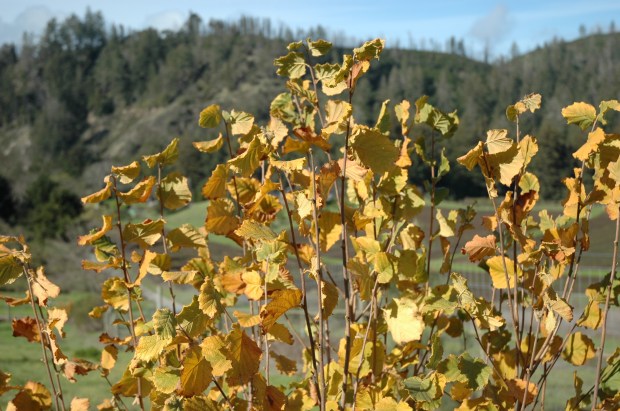
Each year, the obvious harbingers of fall are our many black walnut trees. Descendants of the Mother Tree in the Yard, the younger walnut trees turn lemon yellow starting from the highest, driest trees and ending with the Mother Tree. It is a count down clock to winter. The last trees to show fall color are at the very lowest elevation- in the north apple orchard, on the steep north facing slope of Molino Creek Canyon. Those apple trees turn yellow in late December and early January…slowly dropping leaves into February.

Fall color from black wa’nuts

We hope you are getting out to the fall colors of our area, in the shadier canyons where the big leaf maples, roses and hazelnuts are starting to show.

-this is from my near-weekly blog at Molino Creek Farm’s website

Golden Crowned Sparrow and Germinating

Two weeks back brought the Fall Equinox, a surprising germinating rain, and the return of golden crowned sparrows. In such a short time, the season has shifted between summer and fall and all around us nature is transforming accordingly.

Fall Equinox

In case you don’t follow such things…a little about the significance of Fall Equinox. The first day of Fall was September 22, 2022. The very moment that the sun was shining directly above the Earth’s equator was at 6:04 pm that day. After that, the sun has moved south of the equator, and the days have become shorter than the nights. This week, daylight is shortening 2 minutes and 23 seconds each day. Here are sunrise and sunset times for Monday October 3rd through Wednesday October 6th, so you can see what’s going on:

DaySunriseSunset
   
Monday 3rd  7:07 am6:52 pm
Tuesday 4th7:08 am6:47 pm
Wednesday 5th7:08 am6:46 pm
Thursday 6th7:09 am6:44 pm

Germinating Rain

That equinox week, an unusual storm brought much of our area enough rain to germinate annual grassland plants. Three-quarters to an inch of rain is all it takes to green up the grasslands. In the forest, redwood sorrel perked up, a newly lush green carpet under the towering redwoods. Curiously, I didn’t catch the ‘petrichor’ smell this round.

First Rains – What Next?

The shift to the rainy season demands attention. Our rainy season coincides with shorter days and a decline in average daily temperature. Cool, wet winters and hot, dry summers are what typify the rare Mediterranean climate regions like where we live. The wisdom of this area suggests that we must be prepared for the onset of stronger rains by October 15th, the average date of the first rainy storms.

Slow it Sink it Spread it

We prepare by making sure that things don’t runoff. “Slow it, sink it, spread it” is the rainfall mantra for our dry climate. Our job is to slow down rainfall so that it has time to infiltrate into the soil. We build raingardens to help sink the rain into the soil. Where we can’t sink it in small areas, we spread the flow out onto larger areas to give it more chance to slow and sink…and less chance to erode the precious soil which is impossible to replace, and which can pollute streams.

First Flush

Rain isn’t the only thing that runs off with the advent of the rainy season: the first flush of rain carries with it a whole summer’s worth of accumulated pollution. The first flush, as the runoff from the first rainfall is called, is the most polluting runoff event of the year.

A Legacy of Runoff Monitoring, Disappearing

There used to be a program led by the Coastal Watershed Council that organized volunteers to sample the first flush runoff from municipal drainages from many cities around the Central Coast, including Santa Cruz. That ‘First Flush’ program gradually degraded and then apparently disappeared – one wonders if the very concerning data were the reason.

In the early years, the program actually sampled the first flush, but it later curiously shifted to sampling in summer months. What continued was something the group calls ‘Snapshot Day’ in early summer, after one would expect that rains had cleansed drainages and runoff declined; curiously, even that program found many areas of polluted runoff concern.

The First Flush monitoring program highlighted high concentrations of pollutants, especially phosphorous but also zinc and copper, which are toxic at the concentrations they documented. In 2003, the First Flush monitoring report suggested that all the sites had runoff that was toxic to mussels, the indicator species used to assess water quality. In subsequent years, that measure was excluded, and the reports became more and more difficult to interpret. Then, the program gradually declined in scope, and reports after 2016 are not in evidence on the Coastal Watershed Council’s website.

The Return of the Golden Crowned Sparrow

I have written another essay about golden crowned sparrows, but want to give you a synopsis and a few more interesting facts. I also hope that you will welcome the return of this species to your neighborhood. This species has a very distinct call that will help you to recognize them. I woke last Wednesday morning to the smell of fresh rain and to that distinct song. Flocks of golden crowned sparrows had returned to my yard! They had flown all the way from Alaska. Bruce Lyon at UCSC has shown that the birds have a good survival rate to return to the same shrub patches that they occupied the prior winter. I keep hoping that I can find the time to get to know the behavior and color patterns of enough of the 40 or so birds that flock around my house to recognize them when they return.

These sparrows are grazers, though when they arrive from their journey south they mainly eat seeds for a bit. Their grazing helps to create big barren areas at the edges of shrubs adjoining grasslands; the taller the adjoining bush, the farther out the bare patch extends. Golden crowned sparrows also graze my vegetable garden: soon, I will have to cover up anything they like, a drastic switch from the summer. I will guard my winter greens crop – kale, collards, chard, arugula, and lettuce – until early April when they depart.

For a while, I thought the golden crowned sparrows would leave at Spring Equinox just to keep things simple. After all, if they always arrive at Fall Equinox, why wouldn’t they leave at a similar time?  I haven’t kept a good logbook of their departures, but I’ve been tricked several times when they stopped calling right around my house. It turned out that the flocks move out to graze the deep lush cover crops in the farm fields nearby before taking off for Alaska and British Columbia where they spend their summers.

In Closing

Although we’ve had a germinating rain, we don’t know what the future holds…the past 2 years have had curious weather phenomena: rain followed by hot drought, grasslands drying out and then regreening. This year, there is a strong La Niña in effect – in recent years, this meant drought. The last two years had heavy duty heat waves right up to Thanksgiving when the first big rain occurred.

So, we may get some more time to prepare for the First Flush and the onset of the rains. Do what you can…create or maintain your raingardens – water them if you can to prepare them to filter runoff.

While the golden crowned sparrow friends are around, I hope you will say hi to them and appreciate their rainy season song.

Welcome the Fall!

-this post originally published by Bruce Bratton in his infomative BrattonOnline.com weekly blog: check it out!
Drippy Fog and Fall Color

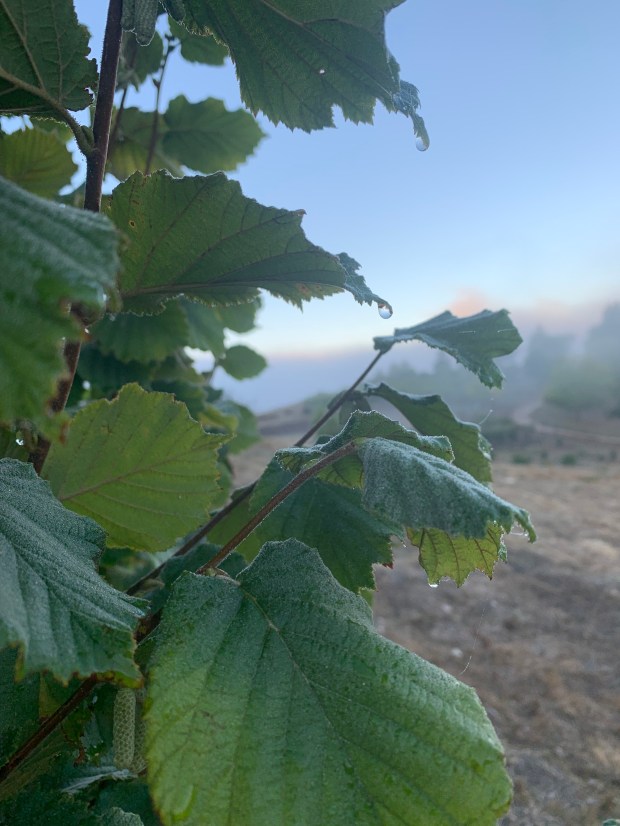
The fog rolled in thickly, the second drippy session of the season. Most fog has been ‘dry’ this summer- an unusual phenomenon not previously broadly recognized as ‘normal’ in our culture. For two mornings, the whole world went gently pitterpat, rooflines and gutters a constant spatter. Then the sun started winking through in silvery streaming rays lighting droplets on leaf tips, sparkling. The fine breezy dust particles stuck together and the wet smell of fall let us breathe deep and clean air once again.

Fog makes leaf tip drips on our hazelnut plants

Bird Friends

We wake each morning to the high shrill peeps of black phoebes, insistent and fierce. Peep, PEEEEEP, peeep! …. flutter, Snap! They nab flying insects expertly out of the air. And then they perch on the roof line, their glistening knowing dark black eyes gaze back at me when I say my hellos. Off they go, flitting arcs from many perches hunting.

The quail have done well this year. The smaller clan coveys have melded into massive tribal gatherings. Seventy plus birds thickly dot grassy hillocks and across fallow farm fields. Three and four birds peck shoulder to shoulder, others only a couple feet away. They must be finding lots of food as these groups don’t move far, satisfied to stay put for an hour or more. When startled, the whir of those many wings is loud and invigorating.

The Brewer’s blackbirds returned en masse, fluttering like fallen leaves from high in the sky. Now their staccato chips, squeaks, and trills brighten the farm soundscape. They strut proudly forward unidirectionally in flocks herding and frightening ground bugs to supplement their diets.

fog streams in above Molino Creek canyon

Ripening Time

In the lush forest of fruit trees, it is apple ripening time. Galas are peak flavor and earnestly moving to harvest bags. Also, Jonagold apples, the tastiest crop, arrived at their best this week – off they went to market, too! Next up…Mutsu and Golden Delicious. After that, Braeburn apples are in line for ripening…and there are quite a few big, beautiful apples on those trees. It is interesting to see the fruits of our labors: bigger apples hanging low on the trees ‘cause that’s where we could most easily reach to do the fruit thinning!

On the ground where Two Dog Farm has been cultivating dry farmed winter squash, the vines are withering and revealing and understory of acres of big yummy squash. The pale yellow of butternut squashes dot the ground on the undulating rich soil of our Roadside Field. The dark green acorn squash are all sidled up against their bushy main stems high up in Vandenberg Field.

Fall Color

Fall color is erupting all around the farm. The big bushy walnut trees are brightening to pure yellow. Poison oak, resprouted after the 2020 fire, is 3’ tall and startling crimson and violet. Wild roses are also turning towards the yellows in the understory of the forest where the fire burned. There is more fall color to come- our apples wait until December or even January to change color!

We hope you are having a spectacular fall enjoying bountiful harvests of healthy organic food raised by small farmers taking great care of their wildlife filled land.

-from my weekly blog at Molino Creek Farm’s webpage

Earth Management Without Data

“I don’t need to know anything more. I know all I need to know.” This is how most of the key people around us approach Earth Management. Is that frightening?

Santa Cruz County has a lot of conservation lands, and those lands are critical for our prosperity. 20% of Santa Cruz County is conservation land. We rely on those lands to provide us water, clean air, and geologically stable slopes. Conservation lands also support recreation, giving County residents reprieve and healing. Open space supports life that is intrinsically valuable and will sustain an elevated quality of life for people on this planet for generations to come. Natural area parks attract tourists, fueling an annual $1 billion income for businesses and supporting 14% of local jobs.

Does Park Management Matter?

It matters how conservation lands are managed. If natural areas recreation is mismanaged, studies have shown that wildlife will disappear, degrading parks visitor experience and the quality of life for county residents. In the long term, collectively these declines endanger the future of humans. Poorly managed recreation also makes for less safe and less pleasant parks user experiences. Mismanaged conservation lands result in eroding trails, increasing safety risk for visitors, reducing the water holding capacity of the land, and degrading habitats including filling wetlands and waterways with sediment. When conservation lands managers mismanage fuels, many are endangered by increased fire risk. If they don’t correctly manage timber operations, livestock, or farming on conservation lands, there could be increased fire risk, more spread of pathogens and weeds, erosion, and degradation of plant and animal life. Problems originating on conservation lands are a burden to surrounding landowners who are threatened by fire, weeds, reduced water quality, trespass, and poorly managed wildlife. Conservation lands were often targeted for acquisition to conserve rare species, but if those species aren’t well managed, they will increasingly deserve State or Federal endangered species status; this increases the regulatory burden of private property owners whose land has habitat for those species.

So Little Data…

Very few people make the decisions about how to manage the County’s conservation lands…these folks don’t have the necessary data to inform their decisions…and one wonders whether they want more data. There are fewer than 30 people in decision making roles for all of Santa Cruz County’s conservation lands. None to very few of those people have formal training in conservation lands management. When the folks planning the North Coast section of the Rail Trail were gathering data for recreational use of North Coast parks, they discovered that there were no reliable data for the adjoining 45,000 acres of conservation lands. They couldn’t find data about how many people were using parks where or when. They found no data on the repair status of the infrastructure (parking lots, trails, restrooms, etc) supporting those parks. Of the dozens of rare and endangered species on that landscape, only a handful have been regularly surveyed so we have no idea of the health of most species’ populations. There are no data on what visitors hope to experience versus what they actually encounter. This leads me to ask…do conservation lands managers want more data…how would we know?

The Elusive Need for Data

The first place one would expect to find conservation lands managers’ expressed data needs is on the web pages of their agencies. For example, California State Parks maintains a statewide ‘natural resource management’ webpage. On that page, the agency curiously notes: “California State Parks…supports scientific studies by universities and other researchers who use state parklands as sites for conducting studies designed to help us understand the ecological health of a park.” Note that this verbiage avoids stating that such research could help inform management. Nowhere on the webpage can you find out how Parks supports science. I have not been able to find a publicly available list of prioritized data needs nor science plans that would help to guide data collection prioritization for any conservation lands managers in the County. The Bureau of Land Management, managers of a sizeable conservation property, Cotoni Coast Dairies, apparently does not intend to complete a science plan, which is mandated for all such National Monument designated lands. With a region rife with research institutions, why would conservation lands managers not outwardly seek assistance with data collection and analysis?

The Few, The Proud

I am reflecting on the many conversations I’ve had with conservation lands managers about their priorities, or lack thereof, for data and analysis to inform their management. Many lament the need for more financial resources to support research within their agency; many have also shown suspicion about research that they do not tightly control. In the most recent conversations, two conservation lands managers told me that they had all the information they needed to manage thousands of acres of Santa Cruz County land. Their swagger suggested that they were experts and that they would notice if there was something awry with their management; if they needed to make any changes, they would know what to do. A few years ago, when another manager claimed something similar in a group with which I was a part, a wise colleague responded that humans have thought they knew the right thing to do for thousands of years only to be eventually proven wrong as science progressed. This know-it-all attitude is reflected in reports and programs such as this publication and another one from a central support organization for State Parks, where it is supposed that it is merely necessary to disseminate ‘best practices’ or to train parks employees to implement ‘tested approaches for management.’

Twisted Logic

Try to make sense of the following logical framework, which local Bureau of Land Management (BLM) conservation lands management leaders have publicly stated. Although BLM has sufficient information to inform their management…the questions they might have for researchers…whatever they might be (not stated/published)…are not expected to overlap with the interests of researchers. But, even if they could find some overlapping interest, researchers would likely not produce information that would be salient for BLM’s management.

A Beacon of Hope

As a stand-out exception to these trends, the Santa Cruz Mountains Stewardship Network, a consortium of lands managers working throughout the region, recently completed a data-driven climate adaptation project. But it is not clear if any particular land management agency has officially adopted the project’s findings, which largely either contradict current management or suggest the need for much more study/work before alternate management actions might be considered. So, perhaps there is some hope…

Support What’s Right

Meanwhile, how can we help advocate for better progress with scientific approaches to stewarding the precious conservation lands of Santa Cruz County? Your most likely leverage point is through advocacy organizations. Don’t support an organization that doesn’t align with your values. For instance, Friends of Santa Cruz State Parks has a mission that purportedly supports ‘thriving’ parks and ‘conservation’ – support them only if you find that science-based land conservation is a priority. It would be great if other groups were able to help State Parks with their stewardship issues. The California Native Plant Society has a great reputation as having a science-based approach to assisting with conservation lands management through advocacy and partnership. Occasionally, Audubon California will help with such issues. The Nature Conservancy has long been a leader helping other conservation lands managers to be more science-based and data driven with their stewardship work.

As always, please vote for the environment. Ask candidates about how they will help conservation lands managers be more scientific with their approaches to stewardship. These issues touch on elections at every level: city, county, state and federal candidates should all have clear environmental platforms for conservation lands assistance. Hundreds of thousands of acres of Santa Cruz County depend on smart practitioners of Earth Management! Let’s help move that forward.