Wildlife conservation

True or False: National Monument Designation Will Confer Additional Natural Resource Protection to Cotoni Coast Dairies?


-Part 1-

Our government designates National Monuments in order to protect them, but would a National Monument designation for Cotoni Coast Dairies really better protect these lands? An informed answer requires an examination of the protections already in place, the language of the monument designation, and how the public and US Bureau of Land Management (BLM) follow through after monument designation. Today we will examine the first two of those three subjects with a subsequent essay that will cover the last subject.

Through decades of public effort, natural resource protections in place at Cotoni Coast Dairies were already very strong when the BLM took possession in 2014. The owners before BLM – the Trust for Public Land (TPL) – created two sets of deed restrictions that incorporated private and public funders’ interests as well as protections imposed by the California Coastal Commission. These deed restrictions require future managers to accommodate public recreation without sacrificing protected endangered species or endangered species habitat. The restrictions also prohibit mining, commercial timber production, and use of off-road motorized vehicles. The TPL and the California Coastal Commission both have standing to enforce these deed restrictions in perpetuity. Since these restrictions serve to protect the Cotoni Coast Dairies property’s natural resources in most of the ways Federal National Monument status normally affords, the question is: what additional natural resource protections might National Monument status afford?

Interestingly, National Monument designation doesn’t necessarily guarantee any specific types of natural resource protection. Those that exist are entirely subject to the discretion of Congress or the President. There are different regulatory guidelines for Congress versus the President in establishing National Monuments. Congress has constitutional authority to declare an area a National Monument; the Constitution allows Congress to make whatever rules it wishes for such land. For example, Congress can allow off road vehicles and commercial timber production on National Monuments, or Congress can prohibit human visitors, altogether. Alternatively, the Antiquities Act of 1906 allows Presidents to designate an area as a National Monument. The President is limited by the Antiquities Act which requires the size of the Monuments is ‘smallest area compatible with proper care and management of the objects to be protected.’

In 2015 two US Congresswomen and both US Senators from California co-sponsored a measure to add the Cotoni Coast Dairies property to the California Coastal Monument. The proposed addition lacked any substantive natural resource protections and ultimately failed to motivate sufficient support to make it to a floor vote. In accounting for the omission, aides to both the House and Senate sponsors have directly claimed that such language was ‘inappropriate’ because the representatives believe that Congress should not exert political influence on federal agencies’ land management decisions. In keeping with this policy, other Monument legislation in California from this era has contained little natural resource protection language.

As early as February 2016, in the wake of the failure of the California proposal, Congressional proponents met with the Obama administration on numerous occasions to urge designation of Cotoni Coast Dairies as a National Monument via an Executive Order under the Antiquities Act. We know little about what if any natural resource protections those Congressional offices lobbied for in their negotiations with the President, because this information is not available to the public. But when Congressional designation of National Monuments failed in the past, subsequent Presidential Antiquities Act proclamations of Monuments have had a regrettably mixed record of inclusion of natural resource protection language.

No discernible pattern exists –not one informed by policy or ‘pragmatism’– to account for the variable inclusion of natural resource protections in Presidential National Monument declarations. Most often, local grassroots conservation efforts motivated Presidents to designate lands as National Monuments. In most of those designations, grassroots organizations proactively provided Presidents with the information necessary to inform specific natural resource protection language in their Monument proclamations. This language often provided for protections above and beyond the federally listed species protected on federal lands by including mention of state-listed, rare, and unusual species.

The following Presidential Antiquities Act proclamations declaring National Monuments all had language protecting natural resources above and beyond what would have been protected had these areas not been declared Monuments:

  • Carrizo Plain
  • Berryessa Snow Mountain
  • Giant Sequoia, and
  • the Pt. Arena Stornetta boundary enlargement of the California Coastal National Monument (of particular relevance).

Presidential Antiquities Act proclamations for these Monuments each called out protections for a number of rare or state-listed species not otherwise protected on Federal lands (Appendix 1). Here is a tally of the numbers of non-federally listed plants and animals in these proclamations:

  • Carrizo Plain National Monument – 8 plants, 3 mammals
  • Berryessa Snow Mountain National Monument – 17 plants
  • Point Arena-Stornetta Unit, California Coastal Monument – 1 plant, 4 animals
  • Giant Sequoia National Monument – 3 animals

On the other hand, some Presidential monument proclamations had little or no such language. For instance, the proclamations creating the Santa Rosa/San Jacinto and Fort Ord National Monuments did not include mention of any specific non-federally listed species.

When non-federally listed species and other natural resource protection language is included in Antiquities Act proclamations of National Monuments, land managers must explicitly manage for those resources. If no natural resource protection language is included in proclamations the managers need never exceed baseline practices of natural resource protection. In my next post I will provide details on how land managers for the above listed Monuments adjusted their management to account for National Monument status, answering in the main the ‘what happens when’ question. For our purposes here suffice it to say that natural resource protection language in Monument designations has correlated with additional protection of those natural resources.

The nut of our position is this: Cotoni Coast Dairies is already largely protected in the ways that National Monument status would confer. If National Monument status is meant to increase protection of Cotoni Coast Dairies –as advocates for Monument status have suggested– the only sure way is if the President’s proclamation includes specific natural resource protections.

————————————————————————–

Appendix 1: Recent, Antiquities Act created Californian National Monuments and the sensitive natural resources that the Presidential proclamations protected.

Monument Species Listing Status
     
Carrizo Plain San Joaquin (Nelson’s) Antelope squirrel State of California Threatened
Pale‐yellow layia

Carrizo peppergrass

Lost Hills saltbush

Temblor buckwheat


California Rare Plant Rank 1B
Hoover’s woolly‐star

Forked fiddleneck

California Rare Plant Rank 4 “Watch List”


Pronghorn antelope

Tule elk


Unlisted
Berryessa Snow Mountain


Indian Valley brodiaea

Red Mountain catchfly


State of California Threatened


Bent flowered fiddleneck

Brittlescale

Brewer’s jewelflower

Snow Mountain buckwheat

Coastal bluff morning glory

Cobb Mountain lupine

Napa western flax


California Rare Plant Rank 1B
Purdy’s fringed onion

Serpentine sunflower

Bare monkeyflower

Swamp larkspur

Purdy’s fritillary


California Rare Plant Rank 4 “Watch List”


Musk brush

MacNab cypress

Leather oak


Not listed
Point Arena-Stornetta


Humboldt Bay owl’s clover


California Rare Plant Rank 1B
Black oystercatcher

Yellow warbler

Black-crowned night heron

Brown pelican


Not listed
Giant Sequoia Great gray owl


State of California Endangered


Northern goshawk


State of California

Species of Concern


American marten


Not listed


Experts Weigh in on Monument Proposal: Sensitive Natural Resources of Cotoni Coast Dairies

Introduction

The BLM-managed Cotoni Coast Dairies property is being proposed for National Monument status, but thus far proposed legislation lacks language typical in such proclamations that recognizes the natural and geologic features which make this place special. This brief proposes such language as reviewed by the region’s experts in this area and its natural resources.

Methodology

The following language about the Cotoni Coast Dairies property contains information about natural and geologic features of national significance as reviewed for accuracy by regional experts familiar with the property. Natural resources presented here include plant and animal species that are found in few other places. Bird species are included if they are suspected of breeding on the property. Because the property has historically been in private ownership and biological investigation has been largely prohibited, this list is not meant to be exhaustive. Experts who reviewed the proposed language for their areas of expertise are included in Appendix 1.

 Proposed Language

“Because of its history, topographic features, and water resources, Cotoni Coast Dairies is a property notable for its species-rich, diverse habitats as well as its sensitive plants and wildlife. The property is located in one of the richest biodiversity hot spots in North America. Many species of plants and wildlife found on the property are listed as rare, sensitive, threatened or endangered under Federal, State, and local laws. These include: Point Reyes horkelia, Choris’ popcornflower, Santa Cruz manzanita, steelhead, coho salmon, California red-legged frog, western pond turtle, white-tailed kite, northern harrier, olive-sided flycatcher, Bryant’s savannah sparrow, grasshopper sparrow, tricolored blackbird, San Francisco dusky-footed woodrat, and American badger (for a complete list, see Appendix 2).

Cotoni Coast Dairies is replete with wild and diverse landscapes and climatic micro-habitats that support unique biotic assemblages. These include deep, riparian canyons containing seven nearly undeveloped watersheds and clear-running streams that have been rarely impacted by humans. Ridges contain intact lowland maritime chaparral, a threatened and species-rich, fire adapted ecosystem endemic to low elevations along the California coast. The property’s four marine terraces contain an ecological staircase providing a unique localized profile of ancient soil development and evolution. Each of these terraces contains sensitive and unique assemblages of coastal prairie grasslands, of which more than 40 types have been documented from the vicinity. The extensive coastal scrub on the property includes species-rich rocky outcrops and large areas inaccessible to humans. The property contains numerous wetlands and springs, which are buffered by the maritime environment and fed by healthy watersheds that provide spawning, breeding, and foraging habitat for fish, amphibian and aquatic reptile species including steelhead, California red-legged frog and western pond turtle. The rare ecosystems of redwood, Shreve oak, and Monterey pine forests on the property are globally significant. The relative isolation of the property provides core wildlife habitat to a particularly diverse mammalian carnivore community including mountain lion, American badger, gray fox, long-tailed weasel, bobcat, and coyote. The grasslands on the property likewise support foraging habitat for an unusually abundant and diverse raptor community including: white-tailed kite, golden eagle, northern harrier, red-tailed hawk, ferruginous hawk, American kestrel, American peregrine falcon, short-eared owl, barn owl, and burrowing owl.”

Appendix 1: Expert Reviewers

These persons provided review of the proposed language for their areas of expertise.

Name Expertise, Affiliation
Mark Allaback Certified Wildlife biologist

Biosearch Associates


Don Alley D.W. ALLEY & Associates

Certified Fisheries Scientist


Sandra Baron Ecologist


Phil Brown


President

Santa Cruz Bird Club


Dr. Don Croll Professor, Ecology and Evolutionary Biology

University of California at Santa Cruz


Dr. Gage Dayton Ecologist

University of California at Santa Cruz


Carleton Eyster Coastal Ecologist


Steve Gerow


Past President and County Records Keeper

Santa Cruz Bird Club


D. Kim Glinka Wildlife Biologist


Dan Grout Wildlife Biologist

Grout Wildlife Research

Brett Hall


California Native Plant Program Director

UC Santa Cruz Arboretum


Grey Hayes, PhD Botanist/Restoration Ecologist


Kim Hayes Biologist/Conservation Lands Manager


Dr. David Kossack San Andreas Land Conservancy


Kerry Kriger, PhD Executive Director

SAVE THE FROGS!


Inger Marie Laursen Wildlife Ecologist


Dr. Bruce Lyon Avian Ecologist

University of California at Santa Cruz

Bryan Mori Certified Wildlife Biologist

Bryan Mori Biological Consulting

Watsonville, CA


Dylan Neubauer


Botanist
Elliot Schoenig Herpetologist


Lisa Sheridan


Conservation Officer

Santa Cruz Bird Club


Dr. Dean Taylor


Botanist

California Academy of Sciences


Jim West


Botanist


Appendix 2: Sensitive Species of the Cotoni Coast Dairies Property.

Animals
Common name Latin name Rarity Status
California red-legged frog


Rana draytonii Federally Threatened

CA Species of Special Concern


Coho salmon Oncorhynchus kisutch Federally and State Endangered

(central California coast ESU)


Steelhead Oncorhynchus mykiss irideus Federally Threatened

(central California coast DPS)


White-tailed kite Elanus leucurus


CA Fully Protected

(nesting)


Bryant’s savannah sparrow Passerculus sandwichensis alaudinus


CA Species of Special Concern
Ferruginous hawk


Buteo regalis California Watch List

(wintering)


Grasshopper sparrow Ammodramus savannarum CA Species of Special Concern (nesting)


Northern harrier Circus cyaneus


CA Species of Special Concern (nesting)


Olive-sided flycatcher


Contopus cooperi CA Species of Special Concern (nesting)


Tricolored blackbird Agelaius tricolor


CA Species of Special Concern

(nesting colony)


American badger Taxidea taxus CA Species of Special Concern


San Francisco dusky-footed woodrat Neotoma fuscipes

annectens


CA Species of Special Concern
Western pond turtle Actinemys marmorata CA Species of Special Concern


Plants
Common name Latin name Rarity Status
Choris’ popcornflower Plagiobothrys chorisianus var. chorisianus


California Rare Plant Rank (CRPR) List 1B
Point Reyes horkelia Horkelia marinensis


CRPR List 1B
Santa Cruz Manzanita Arctostaphylos andersonii


CRPR List 1B
California bottlebrush grass Elymus californicus


CRPR List 4
Michael’s rein orchid Piperia michaelii


CRPR List 4
Bolander’s goldenaster Heterotheca sessiliflora subsp. bolanderi


Locally rare1
Brownie thistle Cirsium quercetorum


Locally rare1
Cascades oregon grape Berberis nervosa


Locally rare1
Coast barberry Berberis pinnata subsp. pinnata


Locally rare1
Coastal larkspur Delphinium decorum subsp. decorum


Locally rare1
Common muilla Muilla maritime


Locally rare1
Elmer fescue Festuca elmeri


Locally rare1
Fire reedgrass Calamagrostis koelerioides


Locally rare1
Hoary bowlesia


Bowlesia incana


Locally rare1
Narrow leaved mule ears Wyethia angustifolia


Locally rare1
Round woolly marbles Psilocarphus tenellus


Locally rare1
Salmon berry Rubus spectabilis


Locally rare1
Woolly goat chicory Agoseris hirsuta


Locally rare1


1 Locally rare species were not included in the suggested language but may deserve mention; these species are recognized by experts as deserving of protection because of their local rarity.

Post Scripts:

  • I submitted the above to representatives and agencies responsible for National Monument designation including the Obama Administration, Department of Interior, Bureau of Land Management, Senators Boxer and Feinstein, Congresswomen Capps and Eshoo.
  • Letters of support for this proposal included with submission from the Trust for Public Lands, Land Trust of Santa Cruz County, Audubon California, California Native Plant Society, Sierra Club, Valley Women’s Club of San Lorenzo Valley, Save the Frogs, and the Resource Conservation District of Santa Cruz County

Rare Biota of Santa Cruz County’s North Coast

By request…a list of the rare biota of Santa Cruz County’s North Coast. The sheer number of rare biota is both a gift and a challenge for us.

How many species do you need to live?

Plants

Federally or State protected plant species on Santa Cruz County’s North Coast
Common name

Status

Latin name Notes
Ben Lomond spineflower

Federally endangered

Chorizanthe pungens var. hartwegii Mostly on inland sands, but also on some shallow soils in the Major’s Creek drainage
San Francisco popcornflower

State endangered

Plagiobothrys diffusus Moist meadows


Santa Cruz cypress

Federally threatened

Hesperocyparis abramsiana Mostly on inland sands, but also recently found in the Scotts Creek watershed; outliers expected elsewhere
Santa Cruz wallflower

Federally endangered

Erysimum teretifolium On inland sands
Robust spineflower

Federally endangered

Chorizanthe robusta var. robusta
White-rayed Pentachaeta

Federally and State endangered

Pentachaeta bellidiflora

The following table uses California Rare Plant Ranks, as follow:

California Rare Plant Rank Description of rarity
1B Plants Rare, Threatened, or Endangered in California and Elsewhere


2B Plants Rare, Threatened, or Endangered in California, But More Common Elsewhere
3 Plants About Which More Information is Needed – A Review List


4 Plants of Limited Distribution – A Watch List


Biologically imperiled plant species on Santa Cruz County’s North Coast
Common name

Status

Latin name Notes
 
Ben Lomond buckwheat

CRPR 1B

Eriogonum nudum var. decurrens On inland sands
Bent-flowered fiddleneck

CRPR 1B

Amsinckia lunaris
Blasdale’s bent grass

CRPR 1B

Agrostis blasdalei
Bonny doon Manzanita

CRPR 1B

Arctostaphylos silvicola Mostly on inland sands
Brewer’s Calandrinia

CRPR 4

Calandrinia breweri
California bottlebrush grass

CRPR 4

Elymus californicus


Only a couple of populations in our county
California falselupine

CRPR 1B

Thermopsis macrophylla Coastal prairie
Choris’s popcorn flower

CRPR 1B


Plagiobothrys chorisianus var. chorisianus Moist meadows, scrub
Dylan’s leptosiphon Leptosiphon ‘dylanae’ An undescribed species only in Bonny Doon, possibly extinct in the wild
Gairdner’s yampah

CRPR 4

Perideridia gairdneri ssp. gairdneri Moist meadows
Harlequin lotus

CRPR 4

Hosackia gracilis Moist meadows
Hoffmann’s snakeroot

CRPR 4

Sanicula hoffmannii
Johnny nip

CRPR 4

Castilleja ambigua  ssp. ambigua Moist meadows
Large flowered star tulip

CRPR 4

Calochortus uniflorus Moist meadows
Marsh silverpuffs

CRPR 1B

Microseris paludosa Moist meadows
Marsh zigadenus

CRPR 4

Toxicoscordion fontanum Only one population known in our county
Michael’s rein orchid

CRPR 4

Piperia michaelii
Mt. diablo cottonweed

CRPR 3

Micropus amphibolus
Ohlone Manzanita

CRPR 1B

Arctostaphylos ohloneana Fewer than a few dozen plants exist
Pinus radiata

CRPR 1B

Monterey pine North Coast includes the Año Nuevo population one of a handful of wild stands; genetically distinct
Point Reyes horkelia

CRPR 1B

Horkelia marinensis Moist meadows
San francisco blue eyed mary

CRPR 1B

Collinsia multicolor Swanton area
San francisco campion

CRPR 1B

Silene verecunda subs. verecunda
San Francisco wallflower

CRPR 4

Erysimum franciscanum Coastal dunes
Santa cruz clover

CRPR 1B

Trifolium buckwestiorum
Santa Cruz County monkeyflower

CRPR 4

Mimulus rattanii  ssp. decurtatus
Santa Cruz Manzanita

CRPR 1B

Arctostaphylos andersonii  Shaded areas
Santa cruz microseris

CRPR 1B

Stebbinsoseris decipiens
Santa Cruz Mountains beardtongue

CRPR 1B

Penstemon rattanii  var. kleei
Schreiber’s Manzanita

CRPR 1B

Arctostaphylos glutinosa
Vanilla grass

CRPR 2

Hierochloe odorata Forest understory

Animals

Federally or State protected animal species on Santa Cruz County’s North Coast
Name

Status

Latin name Notes
American badger

State Species of Special Concern

Taxidea taxus
Bald eagle

State endangered

Haliaeetus leucocephalus
California red-legged frog

Federally threatened

Rana draytonii Breeds in ponds, but uses large areas for movement/summer refugia
Central Coast population

Coho Salmon

Federally endangered

State endangered

Oncorhynchus kisutch Returned for first time in years in 2015 to North Coast streams.
Central Coast population Steelhead Trout

Federally threatened

Oncorhynchus mykiss irideus
Golden eagle

State Fully Protected

Aquila chrysaetos
Grasshopper sparrow

State Species of Special Concern

Ammodramus savannarum
Mount Hermon June beetle

Federally endangered

Polyphylla barbata inland sands
Northern harrier

State Species of Special Concern

Circus cyaneus
Northern spotted owl

Federal candidate

Strix occidentalis caurina
Ohlone tiger beetle

Federally endangered

Cicindela ohlone
Peregrin falcon

Federally threatened

Falco peregrines


Ring tailed cat

State Fully Protected

Bassariscus astutus
San Francisco dusky-footed woodrat

State Species of Special Concern

Neotoma fuscipes annectens
Southwestern pond turtle

State Species of Special Concern

Actinemys marmorata pallida Bask in ponds, nest in adjoining grasslands


Tidewater goby

Federally endangered

Eucyclogobius newberryi In brackish lagoons
Tricolored blackbird

State Species of Special Concern

Agelaius tricolor Listing petition in process
Western burrowing owl

State Species of Special Concern

Athene cunicularia We have only wintering birds left- they nest inland.
White tailed kite

State Fully Protected

Elanus leucurus
Biologically imperiled animal species on Santa Cruz County’s North Coast


Common name Latin name Notes
Ben Lomond rain beetle  
Doloff’s cave spider Meta dolloff Caves
Empire amphipod Stygobromus mackenziei Caves
Empire isopod Calasellus n. sp Caves, undescribed
Empire pseudoscorpion Fissilicreagris imperialis Blind, cave adapted
Empire roothopper Cixius n. sp Caves, undescribed
Laguna cave cricket In one cave, only, undescribed
Puma


Puma concolor Not clear if Santa Cruz mountains population is viable in the long term
Santa Cruz black salamander Aneides flavipunctatus niger Only a very few observations
Santa Cruz kangaroo rat Dipodomys venustus venustus Only viable population potentially at Henry Cowell- extinct in Bonny Doon?
Santa Cruz pseudoscorpion Neochthonius imperialis Blind, cave adapted
Santa Cruz rain beetle Pleocoma conjugens conjugens

Habitats

Coastal Commission protected habitats – “Environmentally Sensitive Habitat Areas” (ESHA)

  • Coastal scrub/rocky outcrops
  • Coastal prairie
  • Wetlands
  • Shreve oak forests
  • Maritime chaparral
  • Riparian habitats


Wildlife conservation and wild land recreation are conflicting goals

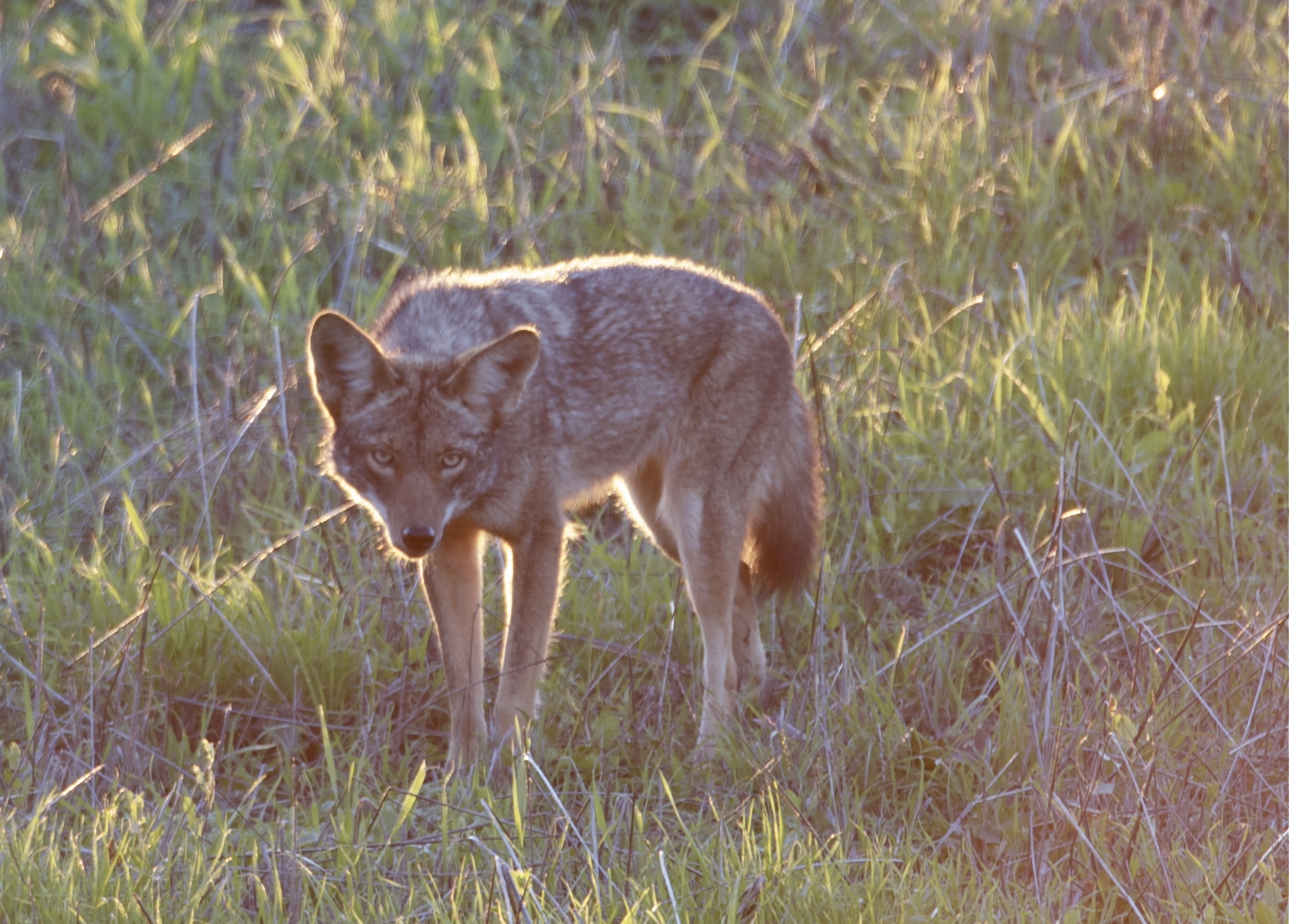
We called her Bella, member of a North Coast coyote pack.

Wild land recreation conflicts with healthy wildlife populations, endangering future generations’ ability to enjoy the nature we currently experience and the services that ecosystems provide.  Wild land recreation here refers to both active (mountain biking, hiking, horseback riding, etc.) AND passive (wildlife viewing, meditation, walking, painting, poetry) types of recreation.  The severity of impacts from these activities on wildlife vary depending on the numbers of people and the species of wildlife.  Here, I focus on vertebrates, though we should be concerned with invertebrates, as well – some of what follows applies to the many species of endangered insects in our wild lands.

Santa Cruz County’s wild lands support diverse vertebrate wildlife – many have been declining due to habitat loss and fragmentation.  Wild land parks are important to the survival of especially wide ranging carnivores such as  American badger, ring tailed cat, gray fox, bobcat, long tailed weasel, and puma.

These predators are essential to supporting wild land ecosystems and the services those ecosystems provide including the water we so rely upon.  If future generations are to enjoy the beauty of redwood and oak forests maritime chaparral and coastal scrub, and coastal prairies and wetlands, all depends on these predators.  Widespread and poorly planned wild land recreation is posing increased threats to these predators in Santa Cruz County.

The impacts of wild land recreation on wildlife have been well and extensively scientifically documented, including in our region.  The diversity and abundance of wildlife decline in parks with recreation as opposed to parks without recreation.  With more recreation, these impacts increase.  Deer flee 200 yards when approached by recreational mountain bikers in parks.  Bobcats and badgers decline in recreational parks and especially den only far from recreation.  While some species of birds become accustomed to recreation, others do not and will not forage or nest close to recreational visitors in parks.  A frog very like our California red-legged frog has been shown to decline in proximity to recreational use of parks.  In sum, because of the wealth of evidence, wild land recreation has recently been recognized as one of the greatest and growing threats to wildlife across the entire world.

WHAT TO DO

If you care for future generations’ ability to enjoy what we have today, speak up against the widespread proliferation of recreational access to wild land parks.  There are many such proposals in Santa Cruz County, right now.  If you consider giving to private, not-for-profit land trusts, consider giving only when they have proven that they are setting aside lands for wildlife, primarily.  If you or your friends recreate in wild lands, stay on marked, planned trails- not the miles of unmarked, ad hoc trails created mostly by mountain bikers in our State Parks.

Public ignoring biodiversity in parks – Business & politicians taking advantage

crowded beach

‘crowded beach’ © Mark Notari

Wildlife conservation is a public priority, but Santa Cruz citizens sleep while politicians and business leaders threaten to deprive future generations of opportunities for the wildlife experiences we have today.

National poll data indicate that 70% of Americans self identify as ‘conservationists.’  Although there is no local data, you would expect an even higher percentage for our progressive community.  In the past 35 years, the public has supported a cadre of local conservationists in just the first steps of conserving wildlife of our county – progressive land use restrictions and large scale protection of open space.  Unfortunately, the public have checked out, abandoning the crucial next step in protecting wildlife – protecting our parks from being loved to death.

The beaches and parks our community has protected are now threatened because they are global tourist destinations.  Politicians and business leaders are maximizing short term profit by packing in as many recreational visitors as possible, threatening wildlife.  Any of the public still paying attention is being duped into believing that any amount of recreation in our open spaces is harmless.  Every organization owning/protecting open space is increasingly opening their lands to a flood of people; their websites, news releases, tours, and talk swell with pride of new “access.”

Flooding parks with throngs of visitors will drive wildlife from lands that were originally protected for conservation.  This is unfair to future generations, who will experience the trees, but not the diverse and alive, critter filled forests we are so lucky to have today.

WHAT TO DO?

As you hear about proposals to increase numbers of recreational visitors, numbers of trails, ‘access points,’ parking lots, etc., I hope you will ask “what do biologists say about impacts to wildlife?”  If you, like me, feel like we probably have enough and it is time for better planning for the wildlife, speak out where you can.  For instance, against a National Monument designation for our North Coast.  And, please, vote for politicians that seek biologist counsel as much as they listen to business leaders.