-I post nearly weekly from Valentine’s Day until Thanksgiving a blog about Molino Creek Farm. So, this is the second to last post for 2026.
Rain. Every vignette, each part of the farm…the entire region…is being wetted. This rain drives the moisture deeper into summer-dried soil awakening new life for the winter season.
Forest Drops
The rain is captured and concentrated in the high boughs of redwoods and firs. Drizzle coalesces into big drops plummeting, sometimes making sharp smacks against limbs, shattering. Mostly, though, the raindrops are muffled quietly diffusing into deep, fluffy needle duff. Giant bananaslugs scoonch across trunks leaving silvery slime trails.
Scrub Soak
Resinous coyote bushes slump, covered with white fresh seed fluff made heavy with water. The bushes densely glisten even under cloud-capped sky. Exploring newly emerging liverworts or mushrooms, you dare not squeeze between those hulking shapes: brushing up against one instantly soaks. Edges of shrubby patches will have to do for the liverwort expeditions. Alarm squeaks resound: families of golden crowned sparrows flush deeper into cover. They are the cryptogam farmers.
Flushing Grasses
Gopher mounds bristle like alarmed hedgehogs. Although dense, the single first leaves of 2” tall grass seedling spikes haven’t covered the moist, deep brown soil. Ferny blue-green rosettes of California poppy catch droplets that magnify and distort their otherwise tidy appearance. The arched dense cover of perennial grass blades dance and bob in heavy downpours.
Tilled Mud
Furrows of loose soil, freshly plowed or harrowed flatten gradually as they saturate. Mud puddles form in tire tracks. Liquified dirt flows in rivulets, down rodent holes, backing up against obstacles, painting one color what had been complex hues of soil surface-chopped plant residue. In between showers, these tilled areas waft thick and sweet soil scent.
Puddled Roads and Trails
Cows lower their massive noses to road puddles – convenient drinking areas far from the trough. Birds delight in the ubiquitous baths, wings splashing, heads scooping, beaks open sucking up sweet fresh rainfall. Every trail and road is dotted with puddles.
End of the Season
The last Palo Alto Farmer’s Market of the season for Molino Creek Farm this Saturday. Bodhi powered the tractor across the fields, discing and planting cover crop into the night Tuesday. Orchard cover cropping progressed with whatever hours I could spare, however many hours my body could muster – alas, only half done before this week’s rainstorm! Imagining the swelling of bell bean seeds, licked by snails, prodded by earthworms in the freshly turned soil.
Strong dark wax boxes of winter squash are stacked high and curing just inside the south-facing doorway of the Two Dog Farm greenhouse.
Farmers wend their way slowly one more time down the rows of tomatoes, happily surprised to be harvesting tomatoes this close to Thanksgiving.
Heavy shoulder bags of apples filled on the steep orchard hillside and hoisted onto the sorting table. Fuji and Braeburn are the last varieties this year to go to market. Sweet and juicy but each having their own very unique flavor, vastly different. We will too soon miss the crunch of that wonderful fruit. A reminder to relish the appreciation of what you have before its gone. I take extra-long to finish a fresh-picked apple nowadays, making sure to chew and taste while gazing at the skin and flesh…the juice…the release of complex aroma upon each crisp bite.
Do humans all want the same things? Do we all know good from bad? When we look for explanations, for meaning, do we all find the same answers, and feel the same sense of wonder? It is my experience that we have much in common.
A famous 60’s poster featuring Casey Sonnabend’s photo.
In Search of Unity
A critique of Our Time Now is that too many are finding too much fault and see too many divisions. Where is unity?
It is easy for me to find My Tribe and to describe The Others. My tribe consists of the ones who believe that all species deserve a chance and we learn to operate from that principle. Often, we feel apart, too few. We despair to see the Monterey Bay’s most special places disappear to poorly planned development, approved by bureaucrats who feel that their jobs are to strike a balance. We believe humans are capable of better, but that money and politics bend to special interests, eroding the quality of life for future generations. We know what is lost in the real world of biology, deep in the fertile healthy soil and along the ancient paths of wildlife, cannot be regained.
Then there are The Many Others, who have other principles. Many are just ‘getting by.’ A great many just want to have fun. Then there are the ones who worship money above all else, and the ones who believe that technology will somehow keep us alive and well after the loss of most of Earth’s natural biosystems. I have met these people, we have spoken about such things. These people are not strangers, they are not abstract. Can anything bring us together?
Falling Apart, Together
One unifying theme I see is a widespread belief that things are falling apart. My Tribe is unified in understanding that humans’ relationship with Earth is increasingly critically imperiled due to poor collaboration, greed, and despotism. Many others believe that humans are doomed to extinction, perhaps sooner than later. We see that a great many people believe that things have already reached a critical state, requiring absolute destruction. There is ample evidence to support all of those positions.
Somehow, through this varied cacophony of hopelessness, a stolid force has held up a belief that everything will be alright.
Coming Together, Naturally
Another unifying theme I experience is widespread trust that everything will turn out fine. We get in our cars and drive sometimes very high speeds among thousands of strangers expecting to arrive safely at our destinations. We go to the store and find almost everything we expect to buy. Our bank accounts are secure. The weather doesn’t go to wonky extremes very often. Most of us can get food and find a safe place to sleep, largely thanks to a society that works due to trust and routine. When things don’t turn out how we expect, most people believe that humans are working to make things better, that we will have solutions to the world’s great problems. There is ample evidence to support those beliefs.
Many people simultaneously hold positive beliefs alongside much more despairing ones. How do we reconcile such disparate world views?
Discrepancies
I have noticed many people struggling with holding opposite world views, unresolved. Most notably, I’ve seen people simultaneously decrying the inhumanity of the US ‘justice’ system and yet lauding it when it turns out favorably to their beliefs…all the while with an inability to detail even rudimentary synopses of legal arguments used in judgements. I’ve also witnessed people believing governments will find a workable solution to climate change despite local, national, and international decisions to the contrary. And, individuals celebrate trickle down economics when evidence strongly contradicts such approaches. In each case, it seems to me that there has not been enough smart talk, enough curiosity, to resolve these discrepancies. We need more smart talk.
Howdy!
After the hellos and beyond the weather, we must find things to talk about to bring us together. This will take getting personal, kindly. We might practice quickly arriving at the question of ‘what do you want to be remembered for?’ Or perhaps, ‘who has done the most good for you, personally (and why)?’ Asking people about how they are feeling is a good idea, too, but perhaps go more deeply than ‘how’s it going?’ Prolonging topics and conversations is a skill I’m seeing as important.
Carry It Forward
The most liked people remember things. Politicians remember names and faces and a few facts about many people. Every social network has someone or some few who recall many more personal things. Your circle is held together by shared memories, by long conversations lasting years. We build community by carrying conversations based on memory, respect, and kind curiosity.
What if we all make it a point to have more caring conversations, taking them as far as seems right each time we see each other? What if we take those conversations to people on our periphery, to build larger communities, to make a more peaceful society, to sustain Life on Earth? We must turn those conversations over and over in our minds, curiously seeking understanding, coming up with the next questions, and bringing those cherished questions back when we reconnect. This is what will bring healing.
-this post originally published on BrattonOnline, a weekly blog featuring some of the greatest minds of California’s Monterey Bay area on current events, news, and philosophy…from the Left of Center.
Here is a link to an online presentation with Q and A about a subset of results of the survey. And, here is a brief article on the results, with an interesting spin.
July Fourth was one of those epic clear days. On the drive out to the coast, we marveled at the clarity, took out binoculars and spotted ‘individual trees’ on the Monterey Peninsula way across the Monterey Bay. The Dorrance Ranch homes were Right There on the side of Mt. Toro. Peak naming phone software corrected the location of the very clear Pimkolam Peak, the farthest off. It was clear but yet surprisingly little wind. It was clear like a winter breezy day. Point Sur where the lighthouse sits in Big Sur was also very nicely visible: a curious dome, seeming like an island out past Monterey.
Wildlife on the Farm
Since then, some of summer weather has been normal; other bits not so much. As normal, morning fog has returned. Of note was the abnormal June-gloom-lessness: no fog in June! Very Odd. Now, we mostly wake to a gray-capped sky, a fog deck sometimes dipping low enough to pour small wisps over the ridges north of the Farm. Then, the fog breaks apart, pieces here and there and then gone. A breeze picks up…and then becomes abnormal: wind land! We are increasingly living in wind land. Not pleasant breezes but hearty menacing gusts, whipping up bits of dry hay and dust devils, setting us on edge about the potential for fire. The wind dies and then breezes commence as ‘normal’….and then after a bit (or not) in no pattern whatsoever, another gust event alerts us to the presence of the out of doors. Sundown brings a welcome calm, the nights peaceful and the fog steals in again by dawn.
The hills around the Farm are turning blonde from tall oatgrass
Wildlife on the Farm
The cutest of cuties- baby bunnies are proliferating, returning to pre-fire numbers and helping graze the grass for fire control. Weeds nipped off: no expense! Bonus: kind black shiny eyes gazing at you framed by the softest mottled brown fur with a most curious jumpyscoot run only when warranted. Tiny Baby Bunnies. Everywhere: roadside, field side…
There are no deer, still. For the other fuzzy creatures, we mostly see only (fresh!) footprints. Well, there was one report of a daytime fox out the road a bit a few days ago. Oh, and MICE! Millions of mice: voles, deer mice, and harvest mice – leaping, scurrying, scuttling and squeaking away through their grassy tunnels, their woodshed nests, and as evidenced by their chewed up fabrics left only briefly outside. Underground rodent friends aka pocket gophers- still abounding like never before.
Red tailed hawk is having a field day, but just one red tailed hawk will not do it…enter the gopher snake. Huge fresh snake tracks in the dust are a common sight. Yellow bellied racers are the other regularly seen snake. Snake sign, in general, is regular: we have lots of snakes! We hear snakes or lizards or mice startled through the dry rattly leaves along the road or trail side every few strides: a wave of critters running from our shadows when we take walks.
Lock your car doors! Here come the Zucchini!
The Fields
Rows upon rows of lanky but sturdy tomato plants are settling into their summer growth. Molino Creek Farm just watered its young tomatoes, as normal- the ‘one watering a year, after planting.’ The farmers carefully place the aluminum irrigation pipes at the right distances between the tick-tick-ticking spray of the rainbirds. Hit the buttons at the Well and out flows so much water…for hours. How deep is our soil? How deep does the water go? How deep are we saturating? Deep enough. Deep experience suggests that this is the way to go….and then on to withholding water the rest of the season. Contrast this with Two Dog Farm’s dryland farming of tomatoes: not a drop of irrigation, relying solely on the previous winter’s soil reserves of moisture. Two ways to do it, diversity in practice, and experiment in motion….Oh, and yes, you’ll have to wait another month for the first tomatoes!
Fire Work
“It seems like all we do with our spare time!” It has become critical fire clearance time! The late (March) rains grew tall grasses and now we gotta clip it down. Brush clipping, too. Truck loads piled high with precarious brush mounds are hauled out to the middle of a spare field, out away from any mischief they might cause. In 2020, the brush piles ‘burned themselves’ but it will be up to us to do that next rainy season, returning the ashy minerals to areas where we can grow hay for the orchard, cycling the farm nutrients from one corner to the next.
We had a fire clearing work party recently, many neighbors chipping in to clear to ‘bare mineral soil’ around one of our three water tank complexes. Plastic 5,000 gallon water tanks with plastic pipes going into them…all very vulnerable-flammable. So, no fuel can be left anywhere nearby. Again, trucks hauling piles of grass, leaves and branches to safe places. The Great Biomass Transportation Scheme is in motion. Same with around peoples’ houses, the barn, our outbuildings. Living in the Country isn’t what it used to be…(or is).
Many well wishes to all our friends around the American West as we set off into another hot dry fire season.
-post originally published on our Molino Creek Farm website.
A sometimes mysterious and much underappreciated plant family – grass. We eat it, weave it, build with it, wear it, make fuel out of it, livestock depend on it, it blankets lawns and playing fields, holds roadsides and hills in place, serves as winter cover crop in agriculture, and waves about in the prairie breeze providing bison food, grassland bird nesting habitat, and forage for the many small creatures that feed predators – wolves, coyotes, eagles, and bears.
What’s a Grass?
Grasses are all in the family Poaceae and are set apart from similar-looking plants by having a hollow stem. The rhyme goes: sedges have edges, rushes are round, and grasses like asses have holes in their stems. Patrick Elvander taught me that- he was an inspirational botany professor at UCSC who died too young. That rhyme deserves some decoding. Sedges mostly have triangular stems and leaves, with 3 edges to their leaf blades. Most rushes have round leaves and stems, both are solid, filled with a pith. Grasses have hollow stems like a straw.
There are more than 500 species of grass in California; around half are introduced. There are more than 200 varieties of grass in Santa Cruz County, so there’s lots to learn locally just with this group of plants!
Blue wild rye, Elymus glaucus, sending up its wand-like inflorescences
Food from Grass
Corn, rice, sorghum, barley, wheat, oats, and rye are the commonly known human food grasses. You might have a hard time telling barley, wheat, oats, and rye seeds apart when they are whole…but corn, woa- what a different looking seed! Corn is a New World grass, the others are from the other side of the world. Rice is pretty different looking (New World wild “rice” isn’t related). Each of these grasses has distinct flavors.
Grain species have been bred into varieties for different uses. For example, corn has varieties divided into: flint, flour, dent, pop, sweet, and waxy. Wheat has seven such varieties. And so on.
Native peoples ate native grasses, but we’re not sure all of the ones they used. European wild oats spread so quickly that when Old World ethnographers first encountered native peoples in northern California, they had already incorporated them in their dietary repertoire.
Holding the Soil in Place
Beyond food, grasses are useful for soil conservation. Have you ever stood in a parking lot or listened to the rain on a roof during a rainstorm? It is noisy! That same heavy downpour falling on a grassland is quiet. The flexible grass blades intercept raindrops, lowering them gently to the ground, springing back up to catch the next one. If the rain is very heavy, the soaked blades fall over, protecting the soil.
People have long appreciated the erosion control utility of grasses around California. In Santa Cruz County, there was for a time a specific County-government mandated erosion control seed mix that was mostly grass seed. Alas, the well-meaning County had prescribed a host of species that were non-native and quite invasive, so I’m hoping no one uses it anymore. At about that same time a similarly poor policy was widely implemented across the state: seeding nonnative invasive annual rye grass seed after wildfires. There was concern about the species’ invasiveness, but the practice was only halted after scientists documented slope failure caused by the unnaturally weighty grass biomass and increased fire danger from tons of fine, flammable dead grass the next summer.
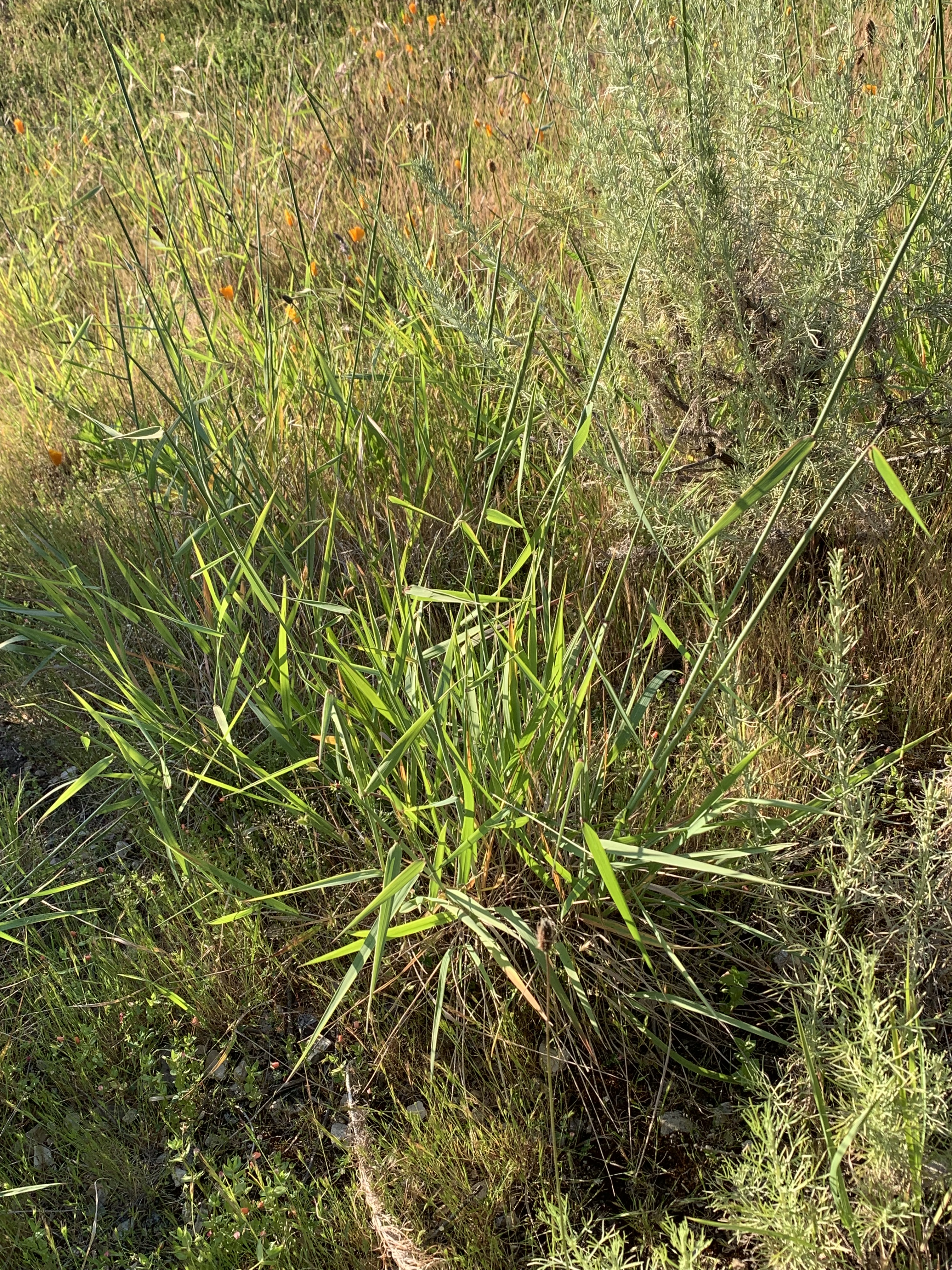
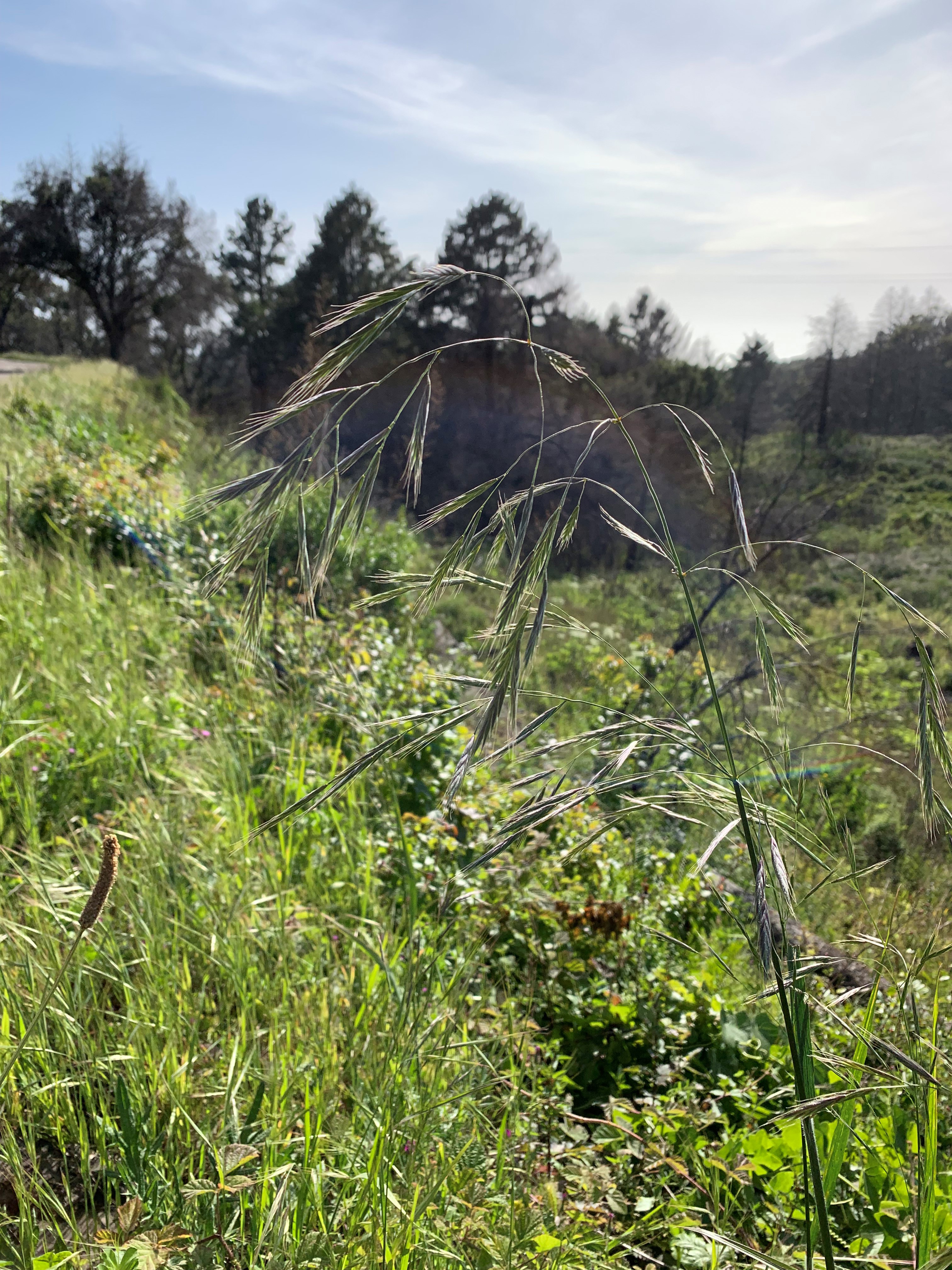
California brome grass, Bromus carinatus, a fine looking easy to establish native perennial grass
Other Uses
You probably know many interesting and useful grasses: lemon grass for Thai cooking and bamboo for stir frying new shoots and use of older shoots for plant stakes and buildings. A local woodland species, vanilla grass, has been grown in plantations for the flavoring of pipe tobacco. Many species have been woven into baskets. Broom corn, a type of millet, makes natural brooms and some midwestern towns were economically supported by this industry in the early 1900’s.
Then there is chicken scratch, cattle and horse pasture, silage for dairies, grains in the feedlots, and bales of hay in the barn: the many ways that grasses feed livestock.
Evil Grasses
Not all grasses are welcomed by livestock. Interestingly, a terribly invasive toxic perennial grass is being sold for seeding horse pastures: tall fescue. This grass easily gets infected by a fungus that is mutagenic and causes horses to miscarry! And, people seed pastures with rye grass despite its tendency to mold and cause something called ‘the staggers’ with poisoned livestock wandering around like they are drunk, losing weight and seeming quite sick.
Besides some species poisoning horses and cattle, other grasses have been bad problems. Some suggest that the collapse of the Mayan civilization was due to the invasion of their agricultural systems by uncontrollable weedy grasses (and drought). Modern agriculture is also plagued by grassy weeds. Some were enthusiastic about using herbicides for grass weeds and even genetically engineering the crops to be resistant to herbicides. Very soon, strains of Italian ryegrass became resistant to herbicides and the presence of that species on farms vastly devalued the resale value of the land.
Achoo!
Italian ryegrass has more notoriety: it is the most allergen filled plant known to humankind. The species proliferates with the nitrogen raining down from air pollution, and so lines highways and takes over meadows around the Bay Area. When it blossoms, everyone gets sick- even people who don’t know they have grass allergies report sore throats and coughing for the 2 weeks of its peak bloom. So, invasive non-native grasses are a health hazard – and grassland restoration and management is important for human health.
Invasion
Walk in a California grassland and 80% of what you step on is non-native, mostly invasive grasses. Each year, new invasive species show up in the grasslands introduced accidently through global trade or purposefully through the nursery or turf grass industries. Once naturalized, new species evolve to become better fit and can be even more invasive.
Moseying Grasses
Did you know that bunchgrasses move around? Many of our native perennial grasses are called bunchgrasses because they grow in clumps, without runners. And yet, the stems of each clump might die on one side and new ones might sprout on the other side, so the grass clump can move around. Long term studies have monitored meters of movement in bunchgrasses over decades.
Soil Carbon and Perennial Grasses
There has been a lot of bogus hand-waving about the differences between native perennial grasses vs. non-native annual grasses. I have been hearing a lot recently that native perennial grasses have much more extensive, deep, carbon-storing root systems in contrast to exotic annual grasses. These distinctions miss the troubling invasion of non-native perennial grasses into our coastal prairies…some of those species are more robust than native perennials. Also, native perennial grasses come in many sizes with many different morphologies- some are teeny tiny (Blasedale’s bent grass, an endangered grass of Santa Cruz’ North Coast), others are very medium sized (meadow barley). I would wager that an annual exotic oat grass on rich soil would have a larger root system and sequester more carbon than the native perennial meadow barley growing alongside it.
This hand waving seems to me to be unnecessary jingoism for soil carbon sequestration via restoration of a very few species of big, burly native bunchgrasses. This is dangerous because our prairies are so much more rich than those few species of large, common native perennial grasses. Planting/stewarding just a few native grasses will cost us a wealth of other species diversity and potentially the resilience of the prairie ecosystem as a whole.
-this article originally appeared in Bruce Bratton’s BrattonOnline.com blog.
Tuesday, most of the day, it was sunny but noticeably cooler. There was a breeze and then it started getting colder after noon. It was 1pm and I glanced towards the ocean and was surprised to see thick fog down there. Another look at 3:30 pm- clear at the beach but a deck of clouds suddenly obscured the whole sky. It smelled like rain, but the rain didn’t start for hours. Sometime in the early dark hours of Wednesday morning, I awoke thinking a coyote was lapping water in the birdbath, but it was the pitter patter of rain dripping from my roof into the rainwater catch buckets. It’s been raining on and off all day, raindrops vying to be the teeniest of them all: a small raindrop contest! Mist was so thick it stuck to everything on all sides, wafting in from all directions. Then some bigger drops pelt down for a bit, then misty drippiness returns, again. Everything sparkles with droplets under a silver-gray sky.
This “first significant” rain started a month earlier than the past two years, when the first real rain was at Thanksgiving…following uncomfortable lengthy hot spells. What a welcome difference! Tomorrow, we’ll have petrichor, the smell of the freshly wetted soil, which takes a bit to emerge.
Thus far, Molino Creek Farm might have had a little over a half inch of rain, judging from the rain buckets and the amount of soil wetting. Our soil is ancient- more than 300,000 years old. It is hydrophobic once dry, so wetting it takes some time…droplets scoot down soil pores or sit on the soil surface or reluctantly soak in. Once the soil starts accepting water, it takes 1” of rain to saturate 1 foot of soil. If we get the expected 4” of rain between now and Sunday, the soil will be gushy four feet down!
Ten Pound Mud Boots
As one neighbor remarked, farmers must now reluctantly stop working, though there is much to do. If we steal off to try to harvest something…and there is much to harvest…we’ll end up with “ten pound mud boots.” Farm field mud is so sticky that each step adds more globs onto your shoes, making huge hunks of mess: you are quickly 4 inches taller walking on mud platforms that stick out 3” in every direction. Lifting your feet makes your pant legs muddy, very muddy.
Boots that weigh ten pounds are good if you want to exercise without moving far, but practically speaking, they are an absolute and unarguable hinderance to vegetable harvesting. We must wait for things to dry, and that’s going to be a while. “Luckily” the show goes on…we rushed and harvested enough prior to the rain to go to market, so off to market we go. Boxes and boxes of late season delicious tomatoes, glowing piles of beautiful winter squash, piles of shiny red ripe peppers will soon grace our sales tables.
Two Dog Farm’s Beautiful and Even More Tasty Red Kuri Squah
The rain has put a stopwatch to the end of the tomato season. The wetness means melt down. Already, a wave of russet mites seriously damaged the Molino Creek Farm plants. Patches of plants started turning a characteristic russetty-brown that you can see half a mile away…the patches spread quickly in all directions, vibrant deep green healthy plants folding over to this vicious pest. And now, the rain. Thousands of tomatoes remain on the plants…
Molino Creek Farm’s Dry Farmed Tomatoes…nearly end of the season
Ravens Back to Normal…and other birds
With the advent of the rainy season, Maw and Caw are back to their normal selves. Everyday inspections of the farm reveal just these two Farm Ravens without their rowdy children or their rowdy children’s proud new mates. Once this past week there were three other ravens, Maw and Caw talking loudly to them, spinning up to meet them high above the farm. Do our two friends feel they must chase away their kids to protect their territory, now? Are the playful windy days of spring the only days they feel comfortable to reunion with their more extended families? Oh, to know the dynamics of Raven Society. I love these two, they are such good friends, and I’m so happy to see them each and every time (especially when they are hopping up and down with their characteristic wing flicks).
We have a kestrel back on the farm and a (single!) sapsucker returned. The kestrel seems to be scooping up Jerusalem crickets these days, sometimes with a few accidental grass stalks. Its plumage is particularly vibrant and so seems very healthy. Why do we only ever get one individual kestrel…and only once did another show for just one week…?? Speaking of pairs, there is, once again, only one sapsucker. So, this second widow(er?) will linger how many winters in this territory before we get another year or so with none and then a pair shows again- that seems to be our story. This got me to thinking that sapsuckers might not have that large of populations…how well are they doing?
At dusk…gliding, prowling, and perching…great horned owls: easy to see around the farm right now.
No Till Orchard Crops
Back to the mud boots…are lack thereof. As we do not till our orchards, we can walk in those, still, to harvest and to harvest some more. We are 1,000 pounds into our expected 4,000 pound harvest. Almost all we have been harvesting has been Gala apples- the old trees our forebearers planted in 1998. They were laden with the most beautiful glowing red fruit, now all boxed up or as fermenting juice for next year’s cider.
You, yes YOU can get these incredibly sweet, crunchy, and beautiful Gala apples at the Food Bin, right on the main drag…Mission Street (and Laurel) in Santa Cruz. Support us Community Orchardists and go buy a bag of these gems. An apple a day….does what? (and have you done it?)
Next up…Fuji apples. In fact, we are sending Fuji, Mutsu, Gala, and Golden Delicious apples with Judy to the Palo Alto market this Saturday. So, if you are over that way…more diversity, more deliciousness. Plus, this is the run up to the last tomatoes of the season- we might not be at markets after another 3 weeks (or sooner for the mud boots).
For internal use only, us Community Orchardists are sharing the prized quince fruits. The legendary addition to apple sauce…the quince jam…the quince juice…the smell and beauty of this novel and ancient fruit. The test this year: do we need to plant more, or is 4 bush/trees enough for our needs? Already, people are suggesting we plant more, but they sit at the markets, unmoving.







 Grey Hayes