Santa Cruz Greenbelt

Well Managed Parks?

Some people I know are saying how ‘well managed’ our public open spaces are around the Monterey Bay. Let’s examine how one might come to such a conclusion and, at the same time, consider carefully parks managers’ roles in protecting wildlife for future generations.

Logical Fallacies

The simple, unsubstantiated statement that most of the Monterey Bay region’s public parks are ‘well managed’ is rife with logical fallacies. The people saying this are hoping that their statement will resonate because they are perceived as authorities about environmental matters. They are taking advantage of a ‘bandwagon’ building on a very publicly vocal minority of parks users who are also repeating the statement for their own purposes. Members of this bandwagon really enjoy some aspect of public parks and are suggesting that because their expectations have been met, everything else the parks managers are doing is being done well, too. They may be relying on black-or-white rationale where a park is either managed well or not, and they’d rather land on the ‘managed well’ side of that dichotomy. Building on that assertion, they purport any level of critique of parks management as personal attacks on parks managers. In the ensuing discussion, they are incredulous that anyone would suggest something isn’t right with parks management. They point out that all the credible public figures regularly praise our parks. When further pressed, the person claiming local parks are ‘well managed’ says ‘prove me wrong!’ … ‘where is there any proof that local parks are being mismanaged?’ they ask. After providing several examples of failures, the next thing I hear is “well I meant ‘generally well-managed,’ not that they can’t do better.’ If the conversation continues, the ambiguity gets wider and deeper. Why do these people continue to utter this statement?

Motives

Sunny dayists, popularity by praise, narcissism, greed, business marketing…all of these alone or combined are good explanations for the motivation of the people claiming parks are ‘well managed.’ Have you ever met someone who is always leaning into the positives around them? I had the great fortune of spending lots of time with one of those types of people. Our situation allowed us to eat at many of the region’s restaurants. When we first went out to eat, I was pleased that they expressed such praise for the food, the service, the atmosphere…everything! After a long while, I noticed that their praise was the same no matter where we ate out. I tested the hypothesis, leading us to one of the worst restaurants in the region: same level of praise! I bet you know someone like this; imagine them saying that parks are so, very ‘well managed.’ Do you believe them? On the other hand, isn’t it just easier and more fun to praise parks managers? When you are part of this bandwagon, such praise makes you popular.

Or, maybe you don’t care about that bandwagon. Maybe you get exactly what you want at local parks and so share the innocent but narcissistic reflection, ‘parks are well managed!’ A perhaps more malevolent explanation is that those declaring ‘parks are well managed’ actually do understand that parks are NOT well managed but they are getting what they want and so they greedily fight any threats to what’s working for them. For instance, perhaps those sharing the ‘well managed parks’ assertion are daredevil acrobat drone pilots who raise kids and drink beers with the parks managers families…might those be the sort of people who would declare ‘parks are well managed!”  There’s one more type that comes to mind: the businessperson. You can probably imagine the marketing lingo of any shrewd businessperson in the fields of nature education, outdoor recreation, tourism, conservation, public administration, or politics. Their statements are carefully crafted to build their personal brand, make more money, have more power. In that context, ‘parks are well managed,’ becomes what in politics is known as a “tribal statement.” One says ‘parks are well managed’ with a nod to one’s colleagues who are most likely to provide some positive business outcome. For instance, parks managers might provide support for nonprofits in the nature education space. Hearing that you are part of the bandwagon, perhaps an outdoor equipment maker will donate some gear to your organization. When a politician is reminded that you share their black-or-white jingoes, they might be especially helpful in supporting initiatives that move you towards business success. I know business-oriented conservationists who regularly say things they know aren’t true such as ‘this park is so very well managed!’ in the mistaken idea that such lies will improve their rapport and make them more powerful.

Bandwagon Patrol

Beware the bandwagon and beware the logical fallacies that accompany unsubstantiated generalities about things you know little about. Perhaps we could all benefit from changing vague generalities/assertions to more detailed personal reflections: ‘When I last visited Nisene Marks, I was pleased not to encounter any hikers.’ instead of ‘Nisene Marks is well managed.’ Let’s get more specific in general about things that affect the environment. Instead of ‘parks are well managed,’ maybe one could say ‘if Henry Cowell had a management plan, it would be easier to judge how well it is being managed.’ We can only fairly judge how well a park is being managed within the context of its management.

Context

If Natural Bridges park’s main objective was maximizing beach access, how are they doing at managing for that? Seems like we should know some details about the context of management at individual parks to better understand how well they are being managed. If Cotoni Coast Dairies’ main objective was managing for nature conservation, how would we know how well the managers are doing? We’d need access to supporting data and summary reports, of course!

Principles of Good Land Management

I suggest a framework of good land management principles. First, for land management to be judged at all, there must be a management plan that informs what happens on the ground. The plan needs to rely on the scientific method and an adaptive management framework, include citations for supporting peer-reviewed publications, and have recommendations for monitoring and managing for the ecological and social carrying capacity of the land. Next, managers should regularly be working to adapt management and the management plan using analyses informed by high quality data. Managers who are doing good work will be transparent with their decision making and focus on actively engaging with and including the public in all aspects of land management. Land managers doing good work will be able to prove how they are maintaining all species while providing access designed to maximize public benefit.

-this essay originally published in Bruce Bratton’s illuminating BrattonOnline.com weekly blog. Why not subscribe (and donate!) now?

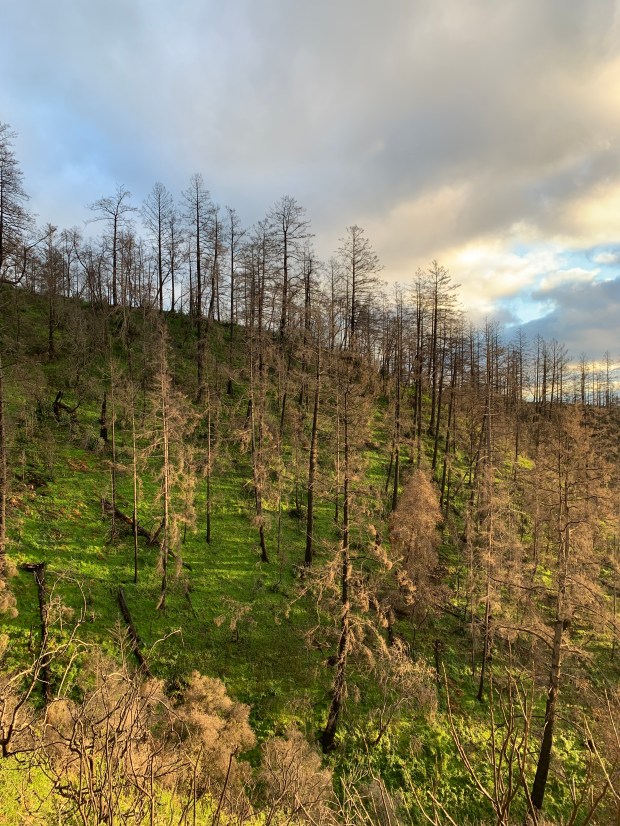
Post Fire Early Winter Mixed Conifer Forest

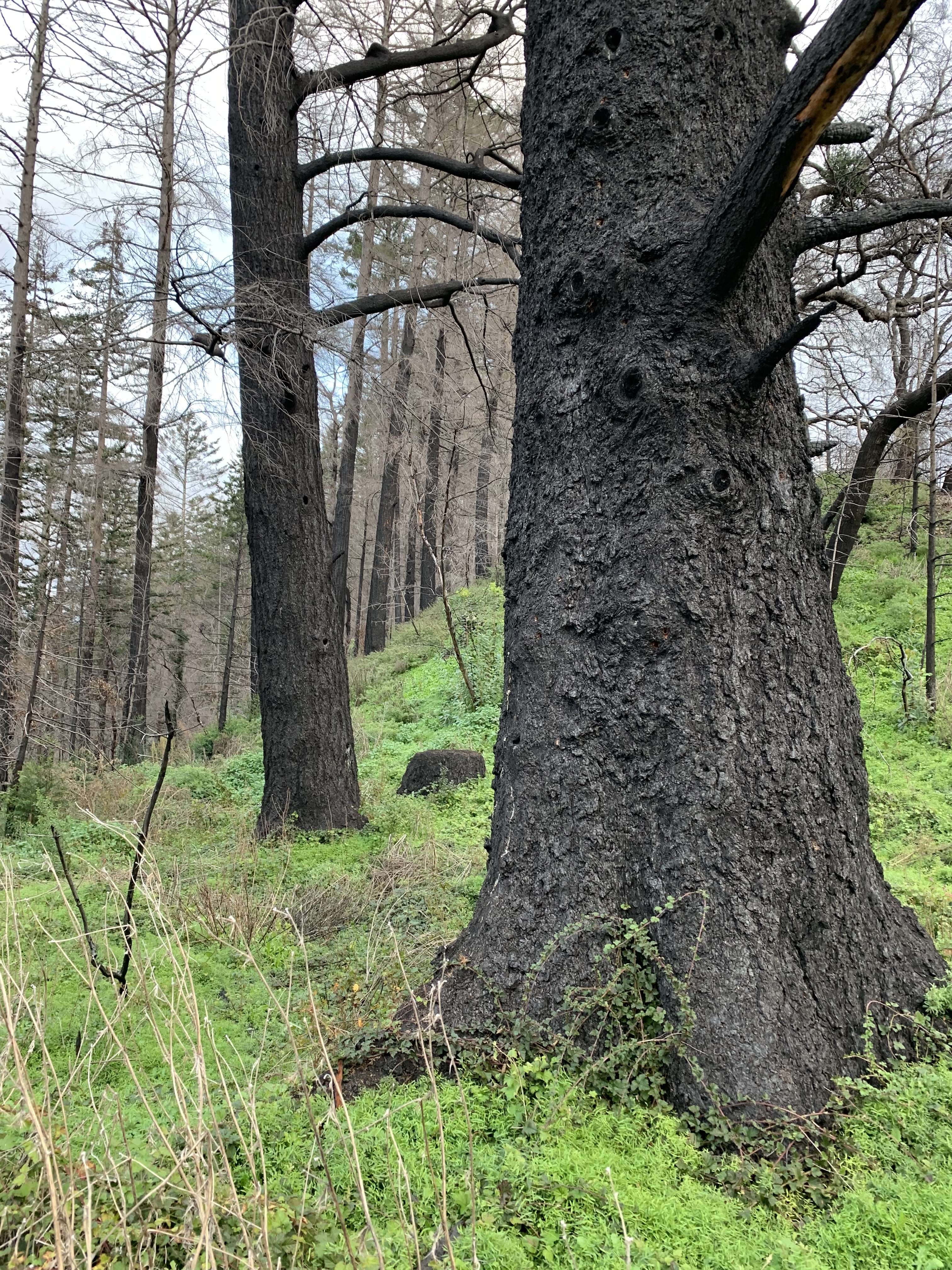
The widespread mixed conifer forest in the hills of Santa Cruz County’s North Coast is drippy wet now, even between storms. Seventeen months ago, the CZU Lightning Complex Fire devoured tens of thousands of acres of mixed conifer forest just north of Santa Cruz. Now, there are thousands and thousands of stark blackened standing dead trees. There are also living and resprouting trees. The dead and the living conifers tower over a wet, glistening, vibrantly green, and lush understory. It is slippery and hikeable now, but as the trees fall and the brush grows up it will become impossible to explore until the next fire…a decade away.

The lush post fire understory of a mixed conifer forest. Above Davenport, CA December 2021

What is Mixed Conifer Forest?

Mixed conifer forest is our most common forest type. While it is true that we have patches of redwood-dominated forest and patches of Douglas fir-dominated forest, many areas have a mix of the two. At the larger scale, peering out of an airplane at 10,000 feet, all of the local forested landscape includes a mix of conifers – redwood, Douglas fir, knobcone pine, ponderosa pine, Monterey pine, and Santa Cruz cypress. Where Douglas fir and coast redwood co-dominate, this type of mixed conifer forest hosts a mix of plants and animals that are distinct to this habitat type. Low light levels from a high, dense canopy and a preponderance of difficult to digest resinous needles are important factors determining what else can live in this habitat type.

Flaming Bark

The mixed conifer forests burned unevenly in August of 2020. Douglas fir trees take a little coaxing, but coast redwood trees take real convincing, to burn. There are many more fire-killed Douglas firs than redwoods. During the last two fires, I watched both redwood and Douglas fir trees catch on fire. Fire seemed to race up Douglas fir trunks, spewing sparks and crackling away whereas redwood trunk flames were slower to move up the tree and was less sparky and noisy.

Unlike redwood, Douglas fir trunks are covered with sticky sap that ignites easily. I heard a story about a teenager that thought it would be fun use a lighter to light some sap on fire on the side of a tree and very shortly needed the help of the fire department to put out the flaming tree, which was threatening the family home.

Glowing Holes

For weeks after the initial fire storm, glowing spots throughout the forest decorated the night. Mostly, these were the smoldering stumps of trees that had died long before the fire. In the mixed conifer forest, there were many dead or dying madrones and tan oaks that had been shaded out. These hardwood stumps made for some hot holes that burned for days. Some smaller Douglas fir trees had also died before the fire, but they burned up quicker.  There are now quite a few treacherous holes making forest hiking more interesting.

Solanum sp, Nemophila sp, Claytonia sp., and more…all covering the post fire forest floor

Understory Greens

The rains have germinated 3” deep shag carpets of lush herbs and hydrated huge patches of shorter bright mosses below blackened tree trunks. Miner’s lettuce, phacelias, and weedy forget-me-nots make the carpet. In patches, taller plants like hedge nettle, blackberry, nightshade and many other plants add to the hillsides of bright green. Many areas are already dotted with white, pink, or purple blossoms brought on by the winter rains and encouraged by warm bright days between storms. A lot more sunlight hits the forest floor now. Where there are patches of live trees, the understory is less thick. In some places, the fire left small hillside meadows, without any trees at all.

The forest soil is still black and slippery with soot and ash. During each of my recent forest hikes, I have slipped and would have tumbled a long way were it not for my grip on the very strong 4’ tall redwood basal sprouts. The soil, in the hotter burned places where the understory herb seeds were destroyed, is covered by strikingly bright mosses littered by needles and small branches blown from the few remaining live trees somewhere uphill or up wind.

Post Fire Wildlife

The burning of the mixed conifer forests means more food for more birds: redwood and Douglas fir forests normally have few seed producing plants, but that’s changed now. In mixed coniferous forest, deer have little to eat; now, the forest floor is covered with deer food. It is easy to see the birds and easy to find the deer tracks. Sharp deer hooves, forming new trails, cut through mosses and lush hillside wildflowers, exposing forest soil. The tracks crisscross the steep hills, patches of tasty miner’s lettuce chewed off. I’ve been seeing deer beds of very flattened understory plants, mostly on level spots along old logging roads. Expect healthy coats on momma deer, more big antlered bucks and spotted big eyed deer twins navigating the hills on dainty legs this spring. Mountain lions prefer dark forest to move around, but they’ll be enjoying more food while the forest canopy grows back.

Fire Makes Beaches and Bonfires

Mostly, the forest floor is healing, and little erosion has been happening. The exception is where humans created roads during the early logging days. To create roads on hills, people carved uphill and dumped the soil they removed downhill. This is called ‘cut and fill’ road engineering. Sometimes the fill side buried logs and stumps which burned under these old roads in the recent fire. Now, the uphill scar is unstable in many places, the fire having destroyed the stabilizing plants. Between burned out fill sides and steep, less vegetated cut sides…there is lots of erosion. Throughout the fire, you can find large and small scallops of hillside slumping onto the old roads or downhill from the roads towards the creeks. Besides being activated post-fire, this legacy of disturbance is most evident now that you can better see the soil surface across the hillsides.

With the couple large storms we had, streams have been carrying soil and logs. Local streams are flowing with mud, as evidenced by the ocean’s big brown plume up and down the coast right after the last storm. That mud will sort out and the sand part will become our beaches- bigger beaches after fires? We’ll see.

One local stream was more black then brown for a while- probably because of ash and soot. Streams are also carrying logs. Judging from the scouring of streamsides, streams have been blocked by post fire logs (ever encounter the term ‘logjam?’); those blockages eventually give way and are swept downstream with great force, battering and baring stream banks downstream and far up their banks. Those logs become driftwood on the fire-augmented sandy beaches. That driftwood will become the bonfires for rocking all night parties that the Coastal Commission has just sanctioned by mandating the creation of 24-hour parking lots from Santa Cruz to Davenport. So, part of the post wildfire wildlife effects will be the noisy, blazing, smoky disturbance of whatever shorebirds were counting on nocturnal refuge on those once peaceful beaches. The CZU mixed conifer forest flames will carry on for human and non-human animals alike, for better or for worse.