Meteorologists are echoing what we feel in our bones: the rainy season is over and we are onto another year of drought. The vibrant grassland greens are fading into echoes of verdancy, patches in huge fields of growing tawny gray. Cow tongues reach far, pulling at the remaining food previously protected along fencelines and hard to reach places. Poppies pop out and lupines poke up from the short stubble and rocky places. The springs and creeks still flow but will soon be slowing. The redwoods are in for another sorry year and are collectively crossing their needles for a bounty of fog should a warm summer ever arrive. The days are breezy and cool, the nights downright chilly.
Birds
During my short walk at dusk, I startled a big covey of quail- at least 50 whirring out of the cover crop and bumbling into the brush then taking off again and packing into the thick foliage of a fencline oak where they will bundle up for the night. Quail are ‘chi-ca-go’ -ing again but are wanting for drinking water.
A hawk wheeled overhead.
We missed the ‘chock’ -ing of hundreds of robins or the whistling wings of hundreds of mourning doves- both downhill progression patterns at dusk, but of previous seasons. Dusk tonight was less momentous.
Early Spring(like) Flowers
The cover crop is blooming a good bit early. We plant mustard as a quick growing cover crop that captures nutrients that would otherwise leave the system. Mustard plants produce compounds that clear the soil from pathogens. The flowers are bright yellow and support many early season pollinators, helping to spur their population growth in anticipation of the many crop flowers that will follow.
Radish is related to mustard, both being in the cabbage family. Radish is in full bloom in the fallow areas and hayfields; it is starting to seed. The onset of radish seeding is the trigger for the ‘first mow’ of the hay fields: mowing with the first radish seeds is the right time to keep songbirds from investing in nesting where we want to harvest mulch.
Radish flowers are open, and some have gone to seed
I originally published this post at my blog on Molino Creek Farm’s webpage.
You might recall the strain of conversation about Maw and Caw our resident ravens. I just want to say that they are So Cute! Well, a little more: they love each other and you can tell it- constantly fretting about one another and this time of year gazing at each other, playing follow the leader and other games. They are well enough fed to have lots of spare time and they fill it with fun. If you travel downhill and along the coast, you find Other Farm Ravens, and not in isolated pairs…big playful troupes of them, paired, yes, but 20, 30, or 50 strong groups – noisy tribes hopping up and down flushing grasshoppers or something just like our two but more. Somehow, they seem smaller, too. I hope someone one day helps us find where our two nest.
Other Farm Wildlife
We’ve got Western Bluebirds in fine spring regalia in and out of the nest boxes already setting up shop. I think I’ll not mention the cacophony of blackbirds much – only to say that they are still noisy and beautiful.
What we don’t have are foxes or coyotes or skunks or racoons. I heard that there is distemper spreading through the predator community nearby- can anyone confirm?
This year had the driest January and February on record in many places around us- San Francisco for instance. Maybe not here, but maybe so. Bob Brunie was digging a hole to plant a new tree and found the soil dry to two feet depth. That’s weird for this time of year- very weird.
Winter Farming
Bob was planting a new peach tree- number 7 in the group of one day 8 on Citrus Hill. If someone wants to donate a nectarine or two, we’ll plant those, too. Whatever we do, we must set up irrigation to start running Soon for the orchards.
It has become mowing and weeding time- 2 Dog Crew has been tidying up the Chardonnay grapes so now the vineyard looks so neat and tidy.
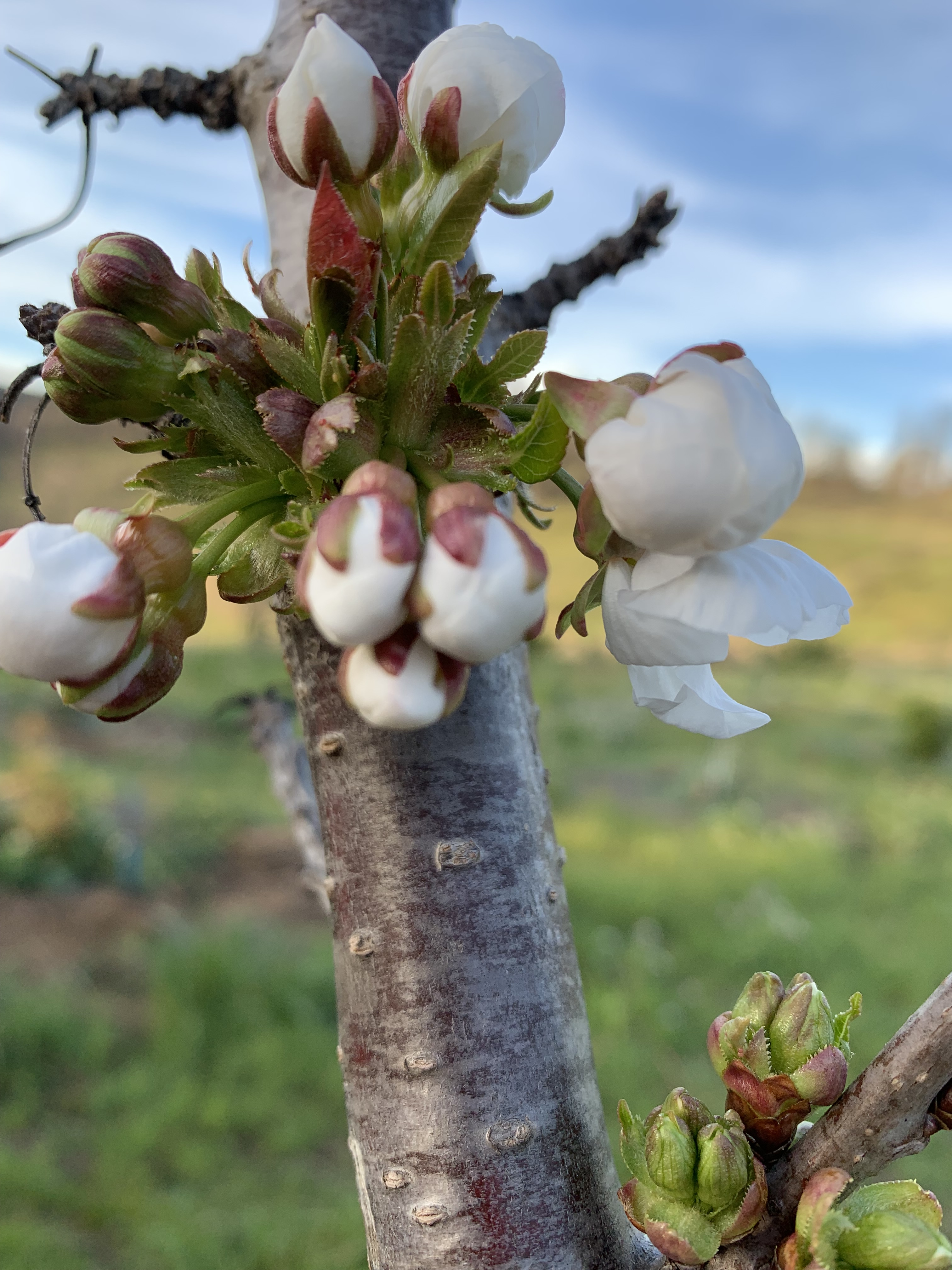
The first cherry blossoms are emerging on the few trees that the fire spared. Maybe we’ll get a bunch of cherries this year!
Lapins Cherries – Starting to Bloom!
Around the Edges: Wildflowers
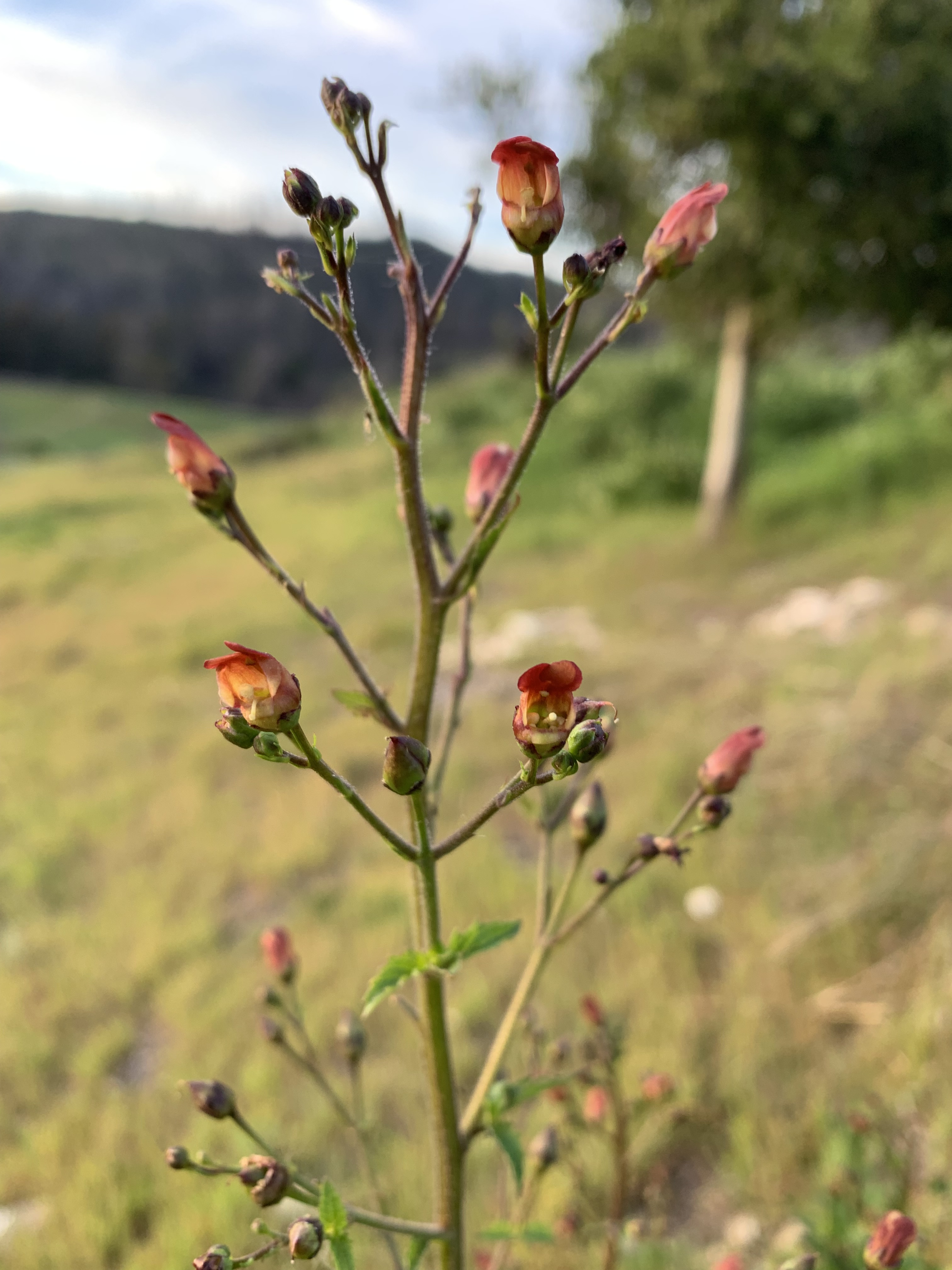
In the wild places of the Farm flowers are blossoming. A common plant is called bee plant, a Scrophularia with flowers some say are like Micky Mouse – a pair of upright petals are like Mickey’s ears. The flowers are carrion colored red-brown and attract meat “bees” – really wasps. But, honeybees and hummingbirds have figured out those flower cups are filled with nectar, so the plants get lots of visitors right now…meat bees haven’t come out yet. Wild radishes have sprays of light flowers like sea foam across the fallow fields. Across the steep hillsides near Molino Creek, trilliums and other native bulbs are starting to flower as the forest produces more and more spring flowers.
Beeplant- a nectar rich native perennial
this post from my regular blog at Molino Creek Farm’s website. I am a partner in that collectively owned farm in northern Santa Cruz County, California.
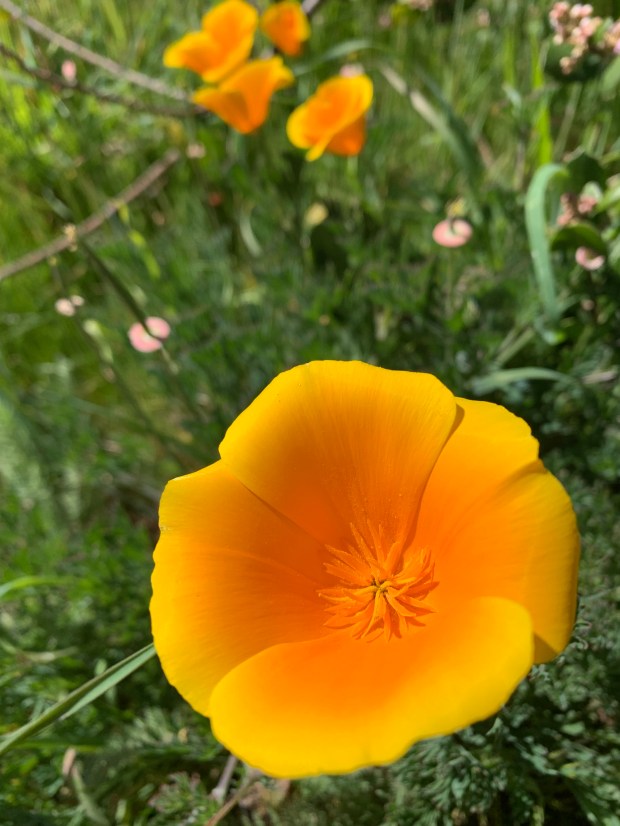
Right on time, the first tulip-sized California poppies have opened. Unusually, and a month early, the sky lupines have started blossoming, as well. The habitat areas, field margins, the hedgerow, and the orchard are starting to fill with Spring blooms. We hope for the return of rain before Spring’s beginning date arrives.
Lupinus nanus Sky Lupine Too early, but still nice
For a few nights, the air has carried a winter scent, like snow; frost decorates leaves in the grassy areas and wild radish leaves wilt from cold damage. We check the margins of avocado and citrus leaves to see if they are damaged. But, its only been evaporative frost- we still haven’t hit critical freezing temperatures! The cool temperatures are helping some fruit trees to sleep well, but others are waking up. The Santa Rosa plum popped into bloom – it only needs 250 accumulated hours of temperatures below 45 degrees Fahrenheit. Other stone fruit trees are budding and/or blooming in the orchard.
Juicy Santa Rosa Plums start with brilliant flowers
The semi-cacophony of blackbirds continues, and other birdy things are happening, too. The blackbirds mostly gather in one tree but as you look around, the party has outliers as bicolor blackbirds court one another away from the crowd. I watched for a while as one outlier male bicolor blackbird did his thing: the trilling scree song while bowing slightly, wings shrugged out, flashing his bright red wing patches. A few feet away, a female watched in rapture…it was just this pair alone at the top of an isolated tree, though they kept glancing towards their flock in the tree nearby. Buzzing by, not entirely oblivious to the blackbird antics…hummingbirds, up to their own shenanigans.
Somewhere, I heard that the blossoming of the flowering currants triggers estrous in hummingbirds. Allen’s hummingbirds returned with those blooms from somewhere Way South. I’m not sure how the year-round resident Anna’s hummingbirds like them. Bright flashing throats and aerial sparring is constant around our yards and up and down the hedgerow. Flowering currant isn’t common in the wild around here, though you can find other, less showy species in that genus in the forests surrounding the farm- the hummingbirds like those, too. With the early nesting of hummingbirds under way, it is time to closely inspect any brush we are clearing before chopping it down. There never seems to be enough time to cut out brush for fire safety, especially when being careful with nesting birds.
The farm fields are sleeping…the cover crops have slowed down with so little rain. The soil surface is dry, road traffic makes dust again. Limes are ripe, tangerines and oranges have color but no sugar, yet. Meyer lemons are hanging heavy and ready to go into lemonade or pie.
The Molino Creek Canyon has changed so much since the fire of August 2020. Big trees and many burn damaged redwood branches have crashed down across the hillside around our farm’s beautiful wintertime waterfall, which is flowing and noisy still. It is difficult to hike there, but we’ll open up the paths again soon with chainsaws and muscle. I’ve been exploring Molino creek, which was heavily scoured by the big rains in December. Now, it is so much easier to walk by the creek- no vegetation and a rocky sidewalk of a path alongside the clear running stream. There are potential dunking holes for the summer and wide rocky beaches. The large expanse of sandstone bedrock has accumulated a covering of redwood seeds. Last year, the redwoods made an Epic Cone Crop, with cones much larger than anyone had seen before. The branches were heavy with cones. For the last month, those seeds have released from the opening cones: dropping and scattering onto the ground. Now there is a red-brown scattering of the delicate seeds. In moist cracks, the seeds are germinating: a new crop of redwoods, just as their mother intended- a rare sight as redwood seedlings only ever get going on bare ground following a fire.
Heat waves and chilly nights, hills drying in what is becoming one of the driest February months on record…after an extremely wet December. After the orchard workparty last Saturday, we stood on a hillside overlooking the farm to be intermittently chilled to shiver and warmed as if by a nearby fire. There were alternating breeze directions ushering in big pillows of air with vastly different temperatures.
To our human senses, the world sometimes seems upside down and the same is true for non-human organisms. Living things share the same genetic structure, allowing us intergenerational memory and the potential for adaptation. Global weirding isn’t just about climate disruption, it is a symptom of human disfunction, feeding psychological malfunctions, creating disequilibrium, mayhem and chaos.
Fire’s lessons
Organic farms like ours rely on creativity. Instead of turning to the newest synthetic chemical pesticide, one of the many creative tricks we use is conventional breeding and plant selection to select stronger plants, taking advantage of the creativity of DNA. Our orchard is planting trees bred for disease resistance.
Once the plants are in the ground, we provide them everything they need for maximum health, creatively experimenting with new foods, including concoctions that feed the ecosystem that supports the crops.
As much as organic farmers creatively produce food, we live in evolving natural systems and we are challenged to constantly adapt. What can we learn from Nature?
One of many burn pile remnants – what would have fueled wildfire now fertilizes a mulch field
Lupines
The wildfire triggered germination of thousands of lupine bushes in the habitat areas we steward around our farm. Years ago, two of our members requested that we nurture these bush lupines, mowing and clearing around them. This was one instance of these partners’ contribution to the pool of collective creativity, nurturing beauty that turned out also to be post-fire habitat, pollinator support, and erosion control.
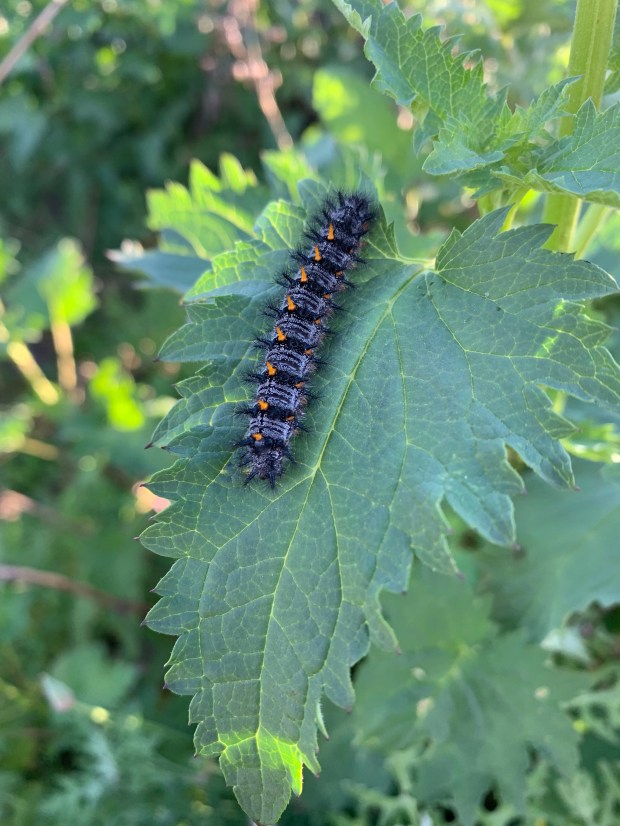
Just now, we are seeing an eruption of tussock moths that love to eat bush lupine leaves. The moth caterpillars will feed Western bluebirds and many other beautiful, feathered friends. The frass that the caterpillars drop will feed other wildflowers and native grasses, diversifying the hillsides.
Bush lupine became tussock moth fodder, opening up sun to a newly fertilized understory
Learning from Nature
From fire to lupines, from lupines to pests, and then from pests to birds and fertilizer…these are a few of Nature’s cycles. What might we learn from these cycles? Because farmers must be keen observers of nature, we tap into this type of ancient wisdom. As co-owners of a beautiful property, our collective is also learning the creativity necessary for evolving and adapting as a group. Cooperatives and organic farms are amazing experimental grounds for solutions to the root causes of the climate crisis.
To tap into the deep potential for creativity embedded in the DNA we inherited from millennia of experimentation, we must turn away from potential-destroying toxins. We must embrace stewarding diversity in the face of the tempting and ‘easier’ monocrop, lest tussock moth-like sieges take place. And, when the pests do erupt, instead of hiding behind toxins, we must invest in deeper contemplation and more complex negotiations, as evolution has long taught us. Until recently, we were taught evolution meant survival of the fittest, but now we understand that cooperative relationships are the key to success. Mutualism. Symbiosis. We have so much to learn.
-originally posted on Molino Creek Farm’s web page as part of my regular blog at that site.
Let’s hope for a repeat of the last couple of years where March and even April have brought us additional important rain. The shallow soils are drying out on the grasslands nearby, but the creeks are still running.
Since last we posted this news blog, back in November, there have been deluges and droughts, cold and heat…Molino is a land of extremes! December was unbelievably wet with heavy storms intermingled with endless mists and drizzles. January came and someone turned off the tap, then no rain expected in February, normally our wettest month. It was 75F today and the sun felt very hot. But, in total this winter, we’ve had lots of cold nights…we’ve burned more firewood to keep warm than in recent memory.
Calling Critters
The most noticeable wildlife is the mixed flock of blackbirds. If you were hard of hearing, you might think it was our ancient bulldozer squeaking and rattling across the hills. Better hearing can make out the seemingly multidimensional mélange of starlings, brewer’s blackbirds, and bicolored blackbirds singing together. Mostly the song is brewer’s blackbirds, but the others are in there, too. 80 birds exchanging, at their own tempo without any evident coordination, low-to-high crescendo-Ing whistles combining to near dizzying cacophony. If you walk by, the song shockingly and suddenly stops and up goes the flock in a vibrating dark cloud. The bicolor blackbirds land again in downward arks like windblown leaves. Then, a few brewer’s blackbirds make clicks, like drumsticks on the edge of a snare drum…but not keeping any pace or rhythm: Chek…chek……check…chek chek…chek….then one, then ten, then suddenly all 80 birds erupt in their whistling joy once again. The whole farm reverberates with this chorus, which is particularly loud this winter.
The other wildlife calls are much more subtle. In the last 2 months, I’ve heard a single fox yawl and a single female lion cry, but the coyotes are keeping quiet. Every night there is but one great horned owl hooting. The red shouldered hawk, a friend that still needs a name, hasn’t been scree-ing as much, but is still omnipresent as is a kestrel and recently a pair of red-tailed hawks. A single peregrine falcon comes by once or so a week to scream terrifyingly at the Molino prey.
Winter Crops
In this climate, we harvest all year round. Gleaning 2 Dog peppers was over in early January, but now we are starting to get a fair harvest of Persian limes with Meyer and ‘real’ lemons on their heels. Venturing out in the cover crop, there are pea shoots to forage. Kale has done well this winter in the home gardens.
Peas in the cover crop – a forager’s delight
Orchard Tending
Not much to do in the row crop fields, but the orchards have needed tending, especially recently. A few weeks back, Bob Brunie and I started up the backpack sprayer and sprayed most of the apple orchard with a mix of ground up kelp and fish along with living beneficial microbes to foster tree microbiomes for maximum health. Small groups and individuals have also been pruning, fertilizing, and assembling/burying water lines. The early winter planted cover crops germinated, but then have only been growing very slowly due to cold and lack of rain. The Robins have been enjoying late afternoon feasting on orchard cover crop vetch.
Cherry buds are swelling…like so many of the fruit trees in our orchards right now
The Storms
This story would not be complete without some notes about the storms of December. That month brought one rainy front after the next with a few days’ pause between storms, so that our solar arrays recharged batteries and the soggy grasses bent back upwards. Lake Molino resprouted and (glug glug) drowned the Bottomlands Field cover crop. For nearly three weeks we had that big pond, but no ducks showed up this time.
This massive rain and all of the fire damage must have sent some debris flow into action along Molino Creek. If you walk down there now, it’s a massively changed scene. Instead of lush Creekside vegetation, now there’s a twice-as-wide scoured rock bed with pummeled banks. Upstream, there is a series of small granite waterfalls into clear pools where once there was just mud, logs, and a few ferns.
The downpours, however, produced very little damage to the Farm. We had some rills on the road, which needed some maintenance anyways. The winds broke oaks apart along our fence lines, those damaged by the fire or some prior issue. In the hills around us on the more recent rainless windy days you can hear tree after tree cracking apart and falling with big bangs and low thuds. Zephyrs are taking down the burned trees and its not safe walking in the forest on blustery days.
The Coming Spring
The first orchard trees are about to bloom. Plums are breaking bud. Early peaches are unfurling leaves. Citrus blossoms are filling the air with sweet perfume. Avocado blossom clusters are unfurling. The fields and field margins are massing with weedy Calendula and oxalis color. And…it is just the beginning!
The biggest show will soon be poppies and then LUPINES. For whatever reason, this is a Huge Lupine Year. Bumble bees are going to be very, very happy and the returning swallows will be feasting on them before too long.
We hope you are enjoying these (too) wonderful days.
Whorls of lupine leaves form an understory to the flowering wild cucumber of Molino’s restored grasslands
– this is the last of my regular posts from the Molino Creek Farm blog for 2021, stay tuned for more regular posts February 2022.
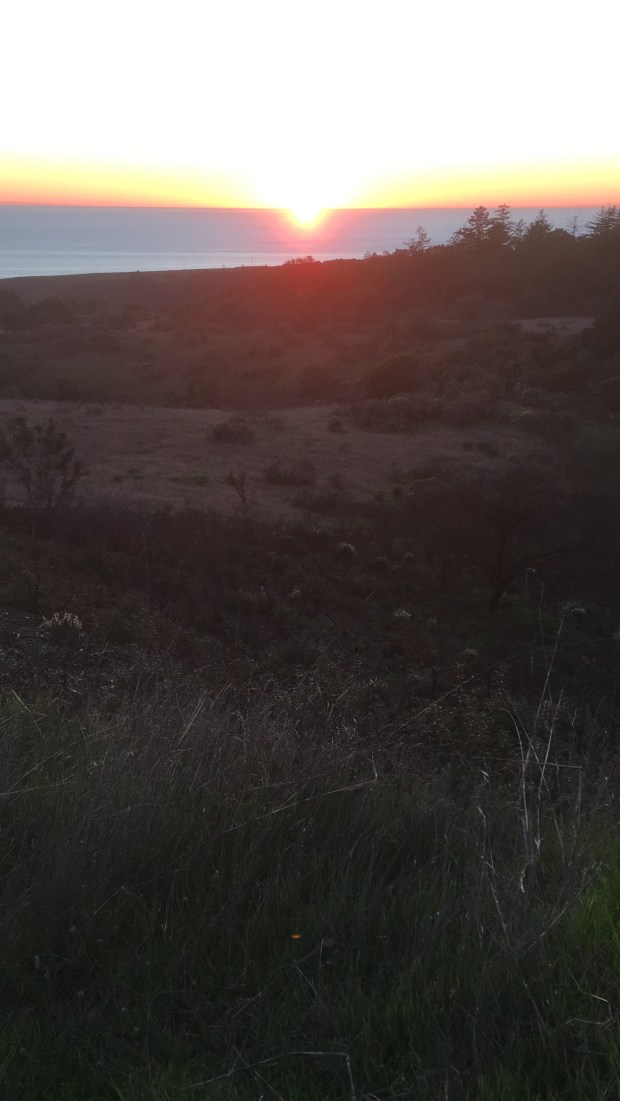
A recent sunset, captured just below Molino Creek Farm along Warrenella Road
For now, I put down my farm tools and stow them oiled and sharp, ready for next Spring. In the orchard, we coil hoses, hang irrigation pipes among the branches high off the ground so they don’t get buried and inadvertently mowed. We cut free and pile remaining tree props and haul and spread the last of the chipped oak branch mulch.
Apple leaves slowly fall, holding on long with fading yellow beauty. The last of fall’s leaves won’t drop until January, the fruit trees revel in the cool moisture after being blown by dry air during the long summer. But the fading light of shortening days push the orchard trees into their necessary and healthy sleep. Even we feel this pull.
Togetherness
The long cool still nights descend rapidly, driving us indoors early to stoke woodstoves and await the roaring warmth. We shed clothes and gaze at firelight, relaxing into the many-hour evenings. It is time to gather sometimes with family, sometimes with friends. Some find these gatherings especially precious from a year spent in solitude and self-reflection. Sparkling eyes greet us, loving words spoken close to our ears during long greeting hugs. Some are no longer with us or will soon be gone. We feel the losses more keenly during the gatherings, close to the warmth of others…spontaneous hushed moments we dare not fill.
Whence the Feasts?
Sighing, we raise from our chairs and head for the kitchen, for this is a season of feasts. The food is from farms. Somewhere in our minds, we hope at least some of our grocery purchases support family farms…maybe that farmer’s market trip helped keep family farming alive. Sometimes it does!
Some say we need to be thinking about new farming models, cooperatives combined with higher wages and increasing food costs, where broader support helps free farming families from the 80-hour weeks that’s required to pay the bills, to raise and support children. For cooperatives to work, we need to find a way to get along, to work together, and we also need for people to be willing to pay more for food. We desperately need more young farmers.
As we eat our food, as we chew, imagine the people it took, the many jobs and steps it took to bring that food to your mouth. Picture the water…the rich soil…the sun that helped produce your food and the tender hearts of (aging) farmers who smile proudly as they reflect on each stage of growing their crops. The newly tilled field, and the sowing. The seedlings planted…eventually the first flowers, then the tiny new fruit. There’s also the watering, the pest control, the nurturing propping and pruning, and, eventually, the harvest. Right livelihood. Good food. Favorite recipes. Big feasts.
In Between, Walks
Those who are able, take walks between meals, enjoying the squinty-bright sun and catching the remaining fall color. Poison oak leaves still dot the hillsides with red, and a few maple leaves remain yellow on the ground. Across much of the wildland, there are no flowers- except in the chaparral, where the manzanitas have just the past few days burst with clusters of bloom. Hummingbirds move upslope to the manzanita patches, or feed on landscape plants; they are also spending lots of time eating bugs. Step carefully on your forest walks…there are slow moving newts moving around!
Wild Brethren
Like us, nonhuman animals are also resting between feasts. This is the break they get between periods of raising the young. I heard the peeping of a young begging towhee, the only young bird sound for the last month. The wild farm birds are the most frightened I’ve ever seen them because we have two Norther Harriers patrolling every hour of each day. When that pair are farther away, out come hundreds of sparrows, juncos, and goldfinches furtively feeding on whatever they can peck. Then, alarm calls and swooshes, they dive into the bushes to avoid the bird-killing Harriers, one right after the other. Silence. Long silence, watchful eyes, and then tentative peeps and the brave ones creep from cover to feed once again, the more cautious ones eventually following.
Nonhumans Alike
Like us, these critters are gathering and holding together with friends and family, loving each other. All day, they watch out for one another…peeping, chipping and singing their language of safety, satisfaction or danger. They go to roost early, an hour before sunset, settling into the thick cover of oak or shrub canopies for these long winter nights. There, with the quietist whispers they tell their stories, sharing their experiences after they sidle up snuggly and cozy to keep each other warm. Like us, they remember the voices of those lost, the uniqueness of the personalities snuffed by fate, taken by the Harrier or by sickness, or by old age.
Last night, two sister quails fussed about not having quite enough space on the most comfortable branch near the top of the thick canopy of an incense cedar. They chucked and chucked, whirring their wings against one another and into the surround branches, trying to make more room before eventually scrunching in and settling down. Tonight, there is more space on that, the best of the high branches, and a bobcat is curled in deep sleep with a full belly…a pile of feathers will take a while to melt into the grass and decay. The remaining sister misses her warmth and her stories but now turns to another of her kin for such comfort…listening closely to the familiar tone and pace of their murmurs, sharing meandering feelings at the end of their day, until the last low chatter brings sleep to the covey and the silence of the night settles under the dark and twinkling sky.
– this another post from my regular weekly blog at Molino Creek Farm’s website.
A fleeting breath of the gentlest breeze brushes through the few remaining walnut leaves, so slight and brief as to barely rustle, plucking only one leaf to add to the fall. Then it is still again.
We inhale the moist air, walk on wet ground and change our clothes to the wavering between balmy and slightly chilly days. The air is thick with winter scent – the smell of fungus and fresh grass. The farm is becoming quieter with the shortening days and the winding down of harvest clamor. The still night silence is rarely broken and then mostly by startling echoes of owl hoots that soon abate – even the night birds are hushed.
The Muffling
The early, warm and ample rain sprouted millions of seeds, now a green blanket everywhere where just a month ago there was bare dirt or straggly dry dusty dead plants. This lush living cover muffles sounds like snowfall and allows my eyes to soften and relax, as I breathe easier for the cooler, cleaner air and the now distant fear of smoke and fire. We are all relaxing into the wet season, the down time.
The moon will soon be full- the bright nights might be adding to the stillness and quiet as critters hunker down in fear of being spotted by Great Horned Owl or Coyote. Great wings outstretched, the perched owls swoop in low arcs lit well by moonlight. Coyote is more frequently yapping and slinking around on the hunt.
The bright days have begun with fog here or below the farm. This late fall fog is not normal. Varied patterns of high clouds take turns with a clear cloudless sky. The sunsets have often been magnificent.
Chittering-chat
The cacophonous whistle, click and squeak of a sixty-strong (and growing!) mixed flock of blackbirds has grown into high entertainment. Like a mysterious whirlwind of blown leaves, the fluttering flock scatters 50 feet up and then settles again on the lush ground. They strut and chatter, shoulder-nudging one another or stab at things on the ground. Our attention is drawn to this great and complex social milieu – yellow eyed Brewer’s blackbirds and larger red-epauleted bi-colored blackbirds mixed and awaiting the arrival of some straggling very rare tri-colored blackbirds. The bustle moves across our farm fields; their departure returning the quiet and stillness as fast as their arrival had quickened our breath.
One of Molino Creek Farm’s many majestic black walnut trees
Yellowing Leaves
The 2-year-old vineyard is also showing that muted yellow fall color as the leaves slowly drop. There might be a few dozen apples left on the trees with leaves also quickly changing yellow. The orchard cover crop we sowed 2 weeks ago is two inches high, vetch unfurling tendrilly leaves, the oats poking up single thin-rolled leaves. The morning dewdrops hang on the tips of these sprouts well into the day.
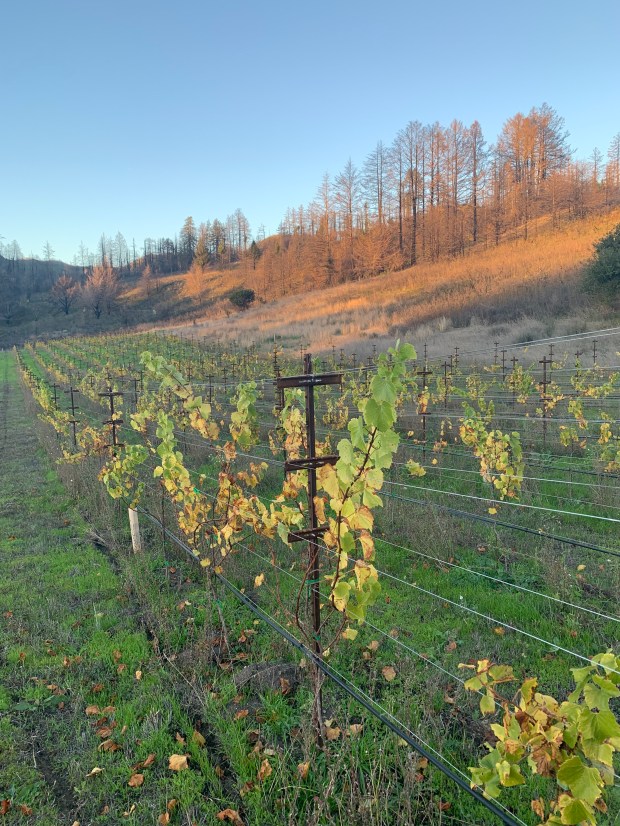
Chardonnay Vines: a second Fall for 2 Dog Farm’s Vineyard
Winter Fruits
One of the Farm’s greatest ironies…just when the cropping seems done – the citrus ripens! Our 6 Persian lime trees are hanging heavy with large green fruit, the spikey Lisbon lemon trees also are bearing. The navel oranges are further behind and less fruitful this year. The tangerines are far behind but growing quickly as are the Meyer lemon trees. Citrus Hill is filling in with the 20 trees we planted 4 years ago joining some larger, older plantings by Chuck and others.
Another of my regular posts for Molino Creek Farm’s website
She stood in the middle of a field still strewn with winter squash, yipping her higher and higher trilling song, snout pointed upwards, sweeping her head to throw her voice across the hills and ridges. She stopped, listening and peering around before starting again, facing other directions. The echoing coyote song might have been another one calling back, and it seemed she wondered, too. But these were just echoes and there was no return call. No one came to join her. She kept singing her piercing high yowls and, in the long pauses between song, she mumbled widely spaced, low hoarse growling barks. This went on for 20 minutes and then suddenly stopped. Then she paced wearily across the farm fields, pausing to glance this way and that across the ground for sign of some small mammal that might be dinner. After a long while, with the failing evening light, I turned away briefly. Looking back, she was gone.
Adan told Judy that he saw two coyotes. That was the first one I saw or heard for more than a month. They seem to be passing through but not daily lurking. Same with a big healthy looking male bobcat: it slowly walks through a field and then is gone, sometimes for many days.
Hungry
There is less prey for these predators than anytime in memory. There is little sign of voles. Gopher throws are there, but not very thick. I haven’t seen a brush bunny in months. There were only ever a couple squirrels- now none. I haven’t seen a new wood rat house assembled anywhere around the farm since the fire. So, coyote, fox, and bobcat must have to travel widely to get enough to eat right now. And the nights get colder, the ground suddenly constantly damp and chill.
Storm Consequences
Another storm swept in this past week. Winds rattled windows, threw foam from tall ocean waves, and took half of the leaves off of the walnut trees. Showers, sometimes heavy, pelted the North Coast, making puddles and rivulets in the fields and roads. The soil is wet enough to have woken up the earthworms: open holes surrounded by round globs of earthworm frass now dot the soil everywhere.
With the series of storms this early rainy season, the grassy areas have turned green and the creeks are running again. There is no still summer nighttime silence: now the farm is serenaded by the constant rush of waterfall splashing, accented by great horned owl hooting. Just one owl, though maybe it is answering one in the next drainage that I can’t well hear.
Harvest Fading
Orchard harvesting is winding down. We have been selling 200 pounds a week of perfect apples, which means a harvest of 800 pounds to sort through with apples also going to cider and the Pacific School lunch program. We get a month of that kind of production this year, even though the Fire had damaged the trees. We are lucky to have the volume of fruit we are getting- the proceeds will pay for compost and coddling moth control, maybe a soil test, maybe some other supplies. Next year will be much bigger…from this year’s 5000 pounds to 8000 pounds and we’ll be asking once again- what do we do with all the apples? And the reply will come: More Cider! There are 70 gallons bubbling away in either Bob Brunie’s or Jacob Pollock’s ciderlairs.
In years past, we would be picking olives right about now. But, Sheri’s not on the farm anymore; no one organizes a pick this year. The fruits are few and small, anway. But the trees are still beautiful and this silvery patch is home to many birds.
Still people comb the tomato rows, the plants mere skeletons but festooned with fruit. The sunflowers have passed, as have most of the cut flowers. String beans, zucchini, cucumbers, and peppers- all fading and melting with the chill nights and soaking rains. The farm pace is plummeting, the season winding down. To thwart any ambition, the ground threatens to eat tires. Long weed-scalped tire tracks tell of spinning tires and nearly stuck trucks. Ambition to drive threatens hours of unstucking. We pulled a tractor with a pickup and a pickup with a pickup, at least, so far. Any wetter, and wheels will get so buried that vehicles will stay until drier times: the bulldozer is dead and the ultimate solution is no longer available.
Thanksgiving normally marks the end of the farming season and the beginning of a much-needed break. The days are getting shorter, and we turned back our clocks this past week. There very nearly is no time at all past our desk job’s quitting hour and the last sunlight, so afterwork chores must be hurried. Anyway, there won’t be any harvest worth harvesting in a couple more weeks. There will be a month until we turn to citrus harvest. It will be nice to rest.
The meadows are turning GREEN: electric, eye straining, shiny, bright grassy green. It smells fresh and alive again. The sky seems a deeper sparkling blue and the stars shinier: it’s like the rain cleaned everything.
I’ve heard it said (with derision?) ‘back east’ – “California’s where Fall means the leaves drop and the grass turns green.” (Ironically, this is sometimes said by the same people that claim we don’t have seasons at all)
In the forest, yellowish fall colors, the scrublands dotted with brilliant red. Maples and hazelnuts are at their brightest fall pale yellow. Nestled into the mostly evergreen bushes of coastal scrub, poison oak glows brilliant crimson, leaves sometimes swirled with subtle purple or blushed with melon orange.
The honeybees have been getting hungrier as the last of the coyote bush flowers fade. A lone Australian import in my landscape, a white bell-shaped flowering Correa shrub, is now nearly being carried off by honeybees. I have never seen a single plant of any kind so buzzy.
Native wild strawberry, naturally established in our orchard understory…a rose by any other name (in a rose family orchard!)
Bonfire Time
It is bonfire time. Directly after the rain soaked the land, regulators lifted the ‘burn ban.’ With increasingly unpredictable rainfall patterns, we know better than to wait. Even after running a chipper on many piles earlier in the summer, we have around 10 tons of brush remaining to burn.
Beautiful, guilty pleasures, bonfires. With the heating of the planet, we are torn about this torching of biomass. In the few years leading up to this wildfire, I told everyone I knew that there was no feasible way of composting wood around here. Any branch over an inch diameter, I said, is just waiting to fuel the next wildfire. What does one do with the trimmings, fallen branches and trees, in that case? In the ten-year interval we expect between wildfires, we would quickly fill all of our open space with brush piles…and then they would burn anyways (as they did in the last fire). If we place branches in the forest, the forest trees will burn hotter and be more likely to die. And so, we burn piles when it is safe to do so. That means burning every time a storm is blowing in. Two piles down….20 more to go…At least we can enjoy the warmth and cheer: friends join in…bonfires by request! (selfishly, this helps us tend the fires)
Non Human Farm Mammals
The mammals love the rain-fueled regreening, too. Last night, I heard the first caterwauling of a cougar in a long time. It was yelling from near the intersection of Molino Creek Farm Road and Warrenella Road. Her sounds freak many people out as they are somewhat similar to a screaming human. The lion in the area making those noises would explain the reason our neighborhood dog, Fiona has had a few long barking sprees recently! What a terrifying sound…what a brave guard dog! Ruff! Ruff! The fierce barking echoes off the surrounding ridge lines.
Some may recall my mention of the relationship between skunks and ground wasps, aka yellow jackets, aka vespid wasps. I have seen it so many years…the first rain and the skunks dig up the wasp nests. What an amazing and guaranteed service. After this last rain, where there were once dangerous zones of sure firey stings, now there are holes, soil thrown up with scattered torn up papery honeycombs, a few upset wasps still trying to make sense of their broken homes. Somewhere there’s a skunk with a very full belly (and lots of skin welts).
Scary (and curious) Birds
One recent dusk, I was dreamily soaking in the beauty of the fading colors and the wet scents of the newly moistened landscape when the oddest sound startled me. The noise was sudden and like the horror movie sound of a hundred attack raptors – coming right at me! I almost ducked, but then realized that it was a hundred mourning doves flying as low and fast as they could, over and all around me. Their wings make a sharp swooping air-cutting noise as they come towards you with only the slightest dove wing whistle after they pass. This pattern has been repeating every evening at dusk- mourning doves jetting at tree (shrub) level downhill across the whole farm to roost somewhere at lower elevation. The conservation of elevational clines, from high to low elevation, on the western slope of Ben Lomond Mountain may be important for undocumented and mysterious reasons…We saw robins doing the same thing (though less speedily) at winter solstice a couple years ago.
Our resident ravens started an unusual bout of extreme danger warning calls, and I left my desk to go outside to ask ‘what up?!’ Whoosh- right by my door-exiting body: a norther harrier. This big acrobatic predator hunted all day long Monday, all over the farm. Late afternoon and the ravens were hoarse from alarm calls and making sad and exhausted crows; I thought maybe they lost a friend, or maybe were crying in despair that this dangerous foe would set up shop more regularly around the farm. They were probably hungry for the day of hiding.
Then, right after the raven dirge…a screaming peregrine falcon lit up the soundscape! What a drag to be on the receiving side of bird-on-bird predators! Eternal vigilance…
A more genteel bird observed…late afternoon and I hear a persistent raspy squeaky bewick’s wren call. It is most persistent, too persistent. And then I saw it, on top of a columnar cactus under my house eaves- looking up at the 3-year-old wasp nest that it had used the last two winters as a winter roost, with a mate. That wren was squeaking and flicking its wings, twitching its tail upwards, and making quite a show, over and over glancing up at the wasp nest…for 15 minutes. What was on its mind??
Harvest Season
Giant Mutsu Apples, Just Getting Ripe
Our Two Dog and Molino Creek Farm crews are still at it: lots to harvest, still! Tomatoes are still holding out, a little. Winter squash still colors the ground. Peppers hang thickly. The flowers are fading…
In the orchard, the apples are mid harvest: this is late! The Gala apples are a distant memory, and we are halfway into the Fuji harvest. We are also picking Mutsu, Braeburn, Jonagold, and Golden Delicious. Those personally passing through the orchard can eat many other varieties…Arkansas Black, Esopus Spitzenberg, and many more.
We are going to have to be quite measured and tactical to sow the cover crop seed in the apple orchard- leaving harvesting rows to last but getting seed in wherever we can- and soon!
Besides the colorful and varied crop of rain-drenched, juicy, delicious apples…the orchard is giving us the longest most colorful fall. A long while ago already the prunes started changing flaming red and orange colors, now the aprium and other stone fruits are rapidly progressing into similarly spectacular colors. Some apple branches are giving it up to their signature yellow leaves. If the past is any indication, this slow fall will continue way into January until we have bare trees. The Wassail seems to happen right as they enter their leafless dormancy.
The Landscape Color Deepened a Few Hues: rain soaked Molino Creek Farm, freshened and dust free
Roaring wind and driving rain sent everyone to shelter in their homes Sunday and Monday. The tips of thousands of tree branches now blanket the ground with fresh green mulch. More than five inches of rain wet the soil many feet down- it all soaked into the thirsty soil. But, water rushed down dirt roads moving dirt and gravel, flowing with eroding rivulets, dumping mud into ditches, carving through storm flung debris.
Everything is soaked – mosses and lichens hydrated and springing to life with winter’s fluffy dripping lushness. In the meadow patches around the farm, perennial poppies push up fresh blue-green ferny foliage. Storksbill germinates first with millions of tiny grass seedling spikes shortly behind. The first broad and bumpy primary leaflets of lupines flush from bare brown gopher thrown soil piles. Bunchgrasses push out a half inch of new green blades from the otherwise dry brown leaves from last spring’s growth. In the forest, thick oak leaf mulch is being quickly, hungrily devoured by furiously unfurling mushroom spawn. A month from now, with a bit more rain, we’ll have chanterelles.
Basket Weaver Wisdom
The weekend also delivered us ancient knowledge. Julia Parker and her family graced the farm with a workshop on the traditional basket weaving of the indigenous peoples of central California. Julia has long been demonstrating and teaching basket making in Yosemite Valley. 15 folks learned from 4 generations of her family with people gathered for a campout then retreating indoors when the rain started coming down. We made new friends and are already looking forward to Julia’s family returning when they can. Perhaps we will tend basketry plants as part of our production…a while back we had a troop coppicing willows for just such a purpose.
Apples and Such
The gala apples are gone (except for the precious remaining ones you might buy at the Food Bin!), now its onto Fujis. Sweet, crunchy Fuji apples with rainbow colors- traditional seasonal salad apples to sweeten the arugula greens. The tomatoes are melting fast from the rains- so, we’re all out there raking them up for the last of the seasons processing- they are still going to market, but you better get them fast! Our Persian limes are swelling and dark green, a good harvest promised for January. Drake’s avocado grafts are taking off with rapid growth, giving us Great Hope in recovering our burnt avocado orchard.
Drake Bialecki Made it Happen: avocado grafts on root sprouts from burned up trees
Wildlife, Including Nut-Eating Corvids
Farm ravens Maw and Caw forage widely across the farm, scavenging farm crops. Their rounds include swoops down the driveways and entry road to see who might have run over a black walnut. These they quickly pounce upon, vigorously pecking at the solidly ensconced nutmeat, so sweet and oily. Sometimes they find a half walnut and retreat to a fence post to work at prying out food.
As hoped, the deer herd has devoured all the wormy castoff apples. In doing so, they have pounded bare the invasive Cape Ivy where we dumped the fruit: weed control while disposing of pests – no wasted fruit there! Mostly, we see deer prints, not the deer themselves, who are mainly hiding somewhere.
The turkeys have also disappeared- not even any prints, anymore.
Bob Brunie has something against chipmunks. Also, his new farm chicken flock complained loudly about the storm. (Yes, we have no squirrels)









 Grey Hayes