Molino Creek Farm

Fall Schlogg

from my blog for Molino Creek Farm…

“How’s it going?” I ask my neighbors. The answer, ‘busy,’ is common. Everyone, especially since last year’s fire says just that. But this past week people answered ‘busy’ with a more heavy seriousness. For emphasis, one person shook their tense and invisibly full upward turned hands – exasperatingly exhaling ‘BUSY!’

With that answer, there are smiles. And humor. But our eyes are lined and worn. People move more slowly, a little more bent. Farmers are midway through the peak harvest, 6 weeks to go. Sharon our midwife neighbor just managed an unusually intense spate of births. Mark and Bob, furniture makers, are stretched with work. In two days, Ian will hit the second of the year’s tax deadlines. Family matters, health recovery, fire rebuilds, community business, job tasks…so much going on! And, household chores never go away: chopping, splitting, stacking, and covering the heating wood piles is a urgent priority. We all heat with wood and want warm winters.

Apple Toting Time

Orchardists are toting apples. 800 pounds picked and processed so far this season. We haul heavy shoulder-slung picking bags up the steep orchard hill. We climb carefully down tall ladders, lopsidedly laden and awkward. We roll apples from bags into sorting bins with a familiar, distinct soft percussive sound. Skilled hand-eye expertise helps dartingly sorting apples by size and condition. Only perfect apples for market. Small apples gifted to children. Blemished apples to ‘sweat’ in boxes for cider pressing.

Starting last year, Davenport neighbors and core community orchardists Mike and Charity have been taking our apples to schoolchildren. Emelia Miguel uses these and other donations, orchestrating nutritious delicious meals for the Pacific School in Davenport. Providing electric Tesla transport and endless labor, Mike and Charity have thus far this year gifted over 150 pounds (more coming!) of community orchard produced apples. Emelia’s crew cooked oodles of applesauce and packed pounds of “lunchbox” sized beautiful peak flavored Gala apples for the young down the hill in our greater community.

Putting Food Up

Industrious orchardists recently preserved a boat load of quinces, liberated from a wind- broken limb. Now there’s quince jam! Blemished apples are processed into dehydraters (schnitz!). Jacob, Eva, and John Brunie toiled last Friday to make a cider pressing…120 pounds of fruit to juice, including a bunch that turned out light yellow from quince…used to spice up the otherwise non-complex Gala juice in hard cider. I dried 30 pounds of seckel pears- after days of tending. Dried tomatoes, canned tomatoes, too!  Most recently we’re picking walnuts, keeping them tumble turned in open baskets for drying. Also, I collected the first small bowl of a mixed variety of hazelnuts, all shed this last week from bushes onto the ground; there will be many more next year as the bushes are getting big.

Squawking with Beak Full

While tending trees, I was attracted to a California scrub jay making the oddest squawk. Jays are known vocal tricksters, mimicking other birds, especially hawks. This vocalization was nasal and muted, but otherwise a normal alarm call. I searched about and finally spotted it: bobbing proudly up and down with each call from the top of an apple tree. Its beak was full of acorn! Like all those jays, once spotted with their catch, it ducked away. If they see you watching them bury their acorn, they dig it up and move it where you can’t see, always nervous about any others stealing their cache.

Other Birds

Our winter-only bird flocks continue to settle in. Thirty meadowlarks flush along our entrance road, down by the coast, if we startle them driving by. Sixty or so tricolor blackbirds are also flocking among the grazing cows down there. The nasal “squee” of the sapsucker is now common up here in our orchard- it is opening up rows of pecked ‘wells’ in the tree bark, again. The tally of band tailed pigeons: 14 in the farm flock. Hundreds of golden crowned sparrows and goldfinches still abound. Jen was delighted to encounter part of our flock of western bluebirds in her yard recently.

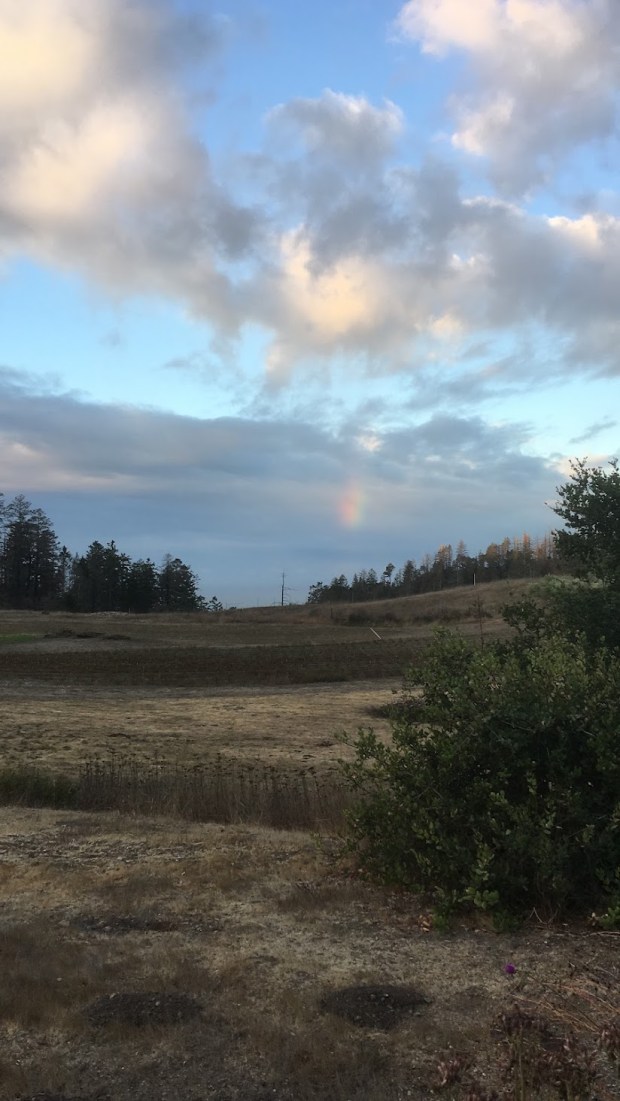
Morning Rainbow, offshore rain

Offshore Rain, North Wind and Sickle Moon

Rain skipped us again this past week, it is so very dry. Many people remarked about the offshore rainbows first thing one morning. That day it smelled like rain and looked like rain, but it didn’t rain. Then it blew, blew, and blew. For more than a day, wind shook our homes. Harvesting apples high int eh trees on ladders was difficult. We watched more soil blow away, our roads swept clean of any loose material. The walnut trees to show early yellow fall color were blown to bare branches. Overseeing the squalls and wind, low in the sky, a beautiful golden sickle-shaped moon was surrounded by bright fields of silver stars. The evenings darken early and the winter wet season looms.
Sweater Weather

The fall see-sawing between heat wave and chilliness continues, a pattern we’ve become used to through even the more typically hotter summer. This past week, the farm warmed for a few days into the mid-80s – unusually warm for us – with nights down to the high sixties. During the days, the lush carpet of white flowering clover in the orchard understory folded its leaflets, hiding out until cooler times and the apples rapidly brightened towards ripeness. Cricket song vibrated through the comfy nights. Then, yesterday, high thin clouds blew in, barely obscuring the sun and the temperature dropped – the arrival of fall “sweater weather.” Banter turned to expectations of rain. “I saw the tarantulas come out” I heard someone remark on a visit to San Luis Obispo – people believe this to be a sign of upcoming rain. A Bonny Doon person remarked that ants were moving inside…yet another sign that rain was imminent. No rain around here, though…but, it did rain in northern California a few days ago and there was a good downpour in LA recently. We’re stuck in the dry middle of the state with confused invertebrates feeling the weather fronts that don’t quite get here.

So, for the farm, dust season continues. The natural world looks drier and drier. Our last rain was months ago. Even in the areas that burned in the summer of 2020, the ground is covered by regrowth. Brown, dry thistle heads rattle across the hillsides in afternoon breezes. Resprouting coyotebrush presents deep green patches in the understory of the thistles – it reached a foot or so high this summer and will recover a closed canopy across many hillsides next year. The dust comes from the humans – it blows from our roads and fields in great arcs coating surrounding vegetation…redistributing nutrients across the landscape. It is the same through the more extensive agricultural landscapes – trucks running down dirt roads in the wide Salinas Valley create huge plumes of dust that carry for miles. “There goes our soil!” I’ve tried covering some of our farm roads with hay cut adjacent to the road, and road gets slick, hay quickly ground up by the many farm worker vehicles…maybe it helps? Soil is very, very slow to create and I fear wind and water erosion deepening the road ruts, making for bigger maintenance projects in the future.

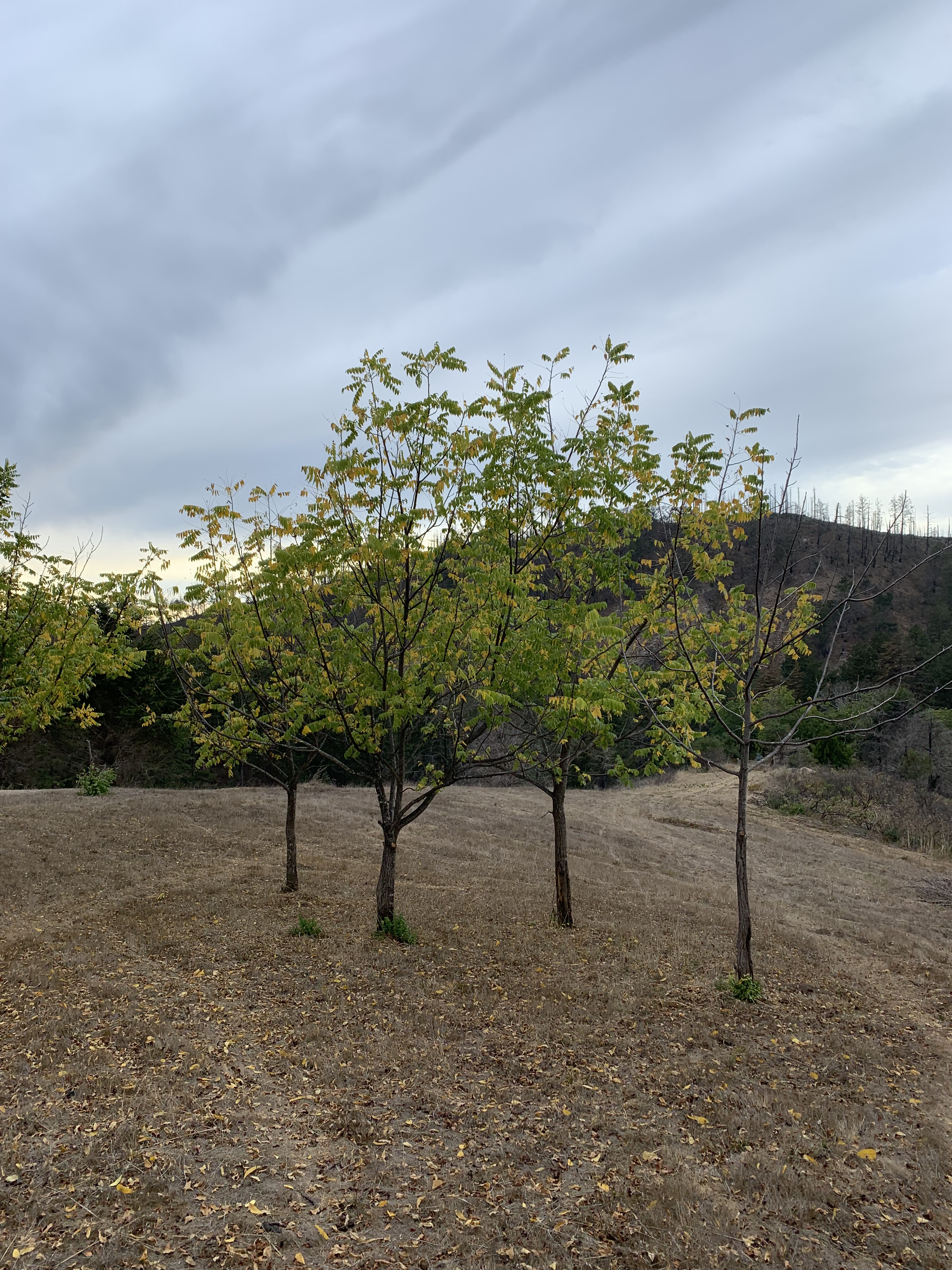
Black walnuts are plentiful on our farm, Joe Curry grew these seedlings from our mother tree

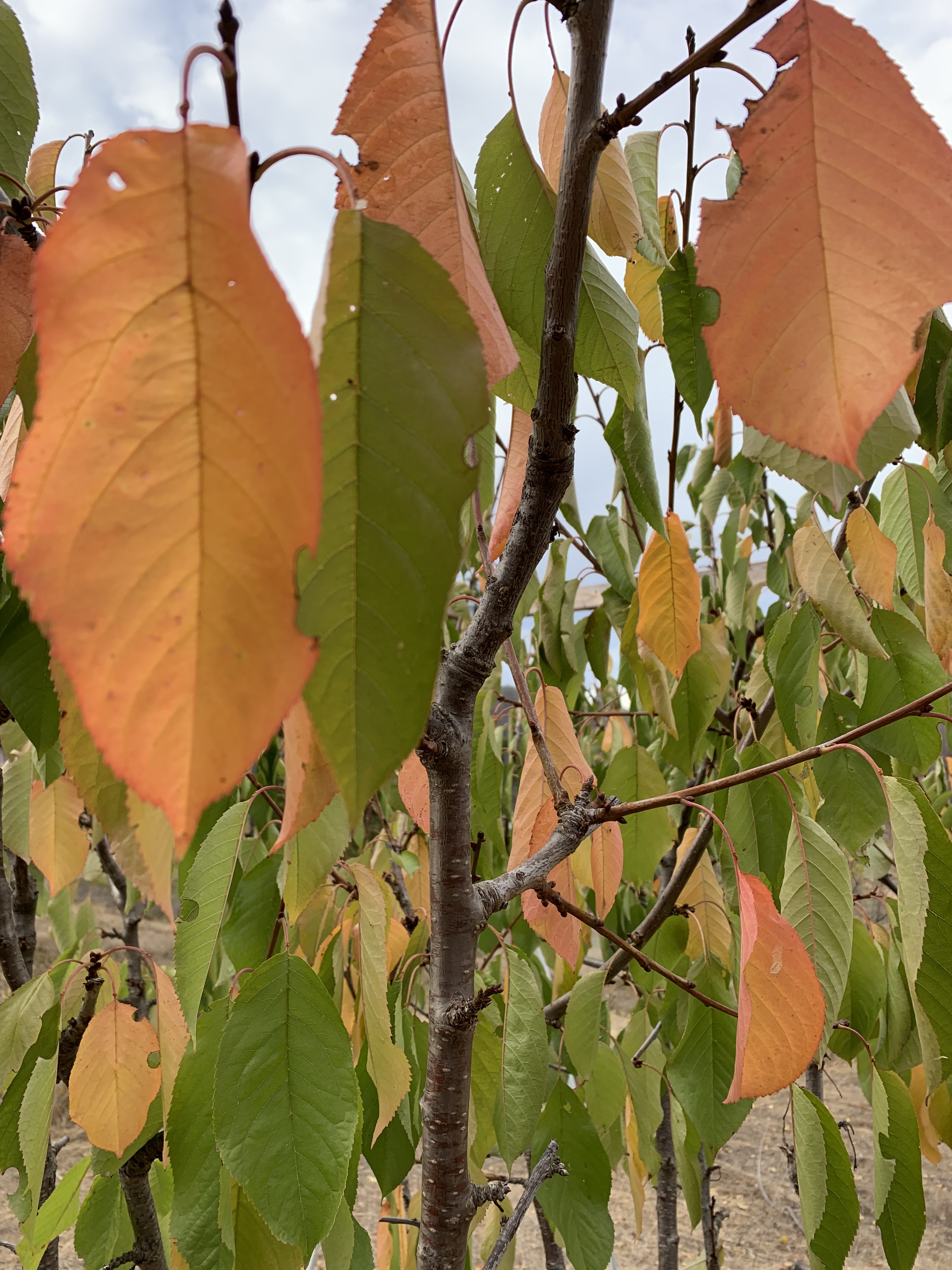
 Fall color progresses. The many black walnut trees that dot the farm have yellow leaves, falling. The orchard’s prune trees have yellow-orange leaves starting to turn and the cherry leaves are changing to a distinct orange-red. Across the nearby slopes, poison oak has been turning crimson since August. In the moist canyons below the farm, big leaf maples are turning bright lemon yellow alongside similarly colored hazelnut bushes. During our cool spells, the crisp air smells like dry leaves and clean air from the North.

Lapins cherry trees, survived the fire, starting to drop colorful leaves

On one of my midday work-break irrigation hikes (turning off water, checking that the tanks were filling), I heard a frantic truck horn beeping. Luckily, it wasn’t the three long beeps that signal an outright emergency. Patterns of horn beeping can tell you a lot. It was evidently a less worrisome issue. Judy’s sky-blue Toyota pickup – her commute vehicle – eventually caught up with me. “The foxes are eating the cat food!” she exclaimed.

My farm neighbors have mixed reports about foxes. Some revel in the frequent sightings; for instance, a few neighbors report (with delight!) an adolescent fox at all times of the night at the ‘hairpin’ turn on the road closest to the farm. Others complain…chicken killing, cat food eating, fruit (or sandwich) stealing…etc. I was opposed to the introduction of “barn” cats onto the farm, but one picks one’s battles. People were unwilling to tend traps enough to reduce ‘problem’ rodents in the barn and believed cats would take care of the matter with less human effort. I cite the millions of songbirds needlessly slaughtered by domestic cats across the nation. Now, we have cat problems: how to feed the ‘feral’ cats without feeding the wildlife! The next bit of fun will be getting said cats to the vet for their routine vaccinations. Meanwhile, its foxes vs. cats – the ancient dog vs. cat battle continues on center stage at Molino Creek Farm. There are cat people…and there are dog people…and we’ve got both!

On the avian front, there are two bird songs making a crescendo: male quail calls and golden-crowned sparrows. After tentative quiet half-calls the past two weeks, this year’s new male quails are settling into more certain and loud ‘Chicago!’ calls…repeated all day long from whatever brush areas remain on the farm. They are filling out their puffy bodies, displaying elegant top knots from their heads, strutting and herding their coveys. These wild chickens have had a strong year of increasing their flock size with plenty of seeds to eat. Sprinkled across quail territory, the golden crowned sparrows are dense across the whole farm. It seems they landed just here on our farm two weeks ago as a staging area before moving farther south. Just 2 miles farther on (Back Ranch Road), they haven’t yet arrived. In prior years, it has taken them a month to arrive at the Elkhorn Slough, 25 miles south. Here, it took them a week after arrival (Sept 21) to start singing their characteristic winter song: “poor will-eee!” Now, this is the most constant bird song across the farm. If I had to guess, I’d say we have a thousand of these cute little friends. Another sign of coming winter: our tribe of Brewer’s black birds have returned. I’m saying ‘our tribe’ on suspicion…I don’t know for sure. But, for years they were shy around me and in Spring 2020 I spent some time hanging out with them…talking to them, answering their odd ‘click’ calls, and gradually getting closer and closer to their feeding flock. The flock that returned looks me in the eye and isn’t so quick to flush, so I think they still know me, so I posit this is the same flock.

A bit about the harvest. There are cases and cases of tomatoes ripening in the barn, tags on each stack noting the date of harvest. Two Dog Farm had a great big winter squash harvest, now curing in boxes awaiting sale. As I loaded two boxes of beautiful Gala apples into the van destined for the Santa Cruz farmer’s market, I spied many buckets of beautiful sunflowers. There are onions and peppers, and so much more coming out of the fields with very full tables at all of our markets – this is the season!

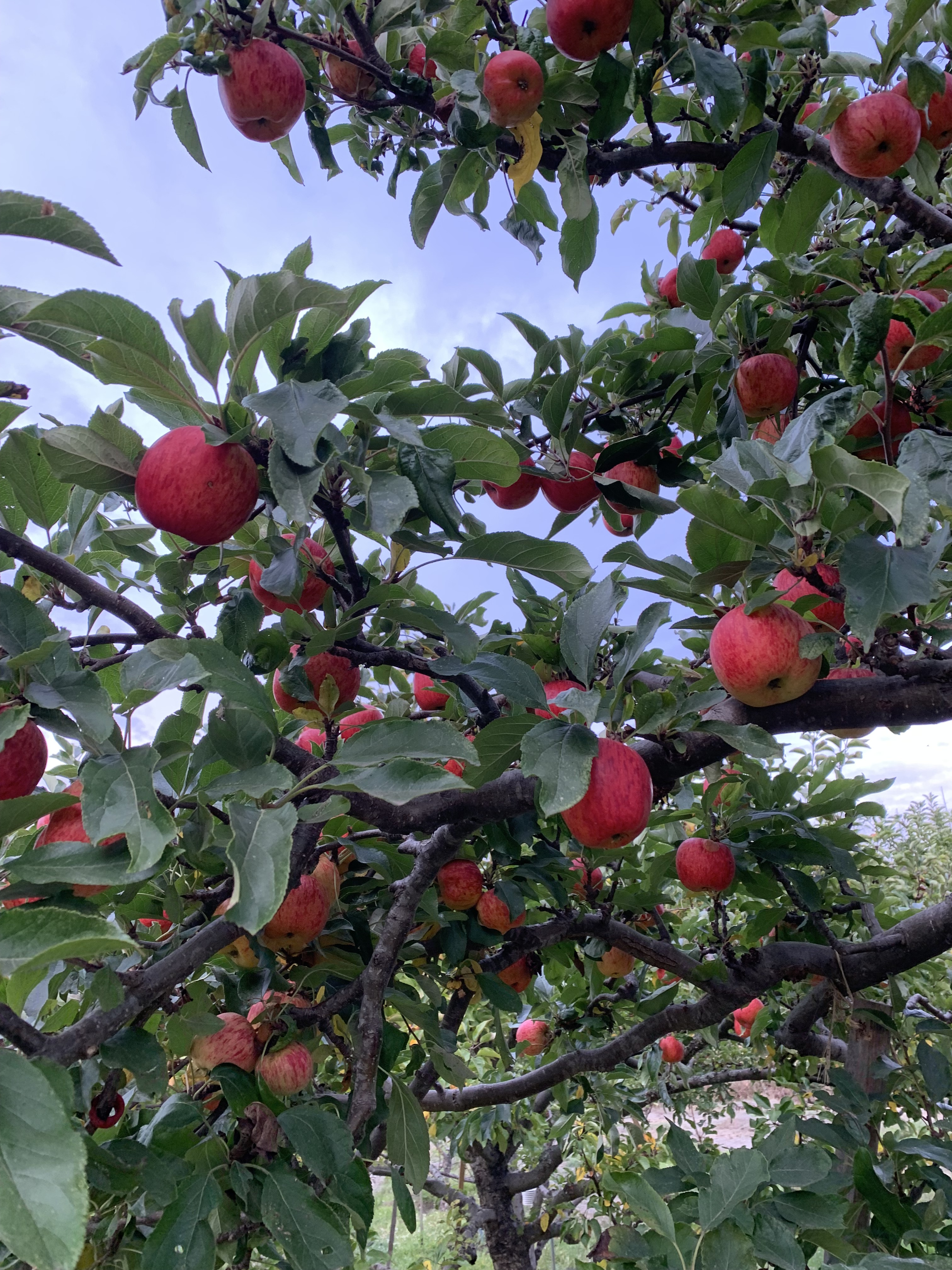
Apples! Ah yes…it is almost peak harvest time. The early apples, Galas, are at the height of their ripeness. We were debating the color of the flesh at last Saturday’s working bee: is the flesh a pure white…or is it creamy white…or….?? Please weigh in on this important debate. The skin of our Gala apples is red-streaked with a peachy yellow background with a bush of russeting. Our team also debated ripeness of other varieties. What appeared to be ripe with tasting suggests another week or so…we await Mutsu, Braeburn and Jonagold. Fuji apples are far behind. The slow ripening and benign weather is allowing us a great non-hectic prolonged harvest season. If you want a whole-case discount (~20lbs/25$) of almost perfect apples, let us know…we were eating schnitz for a year and suggest you consider making those – an excellent snack and easy to rehydrate for cooking.

Community Orchardists have well stewarded these gorgeous gala apples