BLM

Coast Dairies, 2064

I invite you to immerse yourself for a few moments into my dream of the future of Santa Cruz’ North Coast. How will Cotoni Coast Dairies fare in the future, for instance in 2064? During the past year, many things have aligned to allow my dream to be much closer to reality.

It was 2024 and Cotoni Coast Dairies’ new manager, Zacchary Ormsby was the first with the skill, knowledge and respect to manage the property according to the Bureau of Land Management’s (BLM’s) protocol for lands with National Monument and National Conservation Lands status. Zacchary was joined by a freshly hired California Coastal Monument manager, another conservation-oriented biologist, Leisyka Parrot. Congressman Jimmy Pannetta, a skilled veteran of addressing impacts in over-loved and under-stewarded wildlands of Big Sur, has been newly elected to represent Cotoni Coast Dairies’ geography. Jimmy is dedicated to helping address North Coast tourist visitation issues with his important federal government leverage. And Justin Cummings with his doctorate in multi-disciplinary environmental problem solving was newly both the County Supervisor AND the Coastal Commissioner overseeing the park. Meanwhile, many very smart coalitions were poised to work together to assure that Cotoni Coast Dairies is a park for all, well stewarded for wildlife, forever. What a hopeful moment that was!

Looking Forward

It is 2064, the 50th anniversary of Cotoni Coast Dairies becoming public land, and there are national celebrations of this unexpectedly exemplary project. The New York Times has a full color Sunday edition article featuring the park’s success. Cotoni Coast Dairies has become a global destination for accessible, multi-cultural nature tourism. Hundreds of thousands of visitors have enjoyed immersive educational experiences that are the gold standard being copies at other parks around the world. Programs at the park have changed lives of thousands of underrepresented schoolchildren from throughout the Bay Area. Tourists of many nationalities flock to Santa Cruz with this destination in mind. The park’s managers have worked closely with scientists and conservationists, succeeding in restoring the property’s teeming wildlife populations. Visitation is so well managed that many different experiences are available, no matter what ethnicity or language and no matter the financial means. Using cutting edge technology, parks administrators provide the vast array of experiences that visitors report wanting and have developed software to continuously adapt available park experiences accordingly. BLM has received recognition for their sound management through strong public as well as private funding and through the added capacity of dedicated partner organizations and volunteers.

Badgers, Burrowing Owls, and Tule Elk, Oh My!

Early on, BLM partnered with local scientists, State and Federal wildlife agencies, and conservation groups with what turned out to be highly successful reintroduction programs for American badger, western burrowing owl, beaver, and tule elk. Volunteers working with conservation groups adapted prior regional wildlife connectivity successes to create Western North America’s first badger preserve by reintroducing ground squirrels, installing drift fences to underpasses along roads to reduce badger fatalities, and creating landscape-scale habitat corridors, and badger populations recovered. Because badgers prefer sandy soils for denning, Cotoni Coast Dairies managers designed large recreation-free buffers around the best denning sites; at first, those buffers were insufficient, but monitoring refined buffer design, and the badgers responded positively with their first young born in 2040. The badger and ground squirrel burrows created habitat that made it possible to later reintroduce burrowing owls which have established several breeding colonies in the huge swaths of restored coastal prairies. These wildlife species have become an important focus for visitation.

Restored Coastal Prairie

Besides reintroduction of these keystone grassland wildlife species, BLM managers embarked on two other processes that turned out to be critical to the restoration of some of California’s last remaining coastal prairies. First, the entire property, including its prairies, became actively cared for by the descendants of the indigenous people who have tended the landscape for thousands of years. The importance of indigenous stewardship was an insight from the outset, including in the name of the property beginning with the tribal name of the first inhabitants, ‘Cotoni.’ In the process of recognizing and revitalizing their culture, native people have directed hundreds of programs attracting thousands of volunteers, school children, and others to collaborate in the large-scale restoration of the land. They reintroduced fire management and tended wildflowers and grasses, carefully relearning the best ways to nurture them to health. The native peoples have revived their internationally renowned basketry, tending plants throughout the park for materials.

At the same time, BLM managers have used cutting-edge, science-based livestock grazing management to restore coastal prairie health. They have collaborated with many other coastal prairie managers, from Humboldt to Santa Barbara, to manage cattle alongside tule elk herds, moving the animals through a matrix of patches of grasslands managed with prescribed fire and reseeding. The prairies draw visitors each spring to view stunning spring wildflower displays unrivaled in the region.

Vibrant Lagoons and Beaches

The 2050s were a decade of sea level rise adaptation made possible by the strong North Coast public lands managers partnership facilitated for decades by Santa Cruz City Parks. The first beach and Highway 1 realignment to be redesigned was at Scott Creek Beach, back in the 2030’s. Then, there were successes in restoring Lidell Creek/Bonny Doon Beach and Laguna Creek/Laguna Beach, and then the coalitions managed to redesign all the other North Coast Beaches and highway crossings. Economic development, transportation and conservation interests all converged, and every beach has moved inland of Highway 1. Multi-use bridges accommodate public transport, pedestrian, and bicycle use as well as interpretive and viewing areas which draw the highest numbers of visitors.

The redesigned bridges allowed reintroduction of beavers, which in turn restored fish habitat. Coho salmon and steelhead have been reproducing in all the newly restored streams. After 40 years, BLM wildlife biologists have succeeded in restoring California red-legged frog populations to every beaver pond and lagoon on the North Coast; this is the last place they can be reliably found, the last viable population remaining on Earth. While beachgoing recreation is no longer possible on most North Coast Beaches, the small slivers of sand now support snowy plover nests alongside elephant seal nurseries, drawing wildlife-oriented tourists to high tech, wildlife sensitive viewing opportunities.

Visitor Highlights

Cotoni Coast Dairies has become known for its approachability and accessibility. Visitors are greeted by guides who can communicate in 14 languages; interpretive information on interactive signs is available in an additional 30 languages. Guides are provided state of the art, sustainably constructed family homes attached to visitor interpretation outposts spread throughout the property, allowing 24-7 oversight.

Visitor experiences at Cotoni Coast Dairies vary with time in response to ongoing surveys of existing and potential users. While it has become necessary to limit use, a universally available reservation system assures fair distribution of tickets. Free transportation into the park is available from nearby public transit hubs. The reservation system allows park managers to adjust amount and types of use, including segregating users within the park, to accommodate visitor expectations and reduce use conflict. Families feel safe walking small children or elderly family members on tranquil trails while thrill seeking bicycle riders enjoy uncrowded downhill forays without worrying about others’ safety. If you don’t mind more crowded conditions, you won’t be surprised by what you experience. But, if you want more solitude or better wildlife viewing opportunities, parks managers have specific days, trails and destinations just for you.

One of the most popular reservation requests is for guided nighttime wildlife viewing. For this opportunity, small groups are guided into one of 10 remote viewing locations designed to minimize wildlife impacts while maximizing the opportunity to view nighttime wildlife using the latest night vision technology. Visitors enjoy these immersive experiences, with interpretation and storytelling by expert volunteer naturalists.

Digital communication has allowed active feedback about visitors’ experiences to parks managers, and data feeds into the network of universities participating in the studies and assisting with adaptive management. Management response to real time social carrying capacity analysis has become second nature to Cotoni Coast Dairies users and the vastly superior visitor use experience has resulted in a high demand for updating other park system management protocol.

Realizing the Dream

What I describe above is truly attainable if we want it bad enough and are willing to act. The key element of success is public will which is necessary to raise our capacity to succeed. We’ll need leadership, volunteers, capital, technology, and kindness. And, we need to have a common vision: I hope I began that by communicating something we can work together to hone and then aspire to. If you like this vision, let BLM, Jimmy Panetta, and Justin Cummings know by clicking those links and writing  a short note referencing this essay.

-this post originally posted via Bruce Bratton on his vastly illuminating weekly blog at BrattonOnline.com: subscribe now and SAVE!

What Went Wrong at Cotoni Coast Dairies?

Someone new on the scene recently asked me to explain the history of what went wrong at Cotoni Coast Dairies. After many, many years, the property still isn’t being managed for wildlife or public safety, and it still isn’t open to the public. As a prelude to this, I urge readers to read my essay on how the Bureau of Land Management (BLM) came to manage the property in the first place…a curious story, indeed. This essay compliments that prior essay with more details, especially since BLM took over managing the property. Soon, I’ll be writing the third in this series with suggestions about what is needed to improve this unfortunate situation.

Years of On the Ground Nothing, or Worse

Since its purchase for conservation, Cotoni Coast Dairies has a history of very little stewardship and management. Trust for Public Land purchased the property in 1998 and held it until 2014. During that time, managers working for the Trust for Public Land did almost nothing to maintain the property. Occasionally, someone would show up to clear some anticipated future trail. For instance, TPL contractors extensively cleared riparian vegetation along Liddell Creek, chainsawing decades-old willow trees that shaded endangered fish habitat and provided cover for the endangered California red-legged frog. They argued that the clearance was along an ‘existing road,’ and they started putting this trail on early maps as a favored future public access point. (The trail later appeared on BLM’s maps, but federal wildlife protection agency personnel demanded otherwise, so the trail disappeared from plans.) Otherwise, TPL let fences, gates, and culverts rust away, roads and trails erode, weeds spread, and fuels build up creating hazardous conditions for future wildfires.

In 2014, BLM took over management of Cotoni Coast Dairies, and those same patterns largely continued. Early on, BLM staff constructed a new trail, carving through nests of state-listed sensitive wildlife without required State consultation. Like TPL, BLM staff have either overlooked erosion issues along roads or graded long abandoned ‘existing roads’ (aka ‘future trails’) with uncannily similar detrimental impacts to rare fish and amphibians. Meanwhile, terrible weeds and immense wildfire risks continued to spread across the property. The reason BLM staff have given for such poor stewardship: ‘we don’t have an approved plan.’ That changed, but management hasn’t…except for one new stretch of cattle fence and subset of future trails being created mainly by volunteers. The trails and fence came before any work on invasive species or wildfire mitigation, so we sadly sense BLM staff priorities have been directed away from conservation towards recreational access.

Decades of Funky Planning and Community Engagement

Staff from both TPL and BLM have sporadically spent a bit of time working on poor planning processes or participating in largely perfunctory public meetings about property management  at Cotoni Coast Dairies. In the year 2000, TPL convened and facilitated a Community Advisory Group (CAG) to advise on guidelines meant to be used by future managers. A few of us on the CAG were asked to provide feedback about the biological portion of those guidelines, but we were unable to improve the largely cursory and incomplete biological assessments used to guide future property management. It is unclear if those guidelines have ever been used by BLM, or if TPL even cares.

BLM has done little to inventory the property, so it has very poor information with which to plan its management. And so, BLM’s plans have overlooked species and ecosystems that are easily identified and/or previously catalogued by reputable sources. This alienates the conservation community including the wealth of well-trained scientists that this region enjoys.

Instead of the long series of TPL’s CAG meetings, BLM staff have appeared for a very few community-engagement-style meetings, including one early on that was convened and facilitated by the Land Trust of Santa Cruz County. That Land Trust meeting surprisingly and very oddly focused on weighing pros and cons of parking lot locations, but it was never clear why public input was sought or what became of it afterwards. In the midst of this, an outside funder parachuted in hundreds of thousands of dollars so that several local organizations could mount a seemingly ‘grassroots’ Monument Campaign.

Monument Ahoy

In 2015, The Sempervirens Fund led the “Monument Campaign,” a fast-paced, highly scripted, well-funded effort to organize rallies and letter writing to show public support for National Monument designation of Cotoni Coast Dairies. In what is increasingly common “fake news,” the bulk of the Monument Campaign messaging was about opening the property for public use, while in fact Monument designation is more about improving conservation of the property…which would typically increase limitations on public access. This nonsense was compounded by campaign organizers’ refusal to address how designation would increase deed restriction protections already in place from TPL. Furthermore, organizers dismissed concerns about managing the anticipated influx of visitors drawn to something called a National Monument. How important the Monument Campaign was in Obama’s designation is unclear, but the divisions in the community were deep and lasting. Organizers were successful in coalescing well-meaning but very poorly informed people whose nonsensical byline was “Monument designation means my family will be able to visit!” On the other hand, there was a surprisingly politically diverse coalition equipped with well-informed questions and concerns that were never addressed. After that local experience, it is difficult for me to believe that any political faction is immune from using scripted ‘truthiness,’ hype, or even lies when they feel those tools necessary in attracting popular support for secret agendas. Unsurprisingly, leaders of the ephemeral Monument Campaign movement have since disappeared from involvement, leaving the aftermath for the real, long-term grassroots organizations to deal with, and we have yet to experience any conservation benefit of Monument designation.

Pop Up Trail Plans, Abandoned

As the Monument Campaign launched in 2015, BLM issued a proposal for the property’s first public access trail, aka the “Laguna Trail,” in an expedited environmental review process that showed our community how poorly equipped BLM staff were to adequately plan for the property. BLM staff relied on old, insufficient biological inventories for their analysis, failed to survey for endangered species, and did not include any analysis of how the trail would address social equity concerns in providing for visitor use. BLM staff did not respond to the many concerns raised by the public but instead completed their pro-forma circulation and approval of planning documents and rapidly deployed machinery and workers to clear the trail. Trail construction proceeded without conforming to even the nominal environmental guidelines outlined in BLM’s planning documents. The hastily constructed trail cut through state-protected wildlife habitat, degraded historical artifacts, and came very close to a native village site which BLM failed to plan for protecting. In addition, if the project had proceeded, BLM would have opened a trail beginning at Laguna Creek Road and Highway 1 without any new parking, litter, or bathroom facilities, without sufficient staffing for enforcement or interpretation, and without a recreational plan for the property as a whole to analyze how to best protect wildlife while providing public access. This pop up trail was BLM’s way of introducing themselves to the land and to our community.

Introductions to BLM Planning Procedures

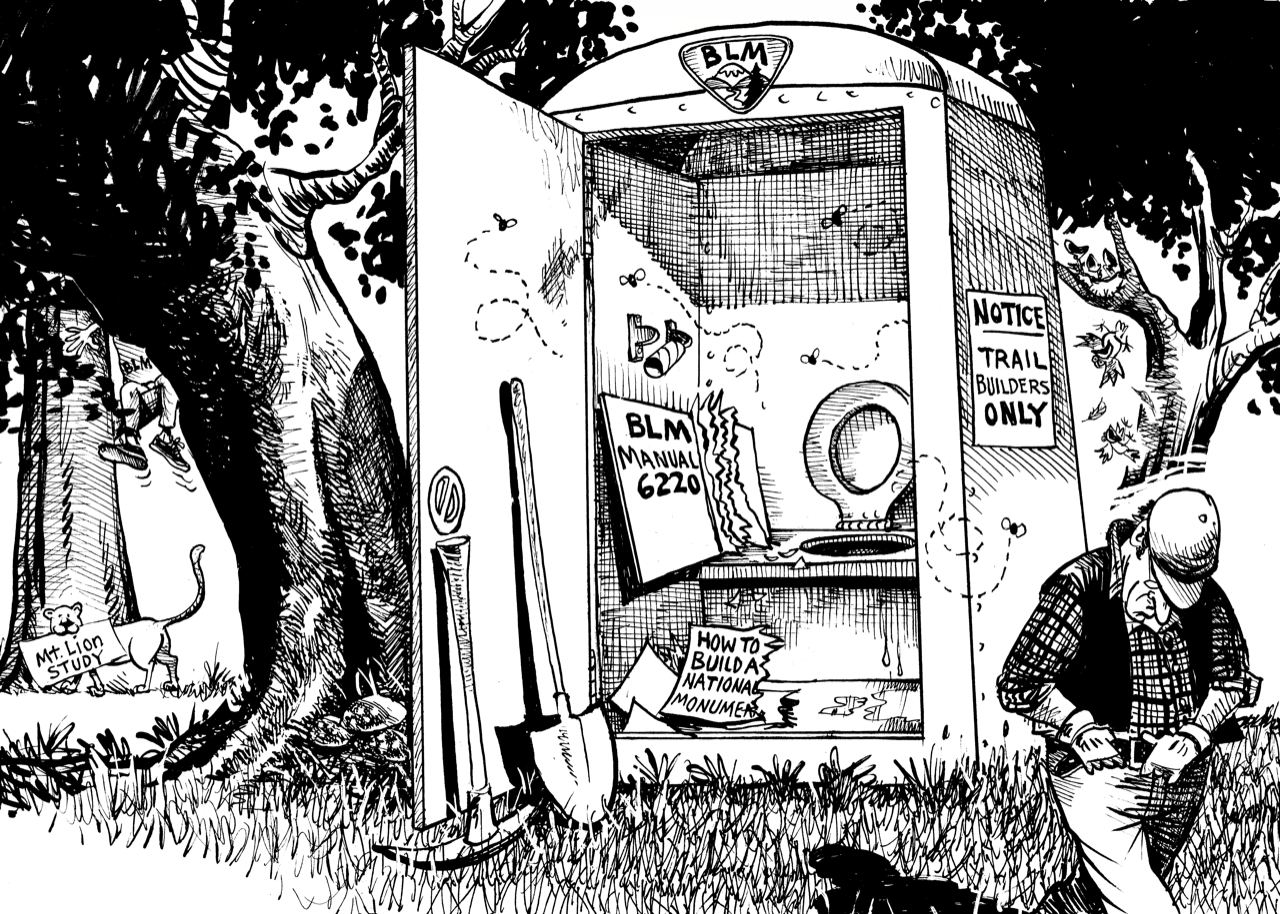
As the first federal land manager in the County, it was BLM staff who introduced our community to the federal government’s environmental planning process. This introduction was surprising in many ways. We had been accustomed to public lands managers paying careful attention to protecting “environmentally sensitive habitat areas” (ESHA) according to Coastal Commission rules. Not so with this property – BLM staff didn’t even provide the public maps of those regulated habitat areas in any of their planning documents! With the promise of National Monument protections, we were hopeful that BLM staff would follow the required and highly regimented process outlined in BLM’s policy “Manual 6220,” which provides staff with guidelines on how to manage national monuments. Again, not so! In fact, BLM staff have not used the 6220 manual and have neglected any public acknowledgement of the manual, as if they do not intend to use it, at all. Moreover, BLM staff have never specifically acknowledged the many species and ecosystems protected through the monument designation process. Monument management protocol seems irrelevant to BLM staff, who are apparently bent on expediting the public access so vocally anticipated by the Monument Campaign (coincidence?).

The job ain’t finished until the paperwork is done!
Cartoon compliments of DeCinzo, Caption by Grey Hayes

Expediting Public Access

BLM staff have chosen expediency over thoroughness in each of their property planning exercises. For their most recent property-wide plan, instead of data-based predictions of visitor use, BLM staff chose a largely arbitrary low-ball figure of 250,000 anticipated visitors/year for the property. Instead of the logical in-depth alternatives analysis of a full Environmental Impact Statement (EIS), BLM staff have chosen expedited Environmental Analysis (EA) processes, complete with incredible conclusions of ‘Finding of No Significant Impact (FONSI),’ despite significant contrary expert testimony that has gone unaddressed and unacknowledged. As we learned for the first time about its ‘federal consistency process,’ the Coastal Commission recently mandated that BLM use a phased approach to opening the property to public use. The Coastal Commission required that only if/when the BLM proved it could adequately manage public use could it open the full range of parking lots and trails; that proof requires monitoring and such monitoring would normally require a baseline inventory of sensitive natural resources, but we have yet to see that happen…we don’t even know the language to which the BLM and the Coastal Commission have agreed.

Nipping at the Community

My personal interactions with BLM staff have historically been less than pleasant, perhaps because those staff members are unused to much public engagement. My experience of poor interactions with BLM staff isn’t isolated. Someone suggested that this might be partly because those staff feel ‘rocked back on their heels’ because of criticism of their work, which is odd because our comments have been professional, polite, and part of what BLM should expect as public lands planning processes. A BLM staffer told me long ago that their colleagues were in for a surprise as they encountered the very actively involved communities of Santa Cruz County’s North Coast. Previously, most BLM staff working at Cotoni Coast Dairies had worked very much out of the public eye, in remote parts of California with little/no public oversight.

While we can’t ascertain why BLM staff have avoided offers for assistance, their subterfuge is as enlightening as it has been damaging. My compassion about staff feeling rocked back on their heels is limited because BLM staff have sought to discredit my work and harm my reputation, even approaching employers with false information to negatively affect my job while also giving ultimatums to conservation networks to preclude my participation. During one encounter at a public meeting, a BLM staff person told me that they would never collaborate with me or the groups with whom I worked because I was “against any public access at Cotoni Coast Dairies.” That was an incorrect statement about my position that I had likewise been hearing from a particularly activist, radical group of mountain bikers. As this BLM staff person echoed that quote, it was possible to better understand communication channels and allegiances.

My earliest interactions with BLM staff at Cotoni Coast Dairies were when I proposed assistance for biological monitoring. I and a few other biologists offered BLM free assistance with biological surveys to improve their understanding of the property. After that proposal, over a very long time, a BLM staff person strung us along through an incorrect informal process without ever encouraging us or acknowledging the potential value of such work. There was a chain of calls and emails that each ended with something like ‘well, maybe….’ By the time we subsequently discovered the correct application process and applied in that way, leadership had changed and the application was then officially refused.

Cumulative Impacts: Traffic, Trauma, Toilets and Trash (the 4 T’s)

It is important to view BLM’s problems in the context of issues related to visitor access on conservation lands throughout Santa Cruz County. As with all of the other public lands managers, BLM has been planning for visitor use and conservation in a vacuum, as if the surrounding lands don’t exist: this is a deeply flawed perspective. Much of the land from Santa Cruz City to the County line is heavily used by recreational visitors. Most weekends, parking lots overflow with cars and parked cars dangerously line the highway. There are too few trash cans and toilets to serve those visitors. Police and emergency responders are stretched to respond to the many accidents such visitation is bound to create.

County Parks, State Parks, the City of Santa Cruz, the Rail Trail, and BLM each have their own properties to manage and the same 4 T’s issues to address, but they aren’t doing it collaboratively. It is clear that none of those agencies has the resources to address those issues and so those issues are borne by our community. Visitors have come to expect trashy beaches. Emergency responders have come to expect exhaustion and insufficient support. Visitors with elderly family members or small children are avoiding parks due to dangerous or disgusting conditions. As each agency plans in isolation to provide for the maximum number of visitors, parks managers are dooming wildlife and visitor experience – the carrying capacity for the entire North Coast will be surpassed. It is no wonder that our community does not trust BLM to be able to manage their land and the visitors that they plan on attracting. BLM entered an arena of mistrust and fueled the fire with their own mistakes.

Who is Responsible?

Those of you who know me well know I don’t like the passive tense: I like clearly stating the subjects of verbs…who (specifically) is responsible for doing what (specifically). And yet, agencies like BLM are opaque…staff even refuse to specify who is specifically responsible for anything you might witness happening. But, placing the entire blame of the tragedy of Cotoni Coast Dairies on current BLM staff is unfair. Local, state and federal elected officials also bear some responsibility; good intel is that some of them have even winked behind closed doors in Washington DC, saying that local concerns needn’t be addressed. But again, placing a large amount of blame on elected officials also doesn’t seem fair: after all, they should be swayed by popular opinion (or at least election).

We saw how enough funding swayed popular opinion with the Monument Campaign, right? Apparently, no funders have been inspired to sway popular opinion in favor of wildlife protection on conservation lands in this particularly biodiverse region. Even if they did, there is a dearth of organizations who would lead that campaign. And so, in regard to the tragedies unfolding at Cotoni Coast Dairies and across Santa Cruz County’s North Coast, we must bear the brunt of blame within our community, which has long lacked leadership, energy, and focus on environmental conservation. For more on that, read my essay “Democracy and the Environment.” And, stay tuned for the third in this series of essays where I will outline steps forward out of this unfortunate predicament.

-this article adapted and updated from what appeared in late March at Bruce Bratton’s blog BrattonOnline.com

Conservation Land Management: Critical Thinking about Local Matters

When you visit conservation lands, how do you think critically about stewardship? There are various things to consider and ways you might help.

The Balance

Often conservation lands managers mention their obligation to balance conservation with public access. In our area, this is especially true for State Parks and the Bureau of Land Management (BLM). Here are some Mission Statements to help you understand:

State Parks Mission: “To provide for the health, inspiration and education of the people of California by helping to preserve the state’s extraordinary biological diversity, protecting its most valued natural and cultural resources, and creating opportunities for high-quality outdoor recreation.”

BLM’s mission is “to sustain the health, diversity, and productivity of America’s public lands for the use and enjoyment of present and future generations.

The normal thing to do when analyzing how to provide a balance between recreational access and conservation is to perform a carrying capacity analysis, which defines ‘limits of acceptable change.’ Monitoring determines if limits are surpassed, and adaptive management reacts with changes to public access patterns to address any problems. If the carrying capacity analysis process were integrated into a collaborative natural resource management program that welcomed public participation, controversies about changing and limiting public access could be managed with more understanding and cooperation.

Visitor Use Expectations

If they followed state of the art management practices, conservation lands managers would consistently determine what prospective visitors expected and adjust to meet those expectations. Expectations are monitored through interviews and surveys not only of people actually visiting the conservation area, but also prospective visitors in the general population. Managers normally encounter a great deal of diversity of expectations from conservation lands visitors. Some want active recreational experiences – trails/roads to jog along or mountain bike; some mountain bikers even want “rad” experiences involving tricky terrain to navigate at high speed on single track trails. Other visitors hope for quiet, contemplative strolls, opportunities to observe wildlife, or safe places to walk with elderly or very young family members. Still other portions of the population want to recreate on motorized vehicles, fly kites or drones, or rock out with parties involving amplified music and dancing. And, other segments of the population want places to meditate, collect medicinal herbs or edible mushrooms, help with stewardship, or take photographs. Obviously, it is impossible to provide everything to all people on any given parcel of conservation land, but how can managers decide what to do?

Meeting Whose Expectations?

Conservation lands proponents are sensitive about meeting many different expectations because they perceive benefits of increasing the public’s support of conservation lands acquisition, which is expensive. Sometimes this is complicated because lobbyists for various recreationally-oriented businesses are good at amplifying their client’s voices to advocate for specific types of visitor use. Traditionally, hunter groups and off highway vehicle organizations achieved successes this way. More recently, mountain biking organizations have been similarly influencing conservation lands management. Proponents of conservation lands acquisition dodge the tricky nature of favoring some types of visitors over others by public cheerleading for ‘maximum public access’ while privately providing pressure for a small subset of visitors, usually those they think are most politically influential. This is why State Parks managers opened Wilder Ranch hiking trails to mountain biking without any analysis or planning, welcomed the public onto the Coast Dairies’ beaches without environmental review, and allowed a private organization to operate a parking lot, gift shop, and privately controlled entrance to Castle Rock State Park. This is also why the Bureau of Land Management will soon allow e-bikes to use trails at Cotoni Coast Dairies. BLM is also planning on crowding all visitors onto trails that will be so heavily used as to spurn contemplative users while disturbing wildlife enough to alienate bird watchers. Families will have their hopes dashed of viewing sensitive wildlife such as bobcats, badgers, and foxes, species that frequent the property before the public has been admitted.

Coastal Commission Cahoots

I would be remiss if I didn’t remind readers that the much-lauded California Coastal Commission has been a close party to such poor ‘maximize public access’ decisions. Politicians have long appointed Coastal Commissioners who agree to the (bogus) ‘maximize public access’ mantra and who consequently believe that protecting nature gets in the way of their political success. Likewise, staff who support this schtick are empowered and promoted…and an organizational culture has been created that knows little else. And so, our beaches, bluffs, and coastal parks are being overrun by visitors, vegetation trampled, hillsides eroding, and wildlife quickly disappearing.

Quality Experience

In our rush to maximize public access, we are losing the quality of visitor experience. Social scientists have long understood that conservation lands visitor expectations can erode based on what is “normal” to experience. As levels of trash increase, people expect trash…and become more careless about leaving trash in natural areas. With poor planning, parks become more crowded, and people lose expectation of contemplative experiences, nature becomes less healing. As over-used, badly managed trails erode into ditches with holes, elderly people stop visiting their favorite places; the average age of visitors grows younger and younger. As poorly educated conservationists work together for the ‘maximum use’ paradigm, families stop expecting to teach their children about wildlife from first-hand observation and the conservation movement loses wildlife advocates.

Oh, But Funding!

Enter into conversation with conservation lands managers with these critiques and the conversation quickly turns to lack of funding as the excuse. ‘We just don’t have the funding to….’ While I am compassionate to lands managers that they face a very dire funding situation, I posit that such poor funding is a result of bad decisions by individuals within their organization and lack of enlightened leadership in the conservation community.

When you hear complaints about funding, I encourage you to ask some follow up questions, like: ‘Have you completed “Carrying Capacity Analyses?”’ ‘Have you delineated “Limits of Acceptable Change?”’ ‘What has your monitoring revealed about the trends of sensitive plant and animal populations on your land?’ ‘How have you managed for changing visitor use and visitor expectations over time?’ If conservation lands managers prioritized addressing those questions in collaboration with the conservation community and the public at large, funding would be less of an issue. When visitor use is curtailed within the collaborative and adaptive management context, there is increased political support and funding for stewardship, planning, and improved alternatives that better address visitor expectations.

What You Can Do

See something, say something. I encourage everyone to speak up and vote for these issues. Any politician at any level must interact with these issues in some way: they should have clearly stated policies that they support to improve conservation lands management. And, they should know the term ‘carrying capacity analysis’ and support the practice as it relates to conservation lands management.

And, if your expectations are not met when you visit conservation lands, you should let the managers know. Are the trails in good shape? Did you see wildlife? Was it too crowded? Did you feel comfortable with the other kinds of users on the same trails? Was there trash? Were bathrooms adequate? Did you and your family feel safe?

Finally, ask conservation lands managers the questions posed above. Also, ask how you might help to manage and monitor within their defined carrying capacity, or how you might then advocate for increased funding for their adaptive management. These dialogues could help immensely.

-this article originally published by Bruce Bratton at his weekly BrattonOnline.com, an invaluable piece of journalism helping thousands of people keep in touch with what really matters around the Monterey Bay area of California. Subscribe today- better yet, donate to keep it going.

Some Cotoni Coast Dairies Reflections

Ever since the United States Department of Interior’s Bureau of Land Management (BLM) took control of 5800 acres of northern Santa Cruz County, conservationists have been asking themselves “what have we done?” The fateful transfer day was in 2014 when a private land trust, the Trust for Public Land, donated the property to BLM. It would be years before the negative repercussions of that handover were obvious. 7 years later BLM unveiled a draft management plan for Cotoni Coast Dairies, a document rife with errors including tables cut-and-paste from other plans from faraway places, lists of misidentified species, and proposals with little analysis and findings absent scientific rigor. How did such a bungling land management agency gain control of such a precious part of California’s coast? The story unfolds…

BLM’s Standard Bearers Support Poor Standards

As one comes to expect in our community, unctuous support for BLM’s draft plan for the property was lugubriously lauded by affiliates of profiteering recreational industries and their political hacks while conservationists carefully documented voluminous errors and omissions and suggested reasonable improvements to protect natural resources while providing access to open space. Subsequently, BLM perfunctorily changed the plan to address only the most egregious errors and, as expected, chose the ‘moderate use’ alternative, publishing an Environmental Analysis (EA), the easy, low-input, and cheap means for the agency to officially finalize approval. Shortly thereafter, conservationists filed an appeal to the Department of Interior and BLM asked for two extensions of the appeal window. During those extensions, and before the appeal was settled, BLM staff bulldozed areas of the property to prepare for one of its planned, but not yet permitted, parking lot. We don’t yet know which BLM official ordered that disgusting and undemocratic act, but we will find out. Conservationists won their appeal, but meanwhile the BLM had destroyed sensitive coastal prairie and cut trees that had long supported the federally threatened monarch butterfly. Meanwhile, it became clear that the only other parking lot location that BLM’s faulty plans had analyzed could not progress as planned because the road to the parking lot traversed private property without the consent of the owners. That was almost as surprising as the Coastal Commission’s allowance for that access road, which would have also paved a stream channel. It seems wherever one looks these days, the Coastal Commission pushes for maximizing public access even if it means careless destruction of natural resources. That matches well with BLM’s management philosophy.

No One Home and No Friends Left

Back in 2014, someone working at BLM told me that their office was ill-prepared for Santa Cruz. For years, their staff had managed land where there was no conservation constituency, where nature degrading recreational activities and other “resource” uses were unquestioned. Since BLM moved into Santa Cruz County and took control of Cotoni Coast Dairies, they have been unable to retain consistent managers: two field managers overseeing the property have departed and the newest one is rumored to be ‘remotely managing’ the property while living far away from the region. And yet, our community has long offered BLM friendship.

At first, BLM welcomed enthusiastic friendships, signing partnership agreements with the University of California at Santa Cruz and the Amah Mutsun Tribe. Now, BLM only admits to being partners with the group previously known as Mountain Bikers of Santa Cruz (see sidebar, from BLM’s Cotoni Coast Dairies property homepage). Why has BLM rejected its tribal and science partners in favor of the mountain biking industry? We need to go back to the beginning of the story to understand.

Swiss Dairyman and Subdivision Moguls

The Cotoni Coast Dairies got its two last names from a Swiss dairy and land investment company, which started in 1901 and ended in 1998 when the investors sold to the Trust for Public Land instead of a subdivision mogul. For 97 years, the land referred to locally as ‘Coast Dairies’ was managed by farmers and ranchers who made it clear that the public was unwelcome. Much of the rest of the County had been explored by botanists and wildlife experts whose wisdom and documentation led to so many parks purchases. But this was not the case with this huge part of the County: it had remained largely uncharted. In 1997, real estate magnate Brian Sweeney announced that he had an option to build more than a hundred luxury homes on the property. The owners were able to quote extravagant roperty value, so conservationists had to raise a lot of funding to conserve the property and thwart the threat from development. Without biological surveys, conservationists had to convince funders about the value of the ‘spectacular views’ and recreational potential instead of conservation values. That seems to me to be how the seed was sown for how people came to value the property in the years to come.

Trust for Public Land: 14 Years at Coast Dairies

After purchasing the property, for 14 years the TPL managed the property while trying to find a way out. TPL managed to give State Parks the ocean side of the property, including the beaches. State Parks opened those beaches to public access without any planning or environmental review. It took many more years to find any organization willing to own the inland portion of the property. TPL solicited proposals from various potential landowners. UC Santa Cruz made a proposal, which didn’t work out. Meanwhile, it was costing TPL a lot of money and headaches to retain the property and the funders wanted it opened for public access. As a last resort, TPL turned to the federal land management agency that had long served as property managers of the last resort: BLM…there didn’t seem to be another option. Besides, some of the illuminati of open space purchasers thought perhaps it could soon be a part of The Great Park, owned and managed by the National Park Service.

The Great Park

For a while after TPL purchased the property, the Open Space Illuminati advertised something called “The Great Park,” an expansive interconnected park system, with a National Park nucleus derived from Coast Dairies and a newly designated National Monument on the adjoining San Vicente Redwoods. For a while, it seemed like this idea had become fet a compli, but enough powerful opponents started asking questions…politics changed…and perhaps funders’ willingness waned. After some time, this particular iteration of a National Monument waned and the Great Park idea became a dim memory held only by a few.

A National Monument

As the Great Park and the San Vicente National Monument ideas waned, a new idea dawned: Cotoni Coast Dairies could become part of a National Monument! Charged up with a great deal of funding from the Wyss Foundation, the Open Space Illuminati parachuted in something that appeared to be popular movement: glossy brochures and websites popped up and The Monument Campaign was born. When conservationists exclaimed concern at the number of visitors that would be attracted to the property with such a designation, the Illuminati said ‘Shut up! This is the only way to make BLM accountable to protecting the property!’ They succeeded: in the last days of the Obama Administration, the president decreed that the property would become part of the California Coastal National Monument.

Post Monument Blues

Shortly after the President’s decree, the BLM dissolved the only staff positions whose work entailed guaranteeing protection under National Monument regulations. Since then, the BLM has refused to abide by its own regulations for managing National Monuments. Meanwhile, the Great Park and Monument Campaign Illuminati have likewise disappeared from the scene, their concerns for protecting the land swept away as they entered the next funding cycle’s focus in some other arena. Enter stage left the influential Outdoor Industry Association where business and profits pour from Nature commodified. Advertisements for ‘rad times’ on Santa Cruz County trails bring thousands of visitors, supporting a ‘green’ economy. Sales of super-expensive bikes skyrocket. Many conservationists are getting too old for the fight. It is easy to see what we have done, but what’s next is anyone’s guess. Best to stay apprised and keep asking questions; perhaps this is a good time for a renewed conservation movement in Santa Cruz County.

-this post originally posted at Bruce Bratton’s wonderful BrattonOnline.com blog

Earth Management Without Data

“I don’t need to know anything more. I know all I need to know.” This is how most of the key people around us approach Earth Management. Is that frightening?

Santa Cruz County has a lot of conservation lands, and those lands are critical for our prosperity. 20% of Santa Cruz County is conservation land. We rely on those lands to provide us water, clean air, and geologically stable slopes. Conservation lands also support recreation, giving County residents reprieve and healing. Open space supports life that is intrinsically valuable and will sustain an elevated quality of life for people on this planet for generations to come. Natural area parks attract tourists, fueling an annual $1 billion income for businesses and supporting 14% of local jobs.

Does Park Management Matter?

It matters how conservation lands are managed. If natural areas recreation is mismanaged, studies have shown that wildlife will disappear, degrading parks visitor experience and the quality of life for county residents. In the long term, collectively these declines endanger the future of humans. Poorly managed recreation also makes for less safe and less pleasant parks user experiences. Mismanaged conservation lands result in eroding trails, increasing safety risk for visitors, reducing the water holding capacity of the land, and degrading habitats including filling wetlands and waterways with sediment. When conservation lands managers mismanage fuels, many are endangered by increased fire risk. If they don’t correctly manage timber operations, livestock, or farming on conservation lands, there could be increased fire risk, more spread of pathogens and weeds, erosion, and degradation of plant and animal life. Problems originating on conservation lands are a burden to surrounding landowners who are threatened by fire, weeds, reduced water quality, trespass, and poorly managed wildlife. Conservation lands were often targeted for acquisition to conserve rare species, but if those species aren’t well managed, they will increasingly deserve State or Federal endangered species status; this increases the regulatory burden of private property owners whose land has habitat for those species.

So Little Data…

Very few people make the decisions about how to manage the County’s conservation lands…these folks don’t have the necessary data to inform their decisions…and one wonders whether they want more data. There are fewer than 30 people in decision making roles for all of Santa Cruz County’s conservation lands. None to very few of those people have formal training in conservation lands management. When the folks planning the North Coast section of the Rail Trail were gathering data for recreational use of North Coast parks, they discovered that there were no reliable data for the adjoining 45,000 acres of conservation lands. They couldn’t find data about how many people were using parks where or when. They found no data on the repair status of the infrastructure (parking lots, trails, restrooms, etc) supporting those parks. Of the dozens of rare and endangered species on that landscape, only a handful have been regularly surveyed so we have no idea of the health of most species’ populations. There are no data on what visitors hope to experience versus what they actually encounter. This leads me to ask…do conservation lands managers want more data…how would we know?

The Elusive Need for Data

The first place one would expect to find conservation lands managers’ expressed data needs is on the web pages of their agencies. For example, California State Parks maintains a statewide ‘natural resource management’ webpage. On that page, the agency curiously notes: “California State Parks…supports scientific studies by universities and other researchers who use state parklands as sites for conducting studies designed to help us understand the ecological health of a park.” Note that this verbiage avoids stating that such research could help inform management. Nowhere on the webpage can you find out how Parks supports science. I have not been able to find a publicly available list of prioritized data needs nor science plans that would help to guide data collection prioritization for any conservation lands managers in the County. The Bureau of Land Management, managers of a sizeable conservation property, Cotoni Coast Dairies, apparently does not intend to complete a science plan, which is mandated for all such National Monument designated lands. With a region rife with research institutions, why would conservation lands managers not outwardly seek assistance with data collection and analysis?

The Few, The Proud

I am reflecting on the many conversations I’ve had with conservation lands managers about their priorities, or lack thereof, for data and analysis to inform their management. Many lament the need for more financial resources to support research within their agency; many have also shown suspicion about research that they do not tightly control. In the most recent conversations, two conservation lands managers told me that they had all the information they needed to manage thousands of acres of Santa Cruz County land. Their swagger suggested that they were experts and that they would notice if there was something awry with their management; if they needed to make any changes, they would know what to do. A few years ago, when another manager claimed something similar in a group with which I was a part, a wise colleague responded that humans have thought they knew the right thing to do for thousands of years only to be eventually proven wrong as science progressed. This know-it-all attitude is reflected in reports and programs such as this publication and another one from a central support organization for State Parks, where it is supposed that it is merely necessary to disseminate ‘best practices’ or to train parks employees to implement ‘tested approaches for management.’

Twisted Logic

Try to make sense of the following logical framework, which local Bureau of Land Management (BLM) conservation lands management leaders have publicly stated. Although BLM has sufficient information to inform their management…the questions they might have for researchers…whatever they might be (not stated/published)…are not expected to overlap with the interests of researchers. But, even if they could find some overlapping interest, researchers would likely not produce information that would be salient for BLM’s management.

A Beacon of Hope

As a stand-out exception to these trends, the Santa Cruz Mountains Stewardship Network, a consortium of lands managers working throughout the region, recently completed a data-driven climate adaptation project. But it is not clear if any particular land management agency has officially adopted the project’s findings, which largely either contradict current management or suggest the need for much more study/work before alternate management actions might be considered. So, perhaps there is some hope…

Support What’s Right

Meanwhile, how can we help advocate for better progress with scientific approaches to stewarding the precious conservation lands of Santa Cruz County? Your most likely leverage point is through advocacy organizations. Don’t support an organization that doesn’t align with your values. For instance, Friends of Santa Cruz State Parks has a mission that purportedly supports ‘thriving’ parks and ‘conservation’ – support them only if you find that science-based land conservation is a priority. It would be great if other groups were able to help State Parks with their stewardship issues. The California Native Plant Society has a great reputation as having a science-based approach to assisting with conservation lands management through advocacy and partnership. Occasionally, Audubon California will help with such issues. The Nature Conservancy has long been a leader helping other conservation lands managers to be more science-based and data driven with their stewardship work.

As always, please vote for the environment. Ask candidates about how they will help conservation lands managers be more scientific with their approaches to stewardship. These issues touch on elections at every level: city, county, state and federal candidates should all have clear environmental platforms for conservation lands assistance. Hundreds of thousands of acres of Santa Cruz County depend on smart practitioners of Earth Management! Let’s help move that forward.

Teach Your Children Well

Five shovels, five rakes, and ten of us sweating and smiling as we worked to restore trails in UCSC’s Upper Campus Natural Reserve. For a few years in the mid-1990s, UCSC undergraduate volunteers joined me, Campus Reserve Steward, one Saturday a month to reverse the harm that hundreds of mountain bikes were causing. We spent the most time along 7 Springs Trail and the Interpretive Trail. Both trails were off limits to bicyclists and clearly signed; they still are. These are very sensitive ecological areas replete with wetlands, springs, and highly erosive soils. They have been set aside for teaching and research, visited by classes and sites of long-term forest research. While we worked, we frequently encountered bicyclist after bicyclist, some skidding to avoid hitting the volunteers. Our team was trained and eager to inform the bicyclists about the trails being closed and why. More than half of the bicyclists were aggressive and unfriendly, unwelcoming to such an interaction. We were yelled at, called all sorts of names, and there were occasional threats of violence, and even spitting. I was thrown to the ground and stepped on once by a particularly aggressive individual. Our work to close the trail was regularly and expertly vandalized and signs frequently defaced. This is a dominant culture of mountain biking. These instances are not outliers, the behavior far too common. I have been hearing similar stories from many people for years. Once, I told a person with his son that I would call a ranger if they jumped a gate headed into a closed, sensitive natural area. He responded, “I AM A RANGER!” And I recognized him as one of the head rangers for State Parks…and off he went, a fine example for his son.

Givers Vs. Takers

I recommend reading Daniel Quinn’s book Ishmael; one of the things I recall from the book is a characterization of humans as being either “givers” or “takers.” Santa Cruz County has been fortunate to have a historic giving culture. A very large percentage of the County has been set aside as parks or is stewarded by large private landowners who take very good care of their land. There is little area for urban sprawl, but now we are facing the next biggest threat: natural areas recreation, one of the top threats to biodiversity on the planet. Leading the assault are trails advocacy groups, some of which have been at this for decades. There will apparently never be enough new mountain bike trails for the funders of these groups. These groups and others like them around the world are being funded by industry through organizations such as the Outdoor Industry Association. Mountain biking trails-building volunteers working for these advocacy groups are spending their free time expanding corporate profits while repairing a small fraction of the damage they’ve collectively caused with their thrill-seeking sport. These are what Ishmael would call ‘takers.’ Together, mountain biking (aka ‘trails’) advocacy groups and the outdoor recreation industry are pressuring every public land management agency in the Bay Area to expand mountain biking trails in an apparent bid to turn every inch of natural area into a high-speed playground, maximizing profits at the expense of the wildlife and the quiet walks once enjoyed by families with small children, bird watchers, and contemplative hikers. On this subject, someone urged me to consider Hanlon’s razor: “Never attribute to malice that which is adequately explained by stupidity.”

The Corruptors’ Rule: Keep Them Stupid

I suspect that a fraction of those building new trails at Cotoni Coast Dairies innocently think they are doing the right thing. The groups organizing these events certainly won’t educate the volunteers about the dubious nature of their work. They won’t share with them the long and expertly crafted critiques of the park’s planning process by the region’s leading biologists. They won’t tell the volunteers already riding mountain bikes on the trails that a broad coalition of conservation groups oppose using the trails before a biological baseline is collected. They won’t tell the volunteers that their sponsoring group has, without expertise, testified in contradiction to conservationists during the planning process in an apparent bid to gain points, and a sole-source trail building contract, with the BLM. The volunteers, knowingly or not, have become active participants in the commodification of nature. So, they are “takers.”

Our Chance

Conservationists (aka “givers”) point out that we have a once-in-a-lifetime opportunity at Cotoni Coast Dairies to collect a biological baseline before trail use commences. With this baseline, we can better understand how trail use affects wildlife, plant communities, soils processes, and the spread of invasive species. The property has been very lightly visited by humans for more than 100 years. Because the property is designated as part of the California Coastal Monument and as part of the federal National Conservation Lands network, there are extensive policies that support and even require such a baseline…this level of policy support is absent with any other conservation land in the County. Do the trails building volunteers know that, through their work, they are supporting BLM in shirking critical land conservation responsibilities?

Snap!

I have put these arguments to volunteers of trails groups working at Cotoni Coast Dairies and have been reminded of a series of fallacious arguments that have been trotted out for decades. The most common statement is: “It’s a done deal, trails were approved and are under way, get over it!” This statement ignores the ongoing and active appeal to the planning process by a coalition of conservation groups. And, even without such an appeal, the statement overlooks the need to manage trails forever and land management agencies’ responsibility to adaptively manage trails to avoid impacts to protected natural resources and user conflicts that would favor certain user groups (such as mountain bikers).

Avoid the Trap

In a bid to trap the unwary, some of the leaders of the trails advocacy groups have suggested that their groups are ‘conservation’ groups. If you are confused, ask the leaders of these groups about what is ‘enough’ and what is ‘too much?’ For instance, when will there be ‘enough’ mountain bike trails? What specific metric would indicate too much soil erosion on a given stretch of trail? What, specifically, is too much user conflict- such as how much displacement of families with small children who fear their 3-year-olds getting hit by mountain bikes (like one person recently reported to me)? How specifically will we know when there has been too much wildlife loss due to natural areas recreation? If the trails advocacy group truly had a conservation platform, they would have answers, created through methods of carrying capacity analysis and they would be able to offer threshold limits of acceptable change (‘enough’ or ‘too much’). I have long interacted with these groups, and this is where I see evidence favoring ‘malice’ instead of Hanlon’s razor ‘stupidity.’ With this kind of experience, one might discover which groups are primarily interested in the commodification of nature, and are, thereby ‘takers.’

Past Evidence

In the 1990’s, one of these trails advocacy groups began their ugly but organized, well-funded campaigns to expand mountain biking trails in this region. I was at the table when the group negotiated the opening of the U-Con trail from UCSC to Henry Cowell. They promised volunteers to close and keep closed the myriad of unsanctioned trails bleeding tons of sediment into the San Lorenzo River; they said that they would post volunteers at trail heads to “self-enforce” closure. They did no such thing. I was also there when mountain biking representatives showed up at the first Gray Whale Advisory Committee meeting, having worked with State Parks for a year to prepare detailed plans for an extensive network of new trails through that property (now part of Wilder Ranch State Park) without any understanding of/interest in the extensive areas with sensitive ecology and erosive soils. Because of their intransigence at coming to agreement with Parks and the Committee, there is still no long term trails management plan and no plan for protecting critical sensitive species. A group consulted with me when Nisene Marks State Park General Plan was being drafted and mountain biking advocates were aggressively advocating for more mountain bike trails, in contradiction to permanent deed restrictions against such use….wasting extensive State and private resources and, once again, needlessly dividing our community. More recently, I countered a mountain biking group publicity campaign that sought to educate the public falsely about the ‘need’ for more mountain bike trails because of the purported paucity of such in the County. After correction, they walked back the campaign and it subsequently disappeared. These situations are, in my opinion, more evidence of ‘malice’ rather than ‘stupidity.’

We are Winning

Despite all of this, the ‘givers’ are winning, pushing forward protections for Nature in parks around Santa Cruz. We realize that the vast majority of us want healthy wildlife AND access to natural areas where we can recreate without fear. We reject the politics of division that those whose object is the commodification of nature so enjoy. Together, we won protections for Nisene Marks State Park. We expanded protections prohibiting mountain bikes in extensive wilderness areas of Castle Rock State Park. We created extensive Natural Preserves at Wilder Ranch State Park, thwarting miles of new mountain bike trails. We have (thus far) maintained prohibitions against mountain biking on single track trails at UCSC. A coalition of conservation groups has recently made great headway in improving the poor recreational planning at Cotoni Coast Dairies. With community support, the San Vicente Redwoods conservation coalition is enacting the most progressive recreation and conservation adaptive management regime our region has ever seen. Expanding awareness even forced one mountain biking advocacy group to change their name to seem more PC. And soon, we may have Congressional representative Jimmy Panetta instead of Anna Eshoo- a massive step forward in leadership to better manage the impacts of natural areas visitors to our communities and to wildlife. I have been fielding so many requests to help on these issues that I can’t keep up. Together, we are turning the tide: there is hope that future generations will be able to enjoy peaceful strolls and see sensitive wildlife in our natural areas, after all.

Your Time

Meanwhile, when you consider how to spend your outdoor volunteer time, focus your attention on groups that know how to help you to truly become a ‘giver’– groups like the Peninsula Open Space Trust, the Land Trust of Santa Cruz County, and the California Native Plant Society.

-this essay originally published in Bruce Bratton’s weekly blog BrattonOnline.com

Recreation vs. Conservation in Natural Areas

We face a quandary for which there are many solutions: the northern region of Santa Cruz County is one of the nation’s top biodiversity hotspots which is increasingly facing one of the largest threats to biodiversity – recreation within conservation areas. Globally, the coast of California is recognized as one of the most important crisis areas where natural areas tourism impact overlaps with critical conservation areas called biodiversity hotspots.

Biodiversity Hotspots

Biodiversity hotspots have been scientifically catalogued in precise ways to direct conservation funding and activities. These areas have particularly high numbers of species limited to small geographic areas, correlating with large numbers of endangered species. Areas with numerous endangered species in different groups receive higher hotspot scores: Santa Cruz County has many endangered species in three groups: ‘herptiles, arthropods, and plants,’ and so is one of only two counties in the nation to receive the highest hotspot score. Similarly, with a larger lens than county boundaries, the San Francisco Bay Area, including northern Santa Cruz County, is recognized as one of the top three biodiversity hotspots in the country. The rationale for using biodiversity hotspot indices for conservation prioritization is so widely accepted that this measure has become the focus of the most funding of any other conservation initiative, a total of $750 million up to 2010. Our region has long benefited from such largesse, including the generous funding to set aside areas like the BLM’s Cotoni Coast Dairies and POST/Sempervirens Fund’s San Vicente Redwoods conservation areas. And yet, purchasing of land for conservation purposes only begins the process of conservation, which will last many lifetimes. Fortunately, there are many strong protections in place for these areas that help to guarantee that they will long be managed primarily for biodiversity protection.

Wildlife Protected at Cotoni Coast Dairies

There are a host of guarantees for biodiversity protection at the Cotoni Coast Dairies property. In 2017, Obama’s presidential proclamation making the property a part of the California Coastal Monument there are protections for such a breadth of ‘Objects of the Monument.’ Monument designation carries with it mandates for very careful planning, inventory, and adaptive management to assure natural resource protection. In addition, the property has been designated as part of the most protected lands in the Country: National Conservation Lands. In addition, BLM maintains and regularly updates lists of ‘special status’ plants and animals to guide protections on their lands. For those interested in mandates for BLM management for biodiversity on National Monuments, I encourage perusal of their Manual 6220. Using one ‘Object of the Monument’ as an example, the 6220 Manual requires that BLM inventory the dusky footed woodrat on the property and, in collaboration with experts at its National Conservation Lands Office, include in its property-wide science plan specifics about how managers will monitor and adaptively manage the property to assure the species’ protection. Regulations protecting biodiversity on the nation’s highest value conservation lands well reflect the majority of citizen’s interests in protecting wildlife, even if it means personal sacrifice. This is good news for conservation in natural areas because of the natural conflict between recreation and conservation.

Recreational Use is Contrary to Wildlife Protection

There has been much published about the negative impacts to wildlife of recreational use in natural areas, but here are a few illustrations of types of negative impacts. The following species are listed as “Objects of the Monument:” gray fox, bobcat, and mountain lion. Predators such as these three species are well recognized as extremely sensitive to recreational use in natural areas, leading to decreased density and abundance of these types of animals. Researchers working in the Santa Cruz area have noted that mountain lions are substantially sensitive to noises from humans, which reduce their use of recreational areas and lead to changes rippling through the rest of the wildlife community, including increased numbers of mice and potential increased frequency of Lyme disease. But, mammalian predators aren’t the only types of wildlife to be disturbed by recreational use.

The Monument Proclamation also calls out protection for Wilson’s and orange-crowned warblers, downy woodpecker, tree swallow, Cooper’s hawk, and American kestrel. Burrowing owl, golden eagle, tricolored blackbird, and white-tailed kite are also listed as protected on BLM’s special status animals list for California. Some bird species have been shown to be especially ‘flighty’ in the face of recreational use, requiring study and specific trail design to adequately buffer distances to avoid impacts. While the effects on specific species varies, some species can be negatively affected by the mere presence of humans, so, unless specific studies can ascertain effects, scientists suggest that avoiding new trails in natural areas is the best measure for conserving sensitive birds. Grassland birds, such as the burrowing owl, are particularly sensitive to recreational disturbance, perhaps because it is so difficult for these species to hide. There are also studies that would suggest care must be taken to avoid recreational disturbance to species like the California red-legged frog, deer, and native plants.

BLM’s Dilemma

BLM managers of Cotoni Coast Dairies face the many dilemmas of managing land for conflicting visitor uses alongside the conflict between recreational access and nature conservation in an especially sensitive ecological area.  The varying types of recreational users run the gamut from mountain bikers who use trails for the physical thrill of staying upright with speed and obstacles…to more scenery- and/or exercise-oriented mountain bikers and hikers…to more passive recreational users such as wildlife viewers…to photographers and painters…to restorationists…and scientists of natural history. Each user group conflicts with the next and the ones further apart with their expectations conflict even worse. I have not seen a plan by BLM to accommodate or monitor such conflicting uses, which will lead to what is called displacement, mainly of families with children and more passive natural areas users. Instead, BLM managers have shown a personal and strong affinity with the mountain biking community, which is also the agency’s closest ally in advocating for and developing recreational trails designed for their use on the property. On the other hand, BLM managers have turned away from engagement with passive users such as wildlife viewers, restorationists and scientists of natural history. Without welcoming this engagement which would have made up for their professed lack of such capacity, BLM managers are now moving forward with little understanding of the distribution and abundance of species, including those protected by statute. The evident BLM managerial-mountain biking community conflict of interest should be a great concern of those of the public who are concerned with biological conservation.

The Collaborative Management Solution

We should be advocating for an alternate way forward where BLM public engagement staff serve as facilitators of solutions-based approaches to the conflicts between users and between recreational use and natural resource conservation. The first step would be for BLM to adhere to its policy requiring a science plan informed by a baseline inventory of the Objects of the Monument and other special status species; this plan would include a carrying capacity analysis and an adaptive management framework to assure protection of the resources. All of those steps could be done collaboratively with scientists and volunteers as is outlined in BLM’s policy guidance. There have been offers for substantive financial resources to assist with this planning. Instead of hiding its scientific studies as it does now, BLM would proudly share what science it has gathered on a public interactive website. Once completed, the science plan could then be the focus of collaborative management of the property including all interested parties working together with the common goal of conservation of biological diversity while providing recreational access to the maximum extent possible. We are lucky to have a coalition of many groups working to make this vision real, including: Rural Bonny Doon Association, Friends of the North Coast, Sempervirens Fund, and Davenport North Coast Association. Your support of those organizations will help greatly.

-this post originally appeared last week in my weekly column at Bruce Bratton’s weekly BrattonOnline.com

Monument Proclamation for Cotoni-Coast Dairies Adds Significant Protections for Biota

The President’s Proclamation adding the Cotoni-Coast Dairies to the California Coastal National Monument has created protections for many biota, helping to guarantee a balanced approach between public access and preservation. The property’s managers, the federal Bureau of Land Management (BLM), had previously demonstrated disregard for all but federally listed species of plants and animals, which are few on the property. The Proclamation now obligates BLM to manage for 24 species as well as 13 biotic communities that are not otherwise federally protected.  The Proclamation guarantees some public access for the property only after the completion of a management plan that is ‘consistent with the care and management’ of these resources.

The following non-federally protected species (24) probably would not have received attention by BLM had this Monument proclamation not included their mention:

  • Wilson’s warbler
  • Orange-crowned warbler
  • Downy woodpecker
  • Black swift
  • Tree swallow
  • Cooper’s hawk
  • American kestrel
  • California vole
  • Dusky footed woodrat
  • Black-tailed jackrabbit
  • Gray fox
  • Bobcat
  • Mountain lion
  • Mule deer
  • California buttercup
  • Brown-headed rush
  • Redwood sorrel
  • Elk clover
  • Madrone
  • California bay
  • Monterey pine
  • Knobcone pine
  • Douglas fir
  • Coast live oak


The following biotic groups/communities (13) must now be protected and managed for by BLM:

  • California sagebrush
  • Coyote brush scrub
  • Amphibians and reptiles
  • Bats
  • Red alder forests
  • Arroyo willow forests
  • Riparian areas
  • Riparian corridors
  • Wetlands – in riparian areas as well as meadows and floodplains
  • Grasslands
  • Scrublands
  • Woodlands
  • Forests

The following federally listed species (4)were also mentioned in the Proclamation:

  • Tidewater goby
  • Steelhead
  • Coho salmon
  • California red-legged frog

The following species (2) are listed in the Proclamation and are also listed by BLM California as requiring protection on BLM lands. These species might not have been protected in perpetuity, though, as that BLM list changes with administrations.

  • White tailed kite
  • Townsend’s big-eared bat

Wildlife Protection at the Potential Cotoni Coast Dairies Monument- The Naysayers

Preservationists have done what they can to protect natural resources at the Cotoni Coast Dairies, should it become a National Monument- but, who didn’t support that work, and why?

The Proposal

Early in 2016, a broad coalition of experts and I drafted a proposal to add natural resource protection to any Presidential declaration of the Cotoni Coast Dairies National Monument. Expert wildlife biologists, amphibian and bird experts, plant community ecologists, and others co-created a list of sensitive species and rare ecosystems that would receive more protection under a Presidential Monument declaration, should that list be included. Sensitive natural resources at other presidentially declared Monuments in California have enjoyed such protections, so there is no reason such protections shouldn’t be in place at Cotoni Coast Dairies.

Questions: Who is writing the Presidential Proclamation that will give the Cotoni Coast Dairies National Monument status? Do they know about this proposal?

Answers: The staff at the Council on Environmental Quality, an office that advises the President. As of Fall 2016, they have our proposal, and we are hoping they will include it, in its entirety.

Supporting the Proposal…

The proposal enjoyed the public support of the following organizations:

The Trust for Public Land, which owned the Coast Dairies property before handing it to BLM, wrote an especially important support letter. Their letter emphasized the importance of including our proposal because it documented species and ecosystems that had been discovered since TPL wrote the legally-binding land management plan that would otherwise serve to protect the property under BLM ownership.

Not Supporting the Proposal…

Despite repeated requests, the following organizations refused to publicly support our sound, science-based proposal to increase protections of natural resources at the Cotoni Coast Dairies:

It is ironic that all of these organizations publicly supported the proposal to make the Cotoni Coast Dairies a National Monument. And, these are all expert conservation organizations. And so, these organizations must have been aware that BLM provides less protection to the natural resources listed in our proposal without those species being included in the Presidential Monument declaration.

The various written rationales for not supporting the proposal included (paraphrased):

  • ‘it would take too much time for our organization to analyze the issue’ (two organizations)
  • ‘our policies have changed since we signed on to support the proposed Monument, now we don’t do those types of things’(one organization)
  • ‘some influential people (elected officials/Monument advocates) wouldn’t like us as much if we supported the proposal- so, it’s not worth it’ (two organizations)

What Can You Do?

If you agree that future generations deserve to enjoy healthy wildlife and clean coastal streams….

And, if you agree in science-based, policy-smart solutions to make that happen…

  • When choosing to join or support in any way an environmental organization: choose from the list of those organizations that supported our proposal.
  • Even without such support, please let the organizations listed above know what you think. Click on the organization names above- I included links to their websites.