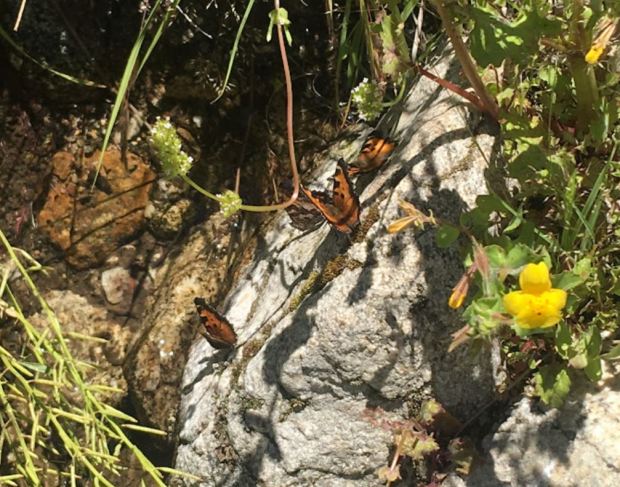
Monarchs, painted ladies, and tortoise shell butterflies are three kinds of butterflies that migrate to and from the Monterey Bay area. Each has its own story.
Butterfly Life History, Reviewed
To understand the rest of what I have to tell you, you’ll have to recall some basics about butterflies. The flying creatures you see are just one of the life history stages of these insects. These flying ones are called ‘adults’ because they are the ones that are reproductive. They mate and the females attach eggs to just the right plant where their hatchlings will want to feed. The eggs sit a while before hatching. When they hatch, out comes what is called a larva, or caterpillar. The caterpillar feeds on certain kinds of plant leaves, gets bigger, and one day finds itself yearning to change. At that miraculous point, the caterpillar morphs into an entirely different-looking thing: a chrysalis. The chrysalis hangs apparently doing nothing, but actually it is using stored food to change into an adult. A chrysalis can move a little. Once the chrysalis has developed it morphs once again, this time emerging as an adult.
Co-Evolution
Plants and butterfly larvae co-evolve, plant genetic diversity creates new generations increasingly well-guarded against caterpillars that eat them. Plants evolve caterpillar toxins, better hairs to clog the mouths or throats of larvae, changed leaf shapes or colors so that they are less recognizable to ovipositing female butterflies, and modifications for food and homes for ants that guard against caterpillars. There are countless other evolutionary strategies to avoid what is called predation by caterpillars. On the other side of the playing field, butterfly species also evolve so that new generations are better adapted to those strategies.
Food Plants
Each of the butterflies I focus on in this essay have co-evolved with plants as outlined above. Monarchs eat milkweed, a highly toxic plant that a few other closely co-evolved species can eat. Painted ladies eat a wide variety of plants with many complex adaptations to herbivory – they are super-eaters! California tortoiseshell butterflies eat Ceanothus, a widespread shrub genus with its own chemistry to ward off herbivores.
Butterfly Maps
Monarch butterflies travel west to the Monterey Bay area in large numbers for the winter to avoid inland frost. Painted ladies travel north as their food dries up in the desert and new food is still edible further north. Tortoiseshell butterflies travel west from high elevations in the Sierra Nevada, also to over winter in our more temperate clime. Those are the simple overviews, but the details are much more complex.
Monarch Life History
In Spring through Fall, four generations of monarch butterflies enjoy life across much of the US before returning to their overwintering spots in Mexico or coastal California. That means there are four batches of fattening caterpillars munching away on milkweed, metamorphosing into chrysalises, and emerging again as those beautiful orange and black, big butterflies to move north. That last generation somehow knows that it must move south (or West to CA), where to avoid the frosts that would kill them if they didn’t leave their succulent patches of milkweed.
Many monarch butterflies have been traveling to high elevation northern Mexico where the climate has been just right for their winter respite. People have been harvesting wood from those forests, reducing habitat. Also, climate change is creating hotter, drier conditions, which might be negatively impacting the quality of that habitat. The only other place that monarch butterflies know to go is coastal California.
On California’s coast, there have been approximately 400 historic overwintering locations from Mendocino County to San Diego County. Only a small subset of these overwintering spots are on land managed by conservation organizations. Most people around here know to check out Natural Bridges State Beach, but there are other spots, as well. The UCSC Arboretum’s Eucalyptus Grove has been home to large numbers of overwintering monarch butterflies in the past. And, overwintering sites #3009 and #3010 are in groves of eucalyptus near Davenport on BLM’s Cotoni Coast Dairies property.
Painted Lady Life History
Painted lady butterflies have a slightly more complex life history and some populations travel much farther than monarch butterflies. The African population flies back and forth 9,000 miles! That’s twice the monarch butterfly migration length.
One late spring, I watched as thousands of painted ladies flew by me, moving south to north in the high elevations of Big Sur’s wildlands. They had originated in the deserts near California’s border with Mexico and were headed as far as they could fly, with an ability to fly most of the length of California in about a week. When one uses up their body fat, which they made as caterpillars, they stop, mate, and lay eggs. The next generation hatches, caterpillars eat as much as they can, then they metamorphose through to chrysalis and adults, which then fly, fly, fly, towards the Pacific Northwest. Come August, wherever an adult painted lady might be, they turn to fly south again. You can see painted lady butterflies all summer long here, but they are more numerous in the Spring when you, if you are lucky and it’s a good year for this species, you can spy hundreds moving north.
California Tortoiseshell Life History
8 years after the Lockheed Fire, California lilac was head-high and abundant in the footprint of that fire. As I led a University field trip in late June, the students were tittering and I couldn’t get their attention. They gleefully pointed out that the shrubs around me were twitching and dancing. I was astonished to see the frantically wiggling chrysalises of hundreds of California tortoiseshell butterflies shaking denuded Ceanothus shrubs all around us. Above the shrubs, clouds of newly emerged California tortoiseshell butterflies were sailing about. Soon, they would be taking flight to the mid-elevation Sierra Nevada to lay eggs on a different species of Ceanothus; they’d run out of tasty leaves here on the coast! After that generation similarly denuded those patches of Ceanothus and made that same wiggle-frenzy of excited chrysalises, those adults fly to the highest elevations in the Sierra Nevada to eat yet a different species of Ceanothus. Running out of Ceanothus and elevation, it is that generation that flies all the way back to Monterey Bay to lay eggs on our Ceanothus and start the cycle again.
Originally published by Bruce Bratton in his famous BrattonOnline.com blog
 Grey Hayes