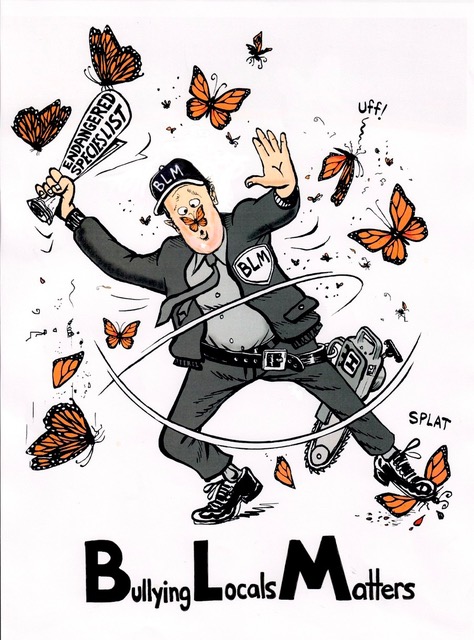
The California division of the Bureau of Land Management suggests that it is concerned about rare species, but what evidence is there for those of us considering their management of Cotoni Coast Dairies? It is crucial that public land managers take care of rare wildlife and plants – doesn’t it seem like public lands are the right place for species conservation? Let’s consider what we’ve seen…
Background
The BLM has some great policies to guide its management of rare species. It has a guidance manual, Manual 6840 “Special Status Species Management,” that says that BLM will manage not only for species on the USA’s list of threatened and endangered species, but also for species that are candidates for listing as well as those which State wildlife agencies consider priorities for conservation. The manual directs each BLM State office to keep a list of State Sensitive Species (both wildlife and plants) and to update those lists every 5 years in collaboration with State wildlife agencies.
BLM California has published the following lists of sensitive plants and wildlife.
California BLM’s Sensitive Species: Problems
Although BLM’s policies are good, somehow their implementation at Cotoni Coast Dairies, designated as one of 5 onshore units of California’s Coastal National Monument, has been faulty. For instance, plant species listed by the State as rare (Rank 1B) are automatically considered sensitive according to BLM policy, but the BLM California sensitive plant list is missing three of the California rare plant Rank 1B species that have been documented at Cotoni Coast Dairies: Choris’ popcornflower, Santa Cruz manzanita, and Monterey pine. In addition, although BLM’s State Sensitive Plant List has Point Reyes Horkelia, it is not noted as occurring under the management of the Central Coast Field Office, which oversees Cotoni Coast Dairies. Moreover, the last time BLM’s sensitive wildlife list was updated was 2009; it is missing many species recognized by California Department of Fish and Wildlife as rare, including some that occur at Cotoni Coast Dairies. Here are the Cotoni Coast Dairies’ wildlife species that would have been included on BLM’s sensitive wildlife list if the BLM California State Director Karen Mouritsen were following her mandated actions under Manual 6840:
| Common name | Latin name | Rarity Status |
| Grasshopper sparrow | Ammodramus savannarum | CA Species of Special Concern (nesting) |
| Northern harrier | Circus cyaneus | CA Species of Special Concern (nesting) |
| Olive-sided flycatcher | Contopus cooperi | CA Species of Special Concern (nesting) |
| American badger | Taxidea taxus | CA Species of Special Concern |
| San Francisco dusky-footed woodrat | Neotoma fuscipes annectens | CA Species of Special Concern |
BLM Central Coast Field Office: Problems
The staff at BLM’s Central Coast Field Office have described themselves as being ‘conservationists.’ If this is so, then they are prevented from carrying out their self-professed ideology by someone higher up in BLM, perhaps at the State BLM level under Director Mouritsen’s oversight. In 2021, Michael Powers is listed as the author of the “Biological Monitoring Plan, Cotoni-Coast Dairies unit of the California Coastal National Monument, Updated December 2021.” It is odd that there is a monitoring plan in absence of the science plan mandated by the 6220 Manual, which provides policy for managing units of National Monuments under BLM’s stewardship. This oddness continues when one more closely peruses Mr. Powers’ monitoring plan.
Section V of the monitoring plan is titled “Special Status Species,” but the section fails to mention the majority of wildlife and plants on California BLM’s sensitive species lists. The only species listed in this section are the California red-legged frog, steelhead trout, and coho salmon – these noted as ‘Federally Listed’ at the top of that section. The section of the monitoring plan fails to list the monarch butterfly, which was published by the US Fish and Wildlife Service as a candidate for listing as endangered a year before the monitoring plan, in 2020. According to BLM policy in the 6840 manual, federally published candidate species are to be considered sensitive species with such monitoring plans.
BLM Natural Resource Impacts
Some would suggest that plans are just plans and lists are just lists, but how do these things really matter? Someone in one of the California BLM offices ordered candidate species monarch butterfly habitat to be destroyed at Cotoni Coast Dairies (one day, we’ll know who!). Destroying that habitat makes it more difficult to restore healthy populations of monarch butterflies on Planet Earth. The increasing rarity of monarch butterflies that BLM has created places more burden on other landowners, both public and private to help monarchs not become extinct.

More broadly, someone evidently told BLM’s Mr. Powers not to consider the entirety of California State BLM-listed sensitive species in the monitoring and, presumably, management of Cotoni Coast Dairies. Since BLM State or local officials have not asked for help with budget, there must be some other issue, but political issues don’t seem logical. BLM’s policy states the following reason for analyzing, monitoring, and planning for the conservation of sensitive species: “to promote their conservation and reduce the likelihood and need for future listing under the ESA.” The majority of Americans on either side of the political divide support wildlife conservation. It is in everyone’s interest for species not to qualify for listing under the Endangered Species Act.
Without concerted collaborative effort, it is likely that at least one of the sensitive plants or animals at Cotoni Coast Dairies will face listing under the Endangered Species Act (ESA) in the next 30 years. The Point Reyes Horkelia is probably the most likely species, but the Monarch butterfly is also quite likely. The BLM has no plans to monitor those species, so the agency won’t know if its management of Cotoni Coast Dairies is helping or hurting those species.
What You Can Do
Would you please help? Please write State Director Mouritsen and ask her to protect sensitive species at Cotoni Coast Dairies as well as throughout California. You might mention that she should:
- Order the Central Coast Field Office to consider BLM California’s sensitive plants and wildlife at Cotoni Coast Dairies as required by BLM’s 6840 Special Status Species Manual.
- Publish an updated State BLM sensitive wildlife list in collaboration with the California Department of Fish and Wildlife, as mandated by the BLM’s 6840 Special Status Species Manual.
- Publish an updated State BLM sensitive plant list to include the State ranked 1B plant species documented at Cotoni Coast Dairies, as mandated by the 6840 Manual.
- Respect those who care about natural resource protection as much as she respects those clamoring for access for mountain bikes at Cotoni Coast Dairies.
- Publish a Science Plan for Cotoni Coast Dairies as required by BLM’s 6220 National Monuments, National Conservation Areas, and Similar Designations (Public) Manual
That could be a short email note….it would be fast to write! It could even be a cut-and-paste of the those bullets. What we need is numbers of notes to show the Director that there are lots of people who care. Here’s her email address: kmourits@blm.gov It would be great if you could cc me, so I have a record of the communications: coastalprairie@aol.com
-this article originally published in Bruce Bratton’s impactful weekly blog BrattonOnline.com
 Grey Hayes
2 comments