oc

Balmy Days, Cool Ocean Breezes

The days have been perfectly warm with a light breeze off the ocean – we have not been smited by the heat so famously noted in inland California and 5. The cool upwelling ocean has been our nearby friend.

Some odd clouds have been streaming overhead, making for glorious sunsets. One sunset this past week was (briefly) completely Pure Lucious Purple.

Cherries Cherries and more Cherries.

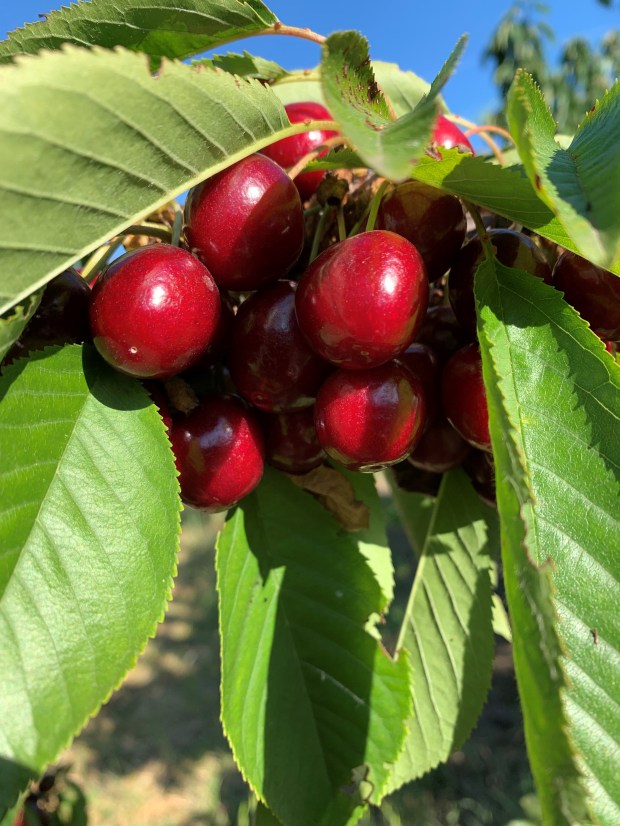
In the past two weeks, we’ve harvested 75 pounds off of the 18 trees. There are another 60 pounds at least ripe right now; those we’ll pick for Two Dog Farm to take to the Alemany Farmer’s Market in San Francisco on this Saturday. The heat is making them get ripe in a hurry! Family, friends, and Community Orchardists are thick in cherry fruit, the very best anyone has experienced. Yum.

In the depths of the night, occasionally we get fog. Rarely now, we wake up to a brief patch of fog, but its not too drippy.

Yip Yip Horray!

Also in the deep dark night: coyote chorus. High squeaky notes of coyote song ring out across the farm. At least three animals are celebrating and almost every night, late-late at night.

Giant gopher snakes are out sunning themselves on the road, frequently.

The second, or third, batch of new bunnies has arrived. There are also big batches of new quail everywhere- not still fluffy, but young enough to be Very entertaining to watch in their barely coordinated flights, weaving willy-nilly much to their parents’ chagrin. After such a flush, it must take hours to regather the covey. Another successful reproductive situation: The Deer! A mother deer is trailing a single fawn around the property.

Here’s a confirmation that Maw and Caw have been quite successful again with two adolescent yelling and demanding offspring. They are good parents, watching carefully after the kids.

In a tall tree near the Brush Field, a pair of red tailed hawks have fledged a talkative young one. This is the first pair and the first offspring I’ve seen since my arrival in 2008. We could use more hawk action with the burgeoning bunnies, gophers, and mice.

Hay There

The grass has dried. All of the grass has dried. So, it is time to make the Last Mowing, dust and all. There are three ways to get rid of the hay this late in the season: 1) pile the hay in the field and let it moulder; hope to apply at the onset of rains before it becomes too heavy to move…2) compost it, layered with dirt and weeds, kept moist…3) put it on the dirt roads for dust control. After the CZU fire burned up the freshly applied understory hay, we won’t be fooled again. Wait for more mulch application! Otherwise, we grind up the hay and leave it be in the roadsides and fields where it won’t be harvested. The mice will like it there. I saw a bunny eating such ‘stored’ hay recently.

-this post also shared via Molino Creek Farm’s webpage, see this link.

The US Bureau of Land Management-  Species Conservationists?

The California division of the Bureau of Land Management suggests that it is concerned about rare species, but what evidence is there for those of us considering their management of Cotoni Coast Dairies? It is crucial that public land managers take care of rare wildlife and plants – doesn’t it seem like public lands are the right place for species conservation? Let’s consider what we’ve seen…

Background

The BLM has some great policies to guide its management of rare species. It has a guidance manual, Manual 6840 “Special Status Species Management,” that says that BLM will manage not only for species on the USA’s list of threatened and endangered species, but also for species that are candidates for listing as well as those which State wildlife agencies consider priorities for conservation. The manual directs each BLM State office to keep a list of State Sensitive Species (both wildlife and plants) and to update those lists every 5 years in collaboration with State wildlife agencies.

BLM California has published the following lists of sensitive plants and wildlife.

California BLM’s Sensitive Species: Problems

Although BLM’s policies are good, somehow their implementation at Cotoni Coast Dairies, designated as one of  5 onshore units of California’s Coastal National Monument, has been faulty. For instance, plant species listed by the State as rare (Rank 1B) are automatically considered sensitive according to BLM policy, but the BLM California sensitive plant list is missing three of the California rare plant Rank 1B species that have been documented at Cotoni Coast Dairies: Choris’ popcornflower, Santa Cruz manzanita, and Monterey pine. In addition, although BLM’s State Sensitive Plant List has Point Reyes Horkelia, it is not noted as occurring under the management of the Central Coast Field Office, which oversees Cotoni Coast Dairies. Moreover, the last time BLM’s sensitive wildlife list was updated was 2009; it is missing many species recognized by California Department of Fish and Wildlife as rare, including some that occur at Cotoni Coast Dairies. Here are the Cotoni Coast Dairies’ wildlife species that would have been included on BLM’s sensitive wildlife list if the BLM California State Director Karen Mouritsen were following her mandated actions under Manual 6840:

Common nameLatin nameRarity Status
   
Grasshopper sparrowAmmodramus savannarumCA Species of Special Concern (nesting)  
Northern harrierCircus cyaneus  CA Species of Special Concern (nesting)  
Olive-sided flycatcher  Contopus cooperiCA Species of Special Concern (nesting)  
American badgerTaxidea taxusCA Species of Special Concern  
San Francisco dusky-footed woodratNeotoma fuscipes annectens  CA Species of Special Concern

BLM Central Coast Field Office: Problems

 The staff at BLM’s Central Coast Field Office have described themselves as being ‘conservationists.’ If this is so, then they are prevented from carrying out their self-professed ideology by someone higher up in BLM, perhaps at the State BLM level under Director Mouritsen’s oversight. In 2021, Michael Powers is listed as the author of the “Biological Monitoring Plan, Cotoni-Coast Dairies unit of the California Coastal National Monument, Updated December 2021.” It is odd that there is a monitoring plan in absence of the science plan mandated by the 6220 Manual, which provides policy for managing units of National Monuments under BLM’s stewardship. This oddness continues when one more closely peruses Mr. Powers’ monitoring plan.

Section V of the monitoring plan is titled “Special Status Species,” but the section fails to mention the majority of wildlife and plants on California BLM’s sensitive species lists. The only species listed in this section are the California red-legged frog, steelhead trout, and coho salmon – these noted as ‘Federally Listed’ at the top of that section.  The section of the monitoring plan fails to list the monarch butterfly, which was published by the US Fish and Wildlife Service as a candidate for listing as endangered a year before the monitoring plan, in 2020. According to BLM policy in the 6840 manual, federally published candidate species are to be considered sensitive species with such monitoring plans.

BLM Natural Resource Impacts

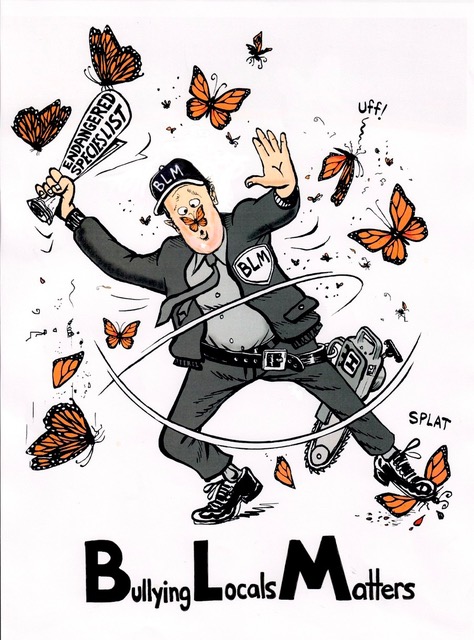
Some would suggest that plans are just plans and lists are just lists, but how do these things really matter? Someone in one of the California BLM offices ordered candidate species monarch butterfly habitat to be destroyed at Cotoni Coast Dairies (one day, we’ll know who!). Destroying that habitat makes it more difficult to restore healthy populations of monarch butterflies on Planet Earth. The increasing rarity of monarch butterflies that BLM has created places more burden on other landowners, both public and private to help monarchs not become extinct.

More broadly, someone evidently told BLM’s Mr. Powers not to consider the entirety of California State BLM-listed sensitive species in the monitoring and, presumably, management of Cotoni Coast Dairies. Since BLM State or local officials have not asked for help with budget, there must be some other issue, but political issues don’t seem logical. BLM’s policy states the following reason for analyzing, monitoring, and planning for the conservation of sensitive species: “to promote their conservation and reduce the likelihood and need for future listing under the ESA.” The majority of Americans on either side of the political divide support wildlife conservation. It is in everyone’s interest for species not to qualify for listing under the Endangered Species Act.

Without concerted collaborative effort, it is likely that at least one of the sensitive plants or animals at Cotoni Coast Dairies will face listing under the Endangered Species Act (ESA) in the next 30 years. The Point Reyes Horkelia is probably the most likely species, but the Monarch butterfly is also quite likely. The BLM has no plans to monitor those species, so the agency won’t know if its management of Cotoni Coast Dairies is helping or hurting those species.

What You Can Do

Would you please help? Please write State Director Mouritsen and ask her to protect sensitive species at Cotoni Coast Dairies as well as throughout California. You might mention that she should:

  • Order the Central Coast Field Office to consider BLM California’s sensitive plants and wildlife at Cotoni Coast Dairies as required by BLM’s 6840 Special Status Species Manual.
  • Publish an updated State BLM sensitive wildlife list in collaboration with the California Department of Fish and Wildlife, as mandated by the BLM’s 6840 Special Status Species Manual.
  • Publish an updated State BLM sensitive plant list to include the State ranked 1B plant species documented at Cotoni Coast Dairies, as mandated by the 6840 Manual.
  • Respect those who care about natural resource protection as much as she respects those clamoring for access for mountain bikes at Cotoni Coast Dairies.
  • Publish a Science Plan for Cotoni Coast Dairies as required by BLM’s 6220 National Monuments, National Conservation Areas, and Similar Designations (Public) Manual

That could be a short email note….it would be fast to write! It could even be a cut-and-paste of the those bullets. What we need is numbers of notes to show the Director that there are lots of people who care. Here’s her email address: kmourits@blm.gov It would be great if you could cc me, so I have a record of the communications: coastalprairie@aol.com

-this article originally published in Bruce Bratton’s impactful weekly blog BrattonOnline.com

Fattening Apples, Impending Heat

The tension of summer is upon us. We relish the beautiful days, like today, with an ocean breeze and high temperatures in the upper 70s to low 80s. The nights are cool enough to be our air conditioning. We awake to cool houses that slowly warm as the day progresses until the (welcome) onset of cooler evenings. The crickets are loud, the birds silent in the midday warmth, and cicadas fill the heat of the day with their one note, incessant, high metallic-whining song.

The magnificent pulse of pleasantly warm days and cool nights used to be normal, for decades it was normal. Recently, there is a prickle of worry that the HEAT will arrive: days of above 90s when the night never cool. We’ve had 4 of those in the last 3 years, 1 right before the 2020 fire and one just after. Those are tough. We might get one of those this weekend. The Weather Service can’t say. While they predict 110F inland, ”readings along the coast are a bit more tricky.” Sigh. All we can do is get the irrigated ground as wet as possible to buffer our poor crops against what might be wilting, damaging heat.

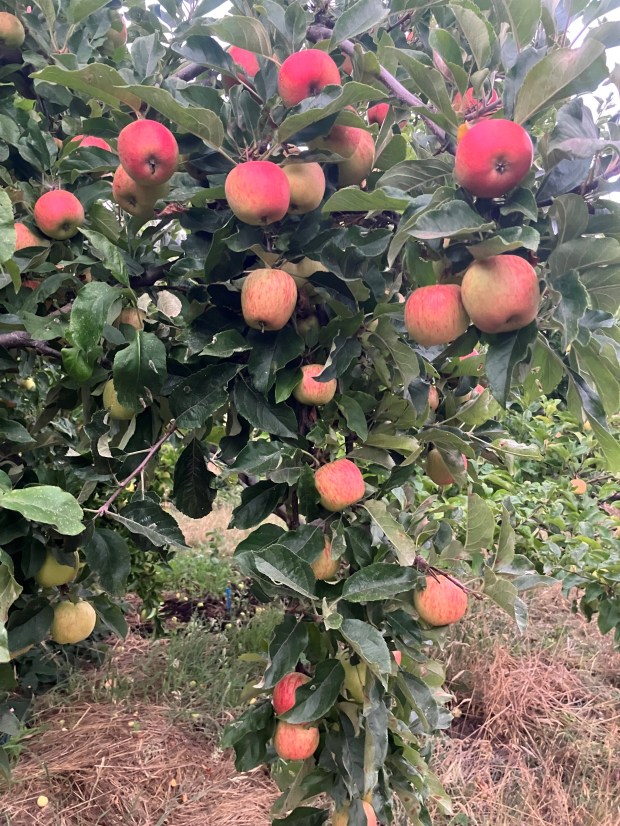
Molino Community Orchardists produce this beauty…a gala apple tree perfectly thinned

Pomelogically Speaking

Meanwhile, in the cool shade of apples trees…We gaze across a lush and happy orchard filled with quarter-sized fruit peaking out from beneath the protective cover of deep green leaves. The many hands of orchard collective workers have thinned almost the entire orchard to well-spaced fruit that is gaining girth expeditiously. By taking off most of the fruit and leaving a few, we relieve the mother trees of too much work. You can almost hear them sigh and relax.

The apple trees are growing so well that their bark is splitting, the first furrows appear on our aging tree trunks. So, this is how trees show their wrinkles. We are only a month away from the first apples ripening: The Gravensteins. We will have just two of those types of apple trees bearing this time around, but there are many more small ones getting bigger – 3 more years and the crop will begin to burgeon. After that, the Gala apples will be on hand in 2 months, and that’s the beginning of the big apple party. Apple trees do not like warm roots, but this spring saw the canopies grow so much that there is good shade across most of the orchard floor. The edge trees suffer more, but we’ll dispense thick mulch over their tender roots soon enough.

Plum Nothing!

Soon, there will be plums but none right now. The challenge with plums is netting them. We need to create an easy-to-deploy single tree netting system, so we can get plums this year. There is a promising fruit set.

Maw and Caw Update

Taking my morning stroll this morning, I heard a raven scream from down near the netted cherry grove. ‘Oh NO!’ I thought…’What’s wrong?!’ Perched on the cherry net structure were 4 ravens, not just our farm pair, Maw and Caw. Did they have twins this year? Was that single scream an obnoxious raven yell, so typical of their adolescent young? More study is needed.

Other Wildlife Observations

Foxes and coyotes calling, fledged barn swallows, frequent Lazuli song. It sounds like someone is strangling a cat, but its just a gray fox calling. It was very startling, though. It’s the first sign I’ve had in a long time that the foxes are still around. Uh-oh for the fruit, though.

Sylvie woke one night to the pitched song of coyotes.

One of the 4 fledged barn swallows from my porch hung upside down like a bat for an hour yesterday. What’s up with that. I worried that it was sick, but then saw it idly preening itself while hanging upside down. Odd bird! It seems to the smallest and is quite a rebel. The other three fly one way, it tilts its head at them going that way, chips, and flies a different way.

The laughing calls of lazuli bunting are very common on the farm. They well compliment the high giggling peeps of the many lesser goldfinches that are feasting on Madia seed happily.

Molino Creek Farm’s dryfarmed tomatoes

Farming

Dusty clouds billow in the wake of mowing tractors, weed-tilling tractors. Bent forms slowly hoe their way down the rows in the morning heat. Shimmering waves of warmth bend the images of quickly growing crops, not yet covering the ground, but soon! This is the time of cash outlay, the gamble that the harvest will bring the returns to pay back all the labor going into the crops right now. Killing gophers, weeding, watering…repeating…over and over, the harvest weeks away.

Black walnut – we have a lot of them on the farm!

Walnuts

We have a lot of black walnuts growing on our farm, never harvested. Still, they are beautiful trees!

-this post also placed at the Molino Creek Farm web space.

Oaks, Terrestrial Coral Reef Analogues

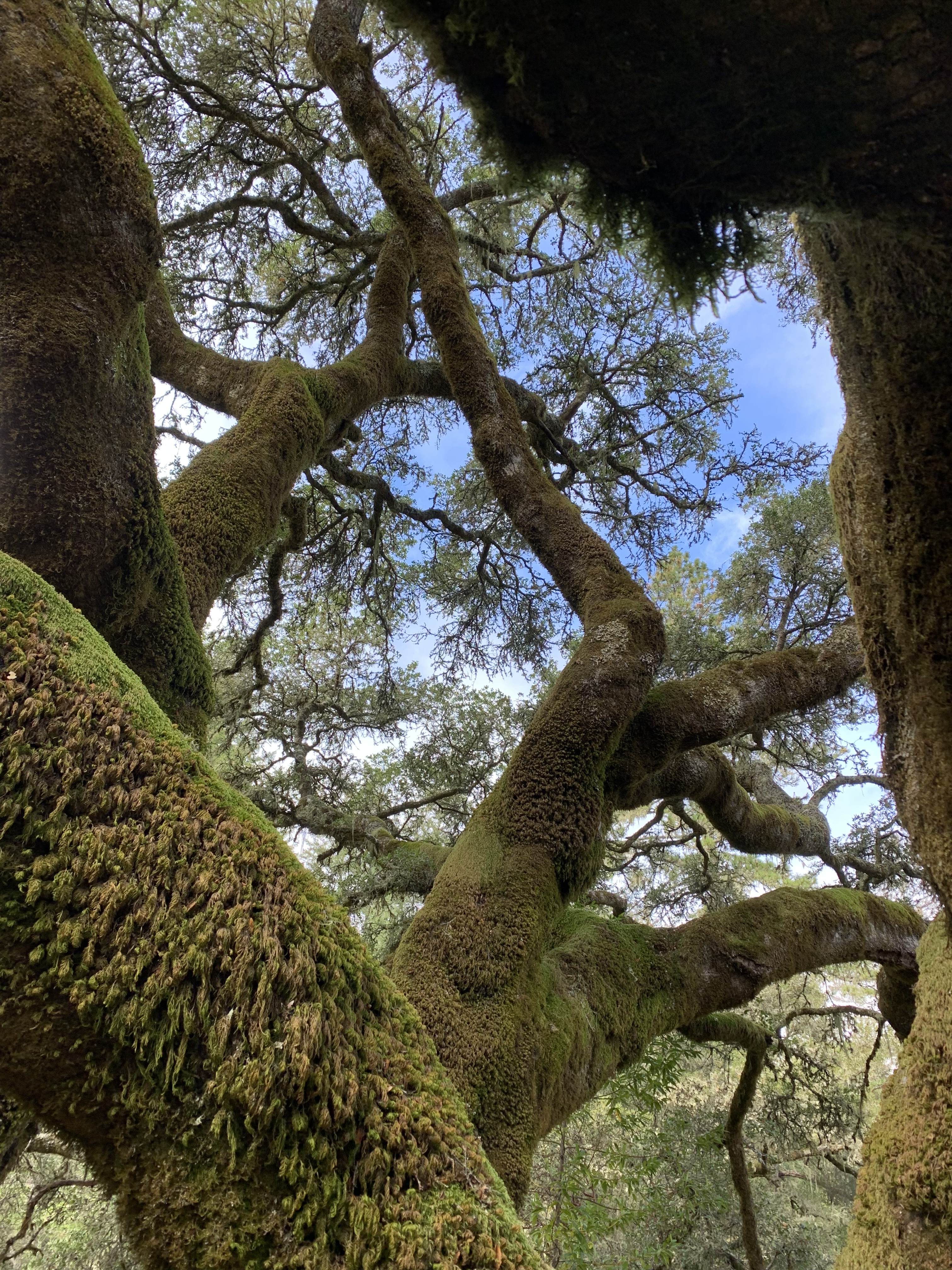
This past weekend, I had occasion to gaze for hours on end up into oak trees, reminding me of an analogy I’ve thought about where oak trees are like terrestrial coral reefs. When snorkeling around an atoll with patches of coral, I glide over vast sea grass beds, which hide flounder, conch, rays, and serve as habitat for many more species. Ahead, I see a tall, dark shadow looming and slowly coming into view is a coral patch. As I draw near, many species of colorful fish dart in and out of crevices and caves formed by the coral. Far from those tropical waters, I hike through extensive grasslands startling grasshopper and savannah sparrows, snakes, and a resting fawn. As I draw closer to the oak forest that rings the grasslands, I see new species of colorful birds and many butterflies popping out and flying back into the protection of the oak canopies.

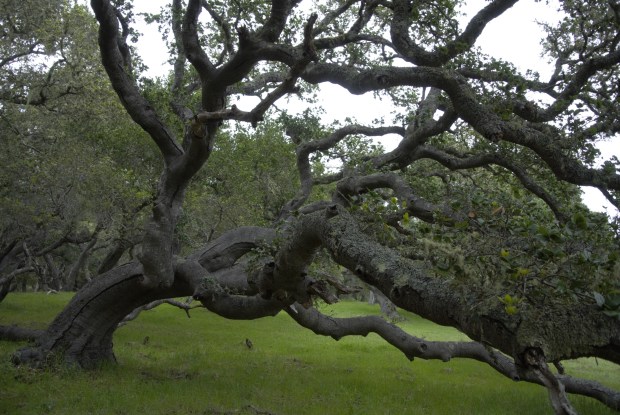
The long-lived evergreen oaks of the central coast serve super-important roles supporting wildlife, and their canopy structure lends for spellbinding entertainment.

Towering live oak near Santa Cruz, California – epiphytic mosses and lichens regularly abound

Our California Sister

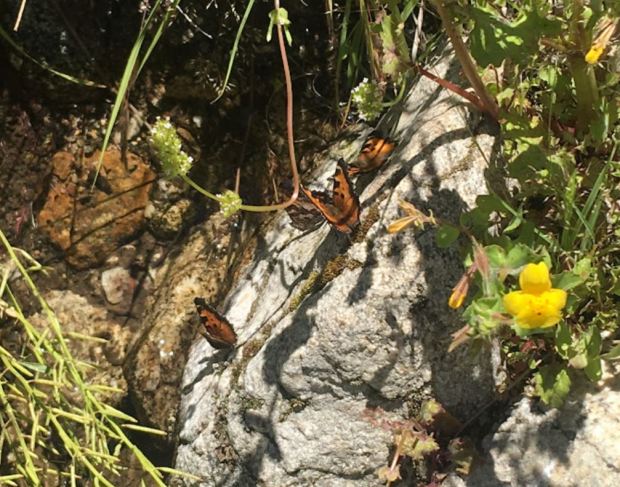
I want to tell you about an oak-related butterfly that often catches my attention. California sister, Adelpha californica. If you spend much time around one of our live oaks right now, chances are good that you’ll see one of these strikingly beautiful butterflies. They can be very, very energetic fliers with bursts of energy followed by short glides, and lots of sudden turns. They behave more like predacious dragonflies than nectar-loving butterflies. Flying in and out of each hole in an oak canopy, they sometimes dart down the top of each branch, methodically seeming to examine every bit of structure. Why?

I have many hypotheses about this high energy ‘patrolling’ of oaks by California sister butterflies. Are they guarding their eggs or larval babies? It takes more than 60 days for an egg to reach its adult stage, growing from tiny to larger caterpillars along the way. During the caterpillar stage, they are vulnerable to predation or harassment by many things, though apparently neither the young or the adult butterflies are tasty due to concentration of toxic oak-leaf compounds. So, perhaps they are looking for just the right place, and just the right time, to glue one of their eggs to the oak. Back and forth the colorful butterflies go, flitting in and out of shade, deeper into the canopy or out from it in the full sun. Maybe they are thermoregulating through this behavior. I also wonder if they might not be clearing spider webs from their territory, to make it safer for their young to learn to fly after they emerge from chrysalis with their tender young wings and clumsy first flights.

Do the California sister butterflies fly around the trees where they grew up, or do they move around more? Are there generation after generation of the same families in the same trees? Do they guard the flower patches near their trees, to maximize their access to nectar? So many questions…

Other Oak Denizens

While watching the California sister antics, I saw a bright yellow swallowtail butterfly cruise rapidly by. Was it a coincidence that it didn’t slow down or was it wary of the danger of trespassing into California sister territory?

In the heat of the day, a high buzzing noise fills the air around the oak groves; during the morning and evening, there are clicks. Both of those sounds are cicadas. The buzzing noise are male adult cicadas. In the soil beneath the oak leaf duff, unwinged young cicadas are sucking on roots for a living. One day, they emerge as winged adults, shedding a hideous exoskeleton that you can sometimes find laying around. Female cicadas lay eggs in holes they cut into an oak tree’s pencil-thin twig bark.

Occasionally, some say especially at the onset of droughts, oak moths flitter around the canopies of oaks by the hundreds. They look like large, animated confetti. Their larvae drop so much poop in those episodic years that it sounds like it’s raining. They don’t kill the oaks, generally- perhaps they help defoliate the trees to keep them from using too much water…or perhaps they help cycle nutrients with all of their rich poop.

Still More Oak Friends

More than once, I saw dragonflies perching on the outermost tips of oak branches. So many bugs jet in and out of the oak canopy that there are plenty of chances for those dragonflies to grab one up and make a meal of it.

I recently encountered an oak tree that buzzed. Looking into the canopy, I noticed that yellow jacket wasps were animating the entire tree with buzzing movement. The wasps were eating an outbreak of oak pests, or just lapping up sweet insect exudates, from scale or aphids, I couldn’t tell – they were too high up.

Some of the oak associate insects make odd looking structures called “galls.” There are lots of different things that do that, and that previous link is a great place to explore the amazing variation of species. I add a photo of one I found this past weekend here, next to a canyon live oak acorn cup.

Birds in the Mix

Oak trees also provide for many birds. Acorns are important food to California scrub jays, which have been shown to store 7,000 acorns in the soil and subsequently forgetting about some that germinate and grow. Acorn woodpeckers store their acorns in holes in tree trunks. Lots of other birds eat acorns.

The most colorful oak bird is the Townsend’s warbler, which (unlike many other of its warbler relatives) overwinters along the coast in California. It is a real treat to see this yellow-streaked bird darting around an oak canopy in the otherwise drab winter.

As oaks get older, they drop limbs, leaving behind cavities that provide nesting locations for other colorful birds, such as the Western blue bird. Such nesting cavities are a limiting factor for the survival of many bird species.

A rare stand of a special live oak – Shreve oak, Quercus parvula shreveii, near Davenport, California

Help the Oaks

Besides the many species of life that oaks support, oak trees make great shade, are drought tolerant, and grow nice firewood. The entertainment value of having an oak close to your home is well worth it. You can grow an oak tree almost no matter what kind of soil you have near your house. So, why not plant one? Or not…if you are lucky enough to live near oak trees, you can bet that a scrub jay will plant one for you and all you need do is help the sprouted young plant along.

If you pick a nursery oak tree, make sure that it is less than a year old and that the roots aren’t swirling around inside the pot: messed up roots are terribly detrimental. If one of those early roots goes around in a circle inside the pot, the mature root will follow its path, a disadvantage to long-term tree health.

You’ll want to water a new oak regularly through the first summer, but not thereafter. Try to avoid summer water if at all possible past the first year.

Oaks grow faster than you think! Get ready to plant one this fall by scoping out the right spot…

-this post originally published by Bruce Bratton at BrattonOnline.com

Never Cry Wolf? A Situation of Subservience

Whenever I wonder why more people aren’t protesting, I think of debt. We owe, we owe, so off to work we go. The income gap widens with constant reminders of homelessness and sick friends/relatives reminding us of the fragility of our lives and the expenses of medical care. Workplaces warn us that we represent The Corporation, even when we speak out as citizens. It is news and some laugh when a Jan 6th protester gets fired because of their illegal actions, but the same holds true for lesser, legal protests on the other side of the political spectrum. Most people find they can no longer afford to protest. The wolf is in the house…and no one is saying anything!

Submit, Move

Even if you aren’t protesting, if you are a federal employee, your work is subject to political whims.

I was working with some brilliant grants officers with the US Department of Agriculture (USDA) just before the last president was elected from the Republican side of the aisle. These employees had good experience navigating the complex Washington DC bureaucracy to help disperse and manage federal funding for the most competitive proposals. Republicans ordered that their USDA office move from DC to Kansas City, and all of those grants officers left, retiring early or finding other jobs. They couldn’t leave their communities, their homes, or their histories behind.

Similarly, but with Democrats at the helm, someone, for some reason, ordered our regional Bureau of Land Management office to move from Hollister to Marina. This put the main office many more miles distant from most of the land their staff managed and, if a BLM employee wanted to stay with the agency, now they had to move or commute a long distance to work.

You can speculate about why those administrations moved the agency offices. We are lucky to have a US Government Accountability Office report showing that the rationale for the USDA move was ludicrous, and so was clearly politically motivated. We don’t have any such study about the Central Coast BLM office, but I’m guessing that it was similarly politically motivated…but why?

Shut Up or Move!

Politically motivated office moving isn’t the only way a public employee might be ordered to pack their bags for a new location or leave. State and Federal public employees working for organizations like State and Federal Parks, the Bureau of Land Management, and State and Federal Wildlife agencies are very shy about saying anything substantive at all about their work. Saying the wrong thing to the wrong person can get you transferred to an unpleasant area doing unpleasant work.

You have to understand that in order to disentangle anything one of those employees says on record.

Puzzling Quotes

I want to present a couple of puzzling quotes from the media from some State and Federal employees working on issues crucial to conservation in California. Two things to keep in mind: 1) democracy depends on an informed citizenry, and a free press is key to that; 2) reporters sometimes get quotes wrong or use them out of context.

State Wildlife Agency Speaks

The first quote is verbatim from a recording from KCBS 740 a.m. from 6/2/2023; you can listen to it here. The story was on the remarkable documentation of one of the state’s most endangered wildlife species, a wolverine. The reporter, Holly Quan, asked how the State is monitoring the wolverine population, and this is the reply from California Department of Fish and Wildlife’s (CDFW’s) David Gammons:

“That’s the $10 million question right there. It’s a pretty difficult thing to do. Estimating the number of any wild animal is a difficult thing to do whether it’s a mule deer where there is a lot of them or something like a wolverine that’s a very rare species.”

The wolverine is protected under California’s Endangered Species Act. CDFW’s mission is to “manage California’s diverse fish, wildlife, and plant resources, and the habitats upon which they depend, for their ecological values and their use and enjoyment by the public.” CDFW has a long history of underfunded monitoring programs and too few well-trained wildlife biologists to adequately manage the State’s increasingly dwindling wildlife. Mr. Gammons not only did not answer the reporter’s question, but also failed to help the public to understand how woefully inadequate the funding is for his agency to do its job. Shame on Ms. Quan for not following up to get a better answer from him.

Federal BLM Talking

Here’s another puzzling paraphrase and quote. This is from a Lookout Santa Cruz article published on 5/30/2023 by Christopher Neely. Mr. Neely asked Zachary Ormsby, BLM’s Central Coast Field Manager, about how he plans to move forward with controversial management dilemmas, including poor access planning and, given expected high visitor numbers, a lack of a science-based approach for wildlife conservation at Cotoni Coast Dairies.

Neely paraphrases the beginning of Ormsby’s answer here:

“The federal government will consider public comment and sentiment on the plan and alternatives, but BLM has the power to unilaterally decide the path forward, Ormsby says. Ormsby says a parking lot is not guaranteed or required before BLM opens the land to the broader public.”

And this is a direct quote:

“My perspective is that we’ll come up with a plan and list of options that will allow this community to move forward with confidence and comfort without filing any more appeals,” Ormsby said. “The common element among all the groups is that we love this land. The only thing we’re trying to reconcile is that we all love it collectively.”

Huh? What Did BLM say??

The paraphrased part seems like a quote from BLM’s legal counsel, basically “We can do anything we want.” The second part is more puzzling. It says a lot that he starts with ‘my perspective,’ which gives him an out for potentially not representing BLM. That last bit about ‘love’ is impossible to disentangle- enjoy trying!

Cotoni Coast Dairies is protected as a part of a National Monument as well as being part of the National Conservation Lands network. Both designations come with a regulatory framework that provides strong protections for the primary purpose of these lands: conservation. The land in question lacks the requisite science plan, which should work in tandem with a management plan, allowing management to adapt approaches to protect wildlife from the impacts of public visitation. There are no (ZERO) staff assigned to the property. There is ample evidence that the current, overstretched staff cannot adequately manage the property, even without public use.

As with the prior CDFW example, BLM’s Mr. Ormsby lost an opportunity to stress the importance of more staffing and more funding to adequately protect the property. Instead, he intoned that it would be just fine to allow the public to access the property without those resources. His dodginess isn’t unique: it would seem that there are unwritten dodginess policies coming from at least as high as the BLM California’s state director, Trump-era appointee Karen Mouritsen. All planning documents for Cotoni Coast Dairies have been reviewed at her level and none reference key conservation policies providing National Monument or National Conservation Lands protections or other policy protections for sensitive wildlife and plants. That is considerable politics, amazing with its official subservience to even prior administrations. That’s how far this culture of fear reaches.

The Dilemma of Submission

History reflects poorly on those saying anything like “I was just doing my job.” State and Federal conservation personnel have access to great power, but they walk a tight rope with the political nature of their jobs. If either Mr. Gammons or Mr. Ormsby suggest that their agencies aren’t able to execute their mandates, there might be reprisal. On the other hand, I’m sure that both of these individuals have good intentions and want to be on the side of wildlife conservation. What can they do?

There are outside organizations that can help, but are they doing enough? I’m very impressed with the work of the nonprofit organization Forest Service Employees for Environmental Ethics. BLM has a similar organization, but one that seems a lot less functional, the Public Lands Foundation for American Heritage. CDFW’s Mr. Gammons unfortunately has nowhere similar to turn, but there are two nonprofits left that are pointed primarily to wildlife conservation in California.

Other Avenues

Defenders of Wildlife and The Wildlife Society are two organizations that might help speak out for the heartfelt concerns of public wildlife conservation employees like Mr. Gammons and Mr. Ormsby. I’m sure that many public employees who support conservation are members of these organizations. You might consider supporting them, too! If you have to choose, I suggest you support Defenders of Wildlife. At least the local chapter of the Wildlife Society has proven much more dysfunctional in my experience, refusing to advocate for what is a mandated, routine update of California BLM’s sensitive wildlife list, whereas Defenders of Wildlife has an excellent track record of tangible wildlife conservation outcomes in California.

-this column originally appeared in Bruce Bratton’s BrattonOnline.com weekly blog

Bluebird Chicks

Baby bird begging is almost as beguiling as human baby crying. Heads turn to see what the fuss is about. Perched near the nest, the mother holds her wings out just a bit, anxiously glancing around. I haven’t seen any fledglings, but the earliest squeakers must be close to getting out of their nests. At least two bluebird nest boxes have clutches going. There are other species of baby bird noises from nearby shrubs, from holes in cabin walls, from tree hole cavities, from anywhere there might be enough cover. The lush productive spring promises well-fed big baby birds. Next door, the jays have already been at their nasty deeds, tearing apart barn swallow nests to eat eggs for breakfast.

Orange crowned warblers! I’ve been using the Merlin bird call recognition software on my iPhone, and it has been teaching me better bird identification. I didn’t know warbler calls before using this tool, but now I can recognize orange crowned warblers, which are suddenly (for me) everywhere I hike through the forest. Some focused time recently netted several warblers, all nearby: Wilsons, orange-crowned, black throated gray, MacGilvery’s, and yellow. Most of these were close by, from the sound of them, but nearly invisible. They seemed to like darting around just under the canopy of the acres and acres of 4 foot tall, post fire California lilac. Imagine, a sea of glossy green-leaved shrubs with flashes of yellow birds and a constant sweet warbler song.

Navel orange flowers produce an amazing scent on Molino Creek Farm’s fabulous Citrus Hill

Sweetness in Scent

Song can be sweet, but so can scent. Molino Creek Farm’s citrus orchard has never had so many blossoms. It is peak citrus blossom time, especially with oranges and their particularly alluring scent. It is dizzying many yards downwind. Closer up, the pure white of their simple flowers is beautiful to look at. This flowering is brief. Soon there will be tiny dark green fruit that will get larger by the week and then slowly turn colorful. The harvest is mostly 9 months away, but still we glean the last few limes, lemons, and tangerines. As the flowers fade and the fruit forms, a new flush of leaves will create thick, sheltering canopies of glossy dark green. We put yoghurt containers of feather meal into the drip lines of the citrus orchard more than a month ago, and it seems to be helping with the generous leafing.

Farm Work

Molino Creek Farm and Two Dog have been planting many plants, and now attention turns to hoes. The last rains spur more weed germination in the dry farmed fields. In the irrigated rows, a massive weed flush threatens to overwhelm the crops. The hoeing race is on!

Molino Creek Farm’s famous dry farmed tomatoes are starting a new season in freshly tilled soil

We are irrigating again: a routine that will last until November. Up early to check the water tank level, turn on irrigation valves, hike around the orchard to see if any irrigation is amiss, fix a leak or two and go home. Lunch time (or later!)- repeat in reverse: turn off the irrigation valves, log the water use, check the storage tanks, and head home again. Big cyclical walks around the farm keep creating material for this writing project.

Half the first round of hay raking is done. Mulch for the orchard gets clipped by a sickle bar mower, then sundried (hah!), then raked, then pitchforked onto the mulch cart, hauled to The Trees, and spread around the rootzone thicker than anyone wants to place it. Really? This thick?! This is the third spring since the fire burned up all the mulch. This will be the last year that weeds come up so thick around the trees. The mulch is thick enough now to subdue seedling weeds. There are also mulch benefits of water retention, slow-release fertilizer, root cooling insulation, and wildlife (vole, lizard, snake) habitat. Long live mulch! Mulch is the key to life!! Under the mulch, worms wiggle and scoot, creating a carpet of 2” deep “castings.”

On our carefully stewarded hillsides, a menagerie of native grasses and wildflowers: Elymus glaucus (blue wild rye), lupines and other things…

-this post also placed at Molino Creek Farm’s website.

California’s Coastal Bluff Diversity

A walk on the ocean bluff is invigorating, so close to many amazing natural phenomena, but these areas see too little ecological protection. Ecotones- the area between two habitats- are well known to host the most species. Birders understand the delight in exploring the edge of riparian or other forest habitats to encounter the most species. Likewise, humans are drawn to the edge of the ocean, and if they are aware of the life around them they have the opportunity to see layers upon layers of life.

Picture the many individuals and groups of people enjoying West cliff drive, strolling the bluffs at Wilder Ranch, gathering at the cliff edge across from Davenport, and driving Big Sur’s Coast Highway. Millions of people a year along the edge of the Pacific Ocean are standing, walking, or driving on a biologically precious part of our landscape.

Mostly obliterated: Agriculture takes a bite out of the near-ocean natural environment

Ocean, beaches, bluffs, and more

In the span of very few yards, many things come together. The ocean dynamically intersects with the beach, which in turn interdigitates with bluffs, creeks, rivers, and lagoons. At each of those intersection sites, biological life explodes with diversity. The ocean’s movement back and forth at the edge of the land is an engine of life, mixing air with water, stirring saltwater with fresh, mixing together and grinding up life, redistributing nutrients and lying bare new areas for colonization by new life. The saltwater spray soaks sand dunes and nearby soil, coating nearby leaves, and limiting what life can thrive to those species which can take the salt, a harsh drying mineral. As you back away from the bluff and beach, each yard gets less salty, less windy, less harsh. The plants at the bluff edge have evolved to be nearly flat but just a bit back the same species is short, but upright. Way away from the coast, a species that was ½” tall at the bluffs is 5’ tall in the understory of an oak forest. Seeds grown from each population of those plants will produce plants that are similarly flat, short, or tall. The forces of the ocean drive individual species’ genetic diversity while forming more macro habitat diversity.

A windy north-facing dune face has short mostly perennial vegetation with an understory of moss and ferns to remind us of the cool, sunless moisture. A south-facing dune slope has taller, more drought resistant plants – more flowers, many annual plants. The slightest depressions in dunes and adjacent grass- and shrub-lands are moister and less windy; the slightest elevation gets more wind and is drier. A 6” elevation difference profoundly influences what plants grow where on the flat terraces behind the windswept bluffs. Those differences have been levelled off in farm fields focused on agricultural production as well as in developed urban areas. Unfortunately, this precious ocean interface has been largely obliterated by humans.

Roads and well-used beaches are a common ocean-beach-bluff interface issue

Impacts

Trampling at the ocean-beach interface, trails through the dunes and bluffs, roads and trails as close as possible to the bluffs, housing with nearby ocean views, agriculture where houses have yet to be built. All those well-known human activities have obliterated this biotically rich interface.

Walking and Thinking

Whenever anyone visits me from far away, the ocean-beach-bluff interface is where we want to go. There are legions of humans that rarely get to experience the beauty of our beaches or the wonder of our bluffs. As we hike bluff trails, I see a wide swath of bare ground underfoot, right where I would otherwise look for the most interesting plant life. On the inland edge of the trail, where the trampling peters out, less frequent foot traffic maintains a level of disturbance that fosters interesting plant diversity. Here I find 5 species of showy red, purple, and yellow native clovers, unusual bright white popcornflowers, fluffy lavender annual paintbrush, dainty native dandelions, and many more species. Further from the trail still, where few ever tread, the plant diversity plummets: a few tall shrubs or a sea of a handful of grass species. This is a good place to see the effects of varying disturbance regimes and to dream of what is best for species conservation.

On the oceanward side of the trail, too perilous for most people to step, there is a different array of native diversity. Yellow-orange fiddleneck flowers twine with seaside daisy, large-leaved strawberry plants, mat-forming perennial lupines, flat-growing meadow barley and brome grass, and the white-sappy-sticky buds of bright yellow flowering gumweed. In that narrow strip, I regularly count 25 showy native plant species in a hundred feet of walking. Soon, those plants will have no where to go, as the ocean chisels the soil from under them and the trampling prevents them from migrating inland.

Highway 1 and trails are common impacts on the retreat of ocean interface biodiversity

The Wide, Flat First Terrace

Outside of the trail edge and out into the few ‘pristine’ native places near the coast, unmanaged prairies are a sea of weeds. On a tour with conservationists recently, I sensed surprise that such places needed management attention. A subsequent hike across the old growth (untilled) prairie north of Año Nuevo illustrated how some types of prescribed burns can help some native plant species proliferate- there were huge patches of tiny blue native iris, grand displays of white native hyacinth, and other wildflowers all integrated into a complex tapestry of native grasses, sedges, and rushes. Bumblebees, long-horned bees, and a wealth of native pollinators bounced between flowers. That’s what the west side Santa Cruz and the expansive brussels sprout fields used to look like.

Interface Restoration

As much as we ‘know’ about the terrible impacts to the ocean-beach-bluff interface, we are doing little to correct the situation. We know that sea level rise is accelerating with climate change. We understand that armoring (sea walls, tide gates, levees, and the like) are not viable solutions to the sea level rise crisis. Public parks managers are aware that recreational use of the ocean interface zone poses grave threats to increasingly endangered wildlife and plants. Conservationists all agree that the natural, intact habitats on California’s first ocean terrace are critically imperiled, having been almost entirely eradicated by development. This knowledge provides a rich opportunity for restoration solutions, if only there was any kind of leadership.

As our society retreats from sea level rise, “green infrastructure” IS the solution. Ecological restoration of the ocean-beach-bluff zone is the only sustainable way to address accelerating sea level rise. The beautiful salt and wind resistant native plant species found in the few remaining natural areas of the bluffs and beaches provide the template for the restoration we need. However, hikers and bikers are literally trampling those templates to death across the entire length of California’s coast. The seeds of plants adapted to this critical habitat are disappearing under foot and tire. Tragically, the California Coastal Commission, which would be the natural lead in protecting these few remaining areas, is increasingly providing pressure to increase visitor use and the consequent negative impacts that recreational access brings.

Where will the City of Santa Cruz retreat? No one knows.

In a parallel situation, the brackish water species that inhabit the far reaches of our lagoons and estuaries are the same ones that we will rely on to keep the salty ocean water from flooding into every low-lying place along the coast. Those backwaters have largely been destroyed: Highway 1 on the North Coast obliterated the back portions of every lagoon – Laguna and Lidell Creeks, San Vicente Creek, and many others. Agriculture cuts deep into these low-lying brackish areas, destroying soils and habitats of the back of the Elkhorn, Tembladero, and Moro Cojo Sloughs. We need to learn how to restore the plants and plant communities in those systems, which are essential at moderating the combination of outgoing freshwater flooding and incoming tidal surge waters, which would otherwise erode massive new channels, carrying sea level rise further inland into built areas and across low-lying agricultural fields.

Stop the Stomp

You can mainly address much of what I mention above through voting for candidates that talk about facilitating “managed retreat” and “green infrastructure” solutions to sea level rise. But, you can also help by pressuring managers to better address recreational use of the beaches and bluffs. If you live in Santa Cruz, there are active discussions about the bluff erosion along West Cliff: are there any politicians talking about long term solutions, managed retreat, and green infrastructure…or, are they just passing the inevitable exorbitant costs to future generations? Your vote matters there or wherever you live- these issues are pervasive.

If you visit parks along the coast, notice how they are managed at the precious ocean-beach-bluff interface. In the last month, I have encountered two people that have reported problems to parks managers. In one case, parks maintenance personnel bulldozed and added gravel to an ocean-side trail, obliterating wetlands occupied by photo documented endangered California red-legged frogs. In another case, an individual reported parks maintenance personnel driving through saturated soils, degrading endangered coastal prairie habitat and associated wetlands. We need to pressure managers to move ocean-side bluff trails away from the bluffs to allow for the expansion and migration of coastal bluff vegetation. Agricultural fields on parkland need likewise to retreat. Oceanside trails should never be graveled, paved, or otherwise hardened. If you care about these things, let’s make some noise! It is high time that State, County, and City Parks create restoration plans for this critical life zone, and those plans should work out solutions to recreational impacts that prioritize conservation.

-this essay originally published by Bruce Bratton at his amazing BrattonOnline.com weekly blog, the only place to get the skinny on the haps in Santa Cruz, California- tune in and keep up!

A Preponderance of Fog

The memory of sunny spring days slipped behind a fog bank. The muffled quietness is emphasized by mysterious pattering drips echoing from the hidden depths of the forest. A single flute-like song from a hermit thrush serenades the slowly darkening evening as it becomes night. The winds have died. All is damp and chill.

Ground Birds

Somehow, the quail predicted this cold spell. Everyone has been asking where the puff ball baby quail are – this is the normal season, and they are late. The fluffy turkey babies are out, though. Passing carefully in our cars, they peep loudly after diving into the ditch, scared that momma will lose them. Mother turkey herds the children a bit, but not too frantically, not like the more fretful quail. The quail are in pairs and in a few small groups, the hens must be full of eggs awaiting the return of warmth. Wet grass is hypothermic to baby birds.

Box Birds

Bluebird parents dip and dive, scooping up caterpillars and bugs. Off they hurry to the nest box where squeaking kids beg noisily for food. Perched at the nest box opening, mother bluebird eyes the gaping mouths of her chicks, picks the lucky one who gets fed, and off she goes to find the next catch. Father bluebird returns with food, same story. They come and go all day, feeding the quickly-growing hungry young ones. In between parental feeding, the babies go quiet. A scrub jay perches on the nest box. Both parents alight nearby. It is a silent standoff for a few minutes until I scare the jay away. Nasty nest predators! Four of the five bluebird boxes have nests this year. Electric blue male bluebirds are quite the color show. We look forward to a menagerie of young in the not-too-distant future.

Lush

The land is lush. Wild oats are 5 feet tall, wild radish bushes 4 feet around, and wild cucumber vines hang heavily on our 7’ fences. A hike through the forest, even on trails has become a swimming breaststroke to part the tall, fast-growing post fire blueblossom bushes. The ground surface is buried under several layers of canopies, hidden holes hold worry for footfall ankle twisting. The native iris are already fading. Nuts hang from hazelnut bush branch tips. The live oaks on the edge of the meadows are dense with new growth and thick with leaves.

Tiny Fuji apples, just forming. Photo by Sylvie Childress, Molino Community Orchard Photojournalist

Orchard Fruiting

Apple flower petals have long since fallen and small fruit have formed. It is time to thin the fruit, to keep the branches from being too heavy, to make for bigger fruit, and to keep the trees from bearing only in alternate years. The first mow is behind us, but the regrowth is thick already wanting the next mow soon. Wide oat leaves and thinner leaved tufts of dark green weedy rye grass poke up from a thick mat of mowed material. A rich moldy smell permeates the air. Nearby, bell beans and vetch that we missed mowing the first round are vibrantly blooming and growing high. Between cover crop and understory weeds, patches of native strawberry are in fruit: the apple orchard’s first harvest! With the late rain, the strawberries are the biggest we’ve ever seen and oh so sweet!

Sylvie Childress, Photographer and Hand Model. Wild strawberries in the Community Orchard understory

Farm Work

Farmers are planting, and there are neat rows of seedlings nestling into freshly tilled fields. Onions and sunflowers as well as rows and rows of tomatoes are pushing roots into the soft brown soil.

Also, the mowers are mowing. As is too often the case, one of our BCS tractors went down and is off to repair just when we needed it most. Bob moved the sickle bar mower to the other BCS and off we went once again. Sheaths of grass are felled in neat rows, drying. The timing…as the thistles begin to flower and before the radish seeds get ripe. Earlier, regular we swiped the hay field with the mower to discourage nesting birds- those paths also add heterogeneity for swallow feeding, coyote loping, and skunk snuffling.

-this also posted at Molino Creek Farm’s webpage.

The Land We Encounter

What if there never was any wilderness? What if the story of Adam and Eve is a myth about a legendary distant wilderness, before humans were human, before animals created homes?

What if the land we encounter has always been tended by humans?

And, what if wildlife, clean running streams, pollinators, badger and fish, all need us to do that tending?

How might that change your relationship with Nature? How might that change your notions of the importance of stewardship for Mother Earth?

In My Travels

In my travels to jungles to experience Earth’s biodiversity, I find the handiwork of humans, even deep in parks. In the Andean cloud forest, on the sides of Machu Pichu, the fog clears, and the bright sun reveals the corduroy of ancient agricultural terraces across impossibly steep slopes for miles around. A guide points to hidden complex irrigation systems that kept these farmed terraces watered. On one such hillside, I discover oca plants, Oxalis tuberosa, with their buttery sweet starchy roots; these were as important a food to the Inca as potatoes. Still they hang on.

In the mountains overlooking the Caribbean on Costa Rica’s coast, I followed red and yellow variegated leaves through dense thickets after passing through a tropical-tree shaded cacao plantation. We discover a mango tree and then a patch of bananas, and then more seemingly wild forest. Along this variegated leaf-marked trail, we find a couple rubber trees scarred from tapping 50 years ago. Finally after 6 hours of hiking, the crow of a rooster, the barking of a handful of dogs, and a clearing announces my arrival at an Indian outpost, the closest one to ‘town.’

A little North, on Belize’s low coastal plain, I am guided to ‘wild’ cacao plants deep in the rainforest. It takes hours of blazing hot, sweat drenched bug-bothered hiking through dense forest to get to the first few cacaos. Along the way, on the river floodplain in a fallen tree light gap, I find diverse hot pepper plants, some with blindingly hot spherical fruit, some elongated and a little sweeter. The hill in the distance is being explored as a jungle-covered pyramid and archeological site. A giant ceiba tree we pass is cherished by the local Mayans as a bridge between the spiritual and physical worlds.

Back In the Santa Cruz Mountains

What if the expansive coastal prairies, hazelnut and buckeye groves, old growth redwood stands, patches of endangered Santa Cruz tarplant, and diversely colored iris clusters are not ‘natural?’ What if they are legacies of Native American stewardship? My eyes were once more open to that kind of encounter when traveling out of the country. Now, I am starting to look at my home landscape with the same kind of curiosity.

California’s coastal prairie on the Santa Cruz North Coast

Coastal Prairies and Endangered Tarplant

Salads of clover greens, nourishing seed cakes of red maids, sweet roasted bulbs…the prairies grew a valued diversity of foods. Digging sticks were used to remove the bigger tasty bulbs, aerating propagation beds for the following year’s bulbs. Small groups carried baskets of seeds for restoration following correctly timed prairie fires. On a few occasions, tarplant seed traded from the Central Valley is carefully sprinkled into wetter parts of the coastal meadows in hopes of providing a favorite tasty and nutritious snack.

The earliest logbooks of Old World peoples traveling along this coast described extensive coastal prairies, all burned. For generations, the dominant cultural belief of the invading people denied Indians the advanced intelligence that they clearly practiced in tending the land. Kat Anderson, who researches and writes about the complexity and expansiveness of Native Peoples’ land care, is slowly helping our culture to overcome such ignorance. She and I still encounter well educated people who have difficulty believing that the native peoples ever managed entire landscapes like these expansive coastal prairies. None of those grasslands would have been open, grassy ecosystems without regular burning, tree and shrub removal, and a wealth of other tending practices that we still must (re-)learn. Check out any patch of coastal prairie that isn’t burned, grazed, or mowed, and you’ll see it closing in from trees and shrubs: it takes just a few years.

Those coastal prairies have many rare native annual wildflowers; Santa Cruz tarplant is an especially endangered species that is barely hanging on in a few last places. Tarplants produce protein rich seeds, a staple food of the indigenous peoples of California who developed efficient techniques for harvesting large numbers of the seeds involving specialized harvesting and tote baskets. The Santa Cruz tarplant is a recently speciated taxon, a species that evolved over just the last 12,000 years – a time frame allowing for native peoples to have played an important role in its creation.

A crowd working with State Parks and the Central Coast Prescribed Burn Association, including members of local tribes, walk drip torches, starting a blaze through the grassland at Wilder Ranch. Needlegrass stands proliferate. 5th generation ranchers guide cattle through pasture gates, tinker with water troughs and maintain fences. The next spring there are immense stands of lupines, native clovers, sheets of white popcornflower, and patches of Santa Cruz tarplant.

How is it important to you that we have coastal prairies? Do you enjoy the soaring of hawks and eagles across the Monterey Bay? Are the stunning poppy displays this spring inspiring? Have you considered that prairies can help slow the spread of catastrophic wildfires, making them less intense and dangerous?

Iris fernaldii, a native iris with phenomenal floral diversity

Hazelnut and Buckeye Groves and Iris Gardens

Cracking the hard shells from hazelnuts in midsummer revealed a smooth pale nut: roasted or raw, it was a valued delicacy. The second year after burning an individual hazelnut bush, the long flexuous stems are now ready for making baskets or fish traps. Hazelnut groves must have been replanted and tended, some bushes for nuts, some for baskets. Nearby were similarly tended buckeye groves, producing nuts that were leached of toxins and ground into flour on the same grinding stones used for acorns. But, acorns were less predictable with some years yielding poor crops.

In the understory of oaks, buckeye, and hazelnut were mats of native iris plants. Each spring, vast displays of iris flowers were picked to decorate costumes for spring ritual dances. The best colored iris plants were marked and propagated the following winter. Iris beds responded well to periodic low intensity ground fires, throwing up many more blossoms and longer leaves that were a favorite for making twine and rope.

Nuts! When I find hazelnut and buckeye, if I look around enough, I’ll find remnants of Indian camps or village sites. Dark soil pitched up from gophers reveals flakes of abalone and clam or trail/road clearing reveals some flakes of worked chert. I have planted both species: they aren’t difficult to grow. Once established, they don’t seem to die. Our hedgerow of hazelnuts was only 10 years old when the 2020 fire swept through and roasted them. The following year, those hazelnut bushes rebounded vigorously; 3 years later, they are bigger than ever. This is the first year that they will make nuts. Almost all of the buckeye trees in the CZU Lightning Complex Fire footprint now have 6’ tall new stems; they will flower and make nuts in a few more years.

That 2020 fire cleared the ground for a resurgence of native iris. People throughout Bonny Doon have been reporting a surprising array of flower colors, including unexpected blues, emanating from what is supposed to be a single species (Iris fernaldii).

A Western gray squirrel forages under the canopy of an ancient hazelnut grove for one of the very few nuts produced this year. The hazelnut bushes have few leaves and few stems, the shade from the dense, young Douglas firs too much for their liking. At the base of a nearby bank, piles of buckeye fruits lie among dry leaves. The forest floor is criss-cross strewn with dead branches from the windy winter, adding dangerously to the fuel load for future wildfires. Iris leaves poke up between this array of cast off branches, a single iris seed pod rattles in the afternoon breeze.

Large, recently burned coast redwood trees

Old Growth Redwood

It took special attention to burn understory of the groves of giant redwoods. After the fires, prized morels sprung up in the spring to be followed by Prince mushrooms in the summer. The peaceful trees provided shade and peace in the hot summer. The towering trees sometimes lost easily gathered branches for firewood.

Redwoods appear in the pollen record of a local lake near Big Basin State Park around 12,000 years ago. This is the time that the native people were tending the land with fire. In the wake of their fires, the bare soil would have provided the right conditions for redwood seedlings to establish, but from where did those seeds blow? Redwood seeds do not travel far on their own. Over the last two thousand years, native peoples burned the redwood forests every 4-6 years. This was often enough to burn up the thick duff and branches while keeping the understory more open, without crowding shrubs and small trees that could add to the danger wildfires posed to the ancient trees.

Across the scar of the CZU Lightning Complex Fire, a few people struggle to clean up the fuels around the remaining redwoods. They hope to save the remaining big trees from the next wildfire, now more dangerous than ever from the immense fuel loading of hundreds of fire-killed trees. Meanwhile, prescribed fires are beginning to be lit in the understories of redwoods once again.

Reflections

If you believed in wilderness before reading this, did I change your thinking about how you see this landscape? Do you believe that humans are responsible for our diverse prairies, for Santa Cruz tarplant itself, for forming groves of hazelnuts and buckeye, for creating iris beds and a diversity of iris flower colors and for stands of old growth redwood? If you are not convinced, what evidence would you need to change your point of view? Who would you trust to provide or deliver that information? Please let me know.

-this post originally appeared in Bruce Bratton’s BrattonOnline.com blog

Weasel Land

 The weather has fretted with fog and drizzle then heat and back again, the flux of summer, accentuated over short periods of time.  It has been long enough since the last rain that the soil is drying for the second time this spring, and it is time to water once (again).

One of the many lush hillsides, well stewarded, at Molino Creek Farm

Fruitiness

We picked the very last of this season’s navel oranges, but our one Valencia tree might still have a few ripen and sweeten. Two young mandarins are producing a few sweet fruit each week. There were enough Persian limes to satisfy some of the orchardists, but those are almost gone. Such wraps up the fruiting season, and a bit of a dearth awaits us to be broken in July when the first cherries ripen. If we can get the gumption to net the trees, we will have those delicious fruit.

Rodent Explosions Past

Last year, everyone was talking about the plague of rodents. There were never so many gophers and mice as then; it seemed like not a foot of ground was spared the gopher till. Many winter squash were chewed, unsaleable. A bunch of our old hazelnut bushes fell over, roots gnawed off near the soil surface. A long, cold rainy winter no doubt took its toll on rodent lives. The voles began their rebound, zipping about and ousting gophers to their demise. Now, new numbers of fanged rodent patrols are on the prowl.

Weasel Friends

Either the long-tailed weasel population has skyrocketed or a handful of weasels are covering some ground. We are all seeing weasels. One weasel was trying to get in the house, poking its snakey body into every nook and crevice, even bobbing back and forth on its hind legs, looking up the walls for a place of better purchase. These weasels have dark red-brown hair and a big white heart spot on their foreheads. They are rumored to ‘run’ down gopher holes. May they control the rodent population!

The Buck Didn’t Stop There

A large buck, its velvet-covered antlers budding up to their first fork, ran hastily across the upper farm this past week. Otherwise, I haven’t been hearing much about deer.

Haying Time

The grass is 5’ tall, on average, in our hayfields. Mostly, it is European oat grass of the “bearded” variety (Avena barbata), but there are also sizeable stands of native brome grass as well as wild radish. When we can, we get to the barn and start up the clickity-clack Italian BCS walk-behind tractor with the sickle bar mower. Aim it at a long row of tall grass and keep it pointed in the right direction. It snicks off the sward at 2” tall, laying down neat hanks of hay that fall to either side. After a few passes, there are beautiful rows of neatly cut grass to cure in the sun before being pitchforked into the mulch cart for placement around the fruit trees. We cut about as much ground as the trees take up- just over an acre! At last calculation, we hoist and spread about 8 dried tons. To do this right, we’ll need to do that pitching before July 1, the magic date that allows the hay to start decomposing and moistening again in the irrigation so that it is less likely to burn very hot with the late summer fires.

Iris fernaldii, one of the panoply of odd colors on Ben Lomond Mountain

Peak Iris

From Santa Cruz to Santa Rosa, it is Peak Time for the Native Iris Bloom. Maybe the wet winter spurred such an epic show. The variation in color and petal shape in the plants near Bonny Doon is astonishing. Around 900’ there are patches of Iris douglasiana, but all are a creamy yellow. Just up elevation, they mix in a narrow band with Iris fernaldii, also a creamy yellow. The douglas types drop out at 1100’ elevation and then there are many more fernald’s. At 1700’ elevation, something magical happens. That blue that the douglas iris was supposed to have now seems transferred to the fernald’s, but there’s more. There are rosy flowers and sky blue, pure white and more deep yellow- no two fernald’s iris seem the same- it is a mystical array of a profusion of color.

the most blue that I. fernaldii gets as far as I can tell

More Color

The colors of iris isn’t all that is happening. The bush lupines and sticky monkeyflower are showing abounding colors. There is so much spring that it can’t be contained. Flowers are gushing brilliant color everywhere. It is time to get out and about!