Rain runs off of bark, soaks into soil, and hisses as it soaks rapidly into mudstone pores. Drops percolate through the earth, moistening roots and wetting bugs, coalescing into aquifers, seeping out in springs, flowing down as streams. Rainwater mixes with rain whipped ocean salt droplets but remains rather pure. As downpours, showers, or drizzle, rainwater washes nutrients out of the soil past slurping, hungry roots, bathing micro-organisms in nourishing soup. More pristine, richer soils more effectively capture free nutrients. More disturbed/tilled poorer ground loses nutrients. Nitrogen in particular leaches from disturbed soils and finds its way into groundwater or rivers, sometimes in such quantities as to be classified as pollutants.

Watershed
The Molino Creek watershed begins in vast swaths of maritime chaparral growing in fractured mudstone with very little discernable soil. Manzanitas, ceanothus, bush poppy, and such are the dominant chaparral shrubs, growing symbiotically with fungi. When the winter storms drench this chaparral, rocks soak up the first good bit before water soaks into the millions of cracks through this highly fractured rock. Down it soaks, a few feet for every inch of rainfall. There’s not much in that water, the nutrient poor ground rife with fungal threads gives up little to the flow. Under the mudstone is a dense sandstone. The interface is a line of springs. The seeping water converges, forming Molino Creek.
Tributary
There’s a tributary on our farm and it remains unnamed. Most know this stream for its 25-foot waterfall, which splashes noisily through the winter. There’s a productive spring in this stream and below it the stream flows year-round, although just a trickle in the drier summers. When the waterfall really roars, we know that the karst below us is full and to expect the lowest sinkhole to become a lake shortly. Water piles out of foot-diameter holes, pillows of powerful flow billow up into the rising lake.


Sink Holes
There are 5 larger sink holes on Molino Creek Farm and there are more on adjoining open space lands. The largest pock of collapsed limestone is 50 feet deep just off a trail downhill a bit on Cotoni Coast Dairies parkland. We also haven’t named the lowest, largest sinkhole but we see it most years, sometimes even with a flock of ducks. There is no known limestone on the other side of Molino Creek for a hundred miles north along the coast, but the limestone continues south to Santa Cruz and then appears again in Big Sur. Our farm’s sinkholes have nice deep soil to allow tomatoes lots of foraging space for nutrients and water. Somewhere way down below there are caves – tiny honeycomb caves or grand ballrooms decorated with flowstone and stalactites. Sometimes, they collapse, creating a dent in the ground above.

Citrus
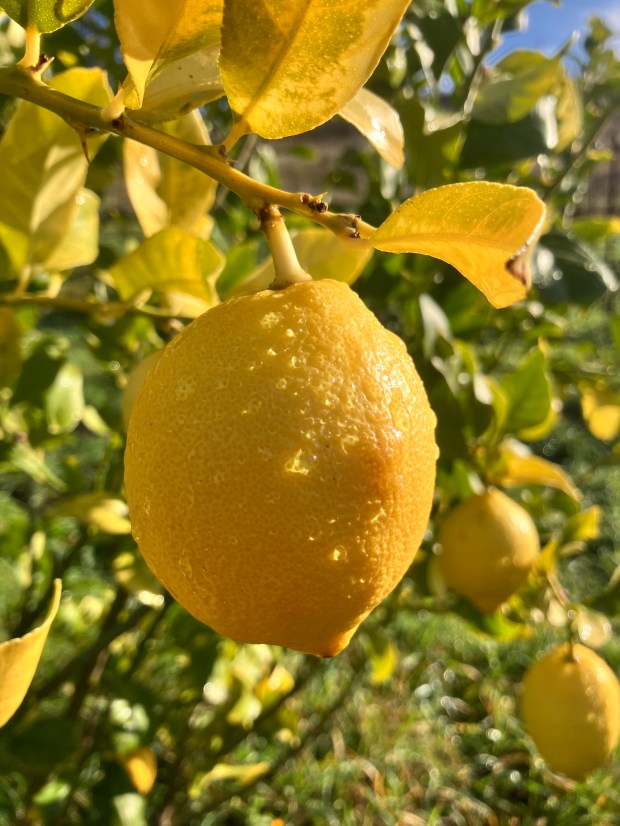
Citrus Hill grows and produces – more each year. We planted many orange, lemon, lime, and mandarin trees in 2019 (-ish), and those are starting to produce. These trees are 4 – 8 feet tall, they are deep green and laden with fruit. We have harvested and distributed over 150 pounds of Persian limes with another 70 that are ready ‘to go’ (right now). Browsing harvesters are snacking on the first ripening mandarins. Four hundred pounds of oranges will gradually ripen between now and 3 more months. Meyer lemons are also slowly ripening.

Roads
Our farm is 3.5 miles from the highway and we maintain another 3+ miles of roads on the farm. This land use changes Nature, requires work, and has many great advantages. The most evident road effect is hydrological: roads become waterways, sluicing rain and runoff into ditches and drains, carrying mud and road gravel. Human and non-human animals use the road routes – easier than the alternative. Long ago, the road from the highway was so poor that it required four-wheel drive and chains. Before that, it was on the back of horses or mules, ox carts, etc. and up a now-obliterated road parallel with Molino Creek.
Shovel and tractor, sweat and sore muscles, are called upon to keep the road drains clear, to spread new material, to fill holes.
Newts and Frogs
With the soaking drizzle, raining right through the night, amphibians are on the move. Driving home up the Coast Highway at 9pm, red-legged frogs were making brave attempts to cross the road in the pouring rain. Rough skinned newts were flashing their tummies, heads held high, trying to be seen. It was slow going slalom to avoid the critters. The small chorus frogs are singing loudly all night long in the cement pond next to the barn where they are laying eggs and cavorting. As a friend pointed out…when it is raining, the whole world is amphibian habitat!
Enjoy the Rain!
 Grey Hayes