farming

Appreciations

I feel gratitude for many of the actions people are doing to help nature around the Monterey Bay. In this column, I will extend praise for those actions to specific people but inevitably will overlook others to whom I apologize in advance…chalk it up to not knowing everything everyone is up to or just plain forgetfulness. I also realize that no one is perfect, so I focus on the specific actions that I appreciate, not the whole of what anybody or group of people does, which might include things that are, on the other hand, very bad for nature.
First Peoples

I lead with my appreciation for the First Peoples for their care for the Monterey Bay region. It is not hyperbole to say we owe everything we experience, the whole of nature, to the First People. The people who are and were indigenous to this place for thousands and thousands of generations took care of this land – every part of it. From squirrel to deer, from river to ridge, from the tallest oak to the tiniest wildflower – these things are here because of those people. The descendants of some of these people are still here, and we have much to learn from them and alongside them if we care to do so. They are still weaving together the fabric of this wonderful part of Earth.

Organic Farmers

I also appreciate organic farmers for caring for nature. By shunning the use of synthetic chemicals for pesticides and fertilizers, organic farmers are avoiding poisoning nature. These farmers forgo these things, pay fees for certification and inspection, and work harder to produce food that often times, to me, tastes better. Farming is not an easy career. I am so glad that I can afford organically grown food and that there is such an abundance produced in our region. There are lots of organic farmers that have inspired me, but I especially think of Phil Foster (Pinnacle Farm), Ronald Donkevoort(Windmill Farms), and Jane Friedmon and Ali Edwards (the original Dirty Girl Farm), and Jerry Thomas (Thomas Family Farm) as inspirations.

Weed Warriors

I want to give thanks to the folks who have long battled invasive plants in our area. Some of the hardest work protecting nature is done by the Monterey Bay’s weed warriors. These folks often volunteer their time to battle the worst invasive species affecting natural areas. They’ve battled French broom, jubata grass, ice plant, sticky Eupatorium, and on and on. Ken Moore was the godfather of weed warriors through his founding of the Wildland Restoration Team (interview pt. 1and pt. 2), but there have been many others. Linda Broadman worked with Ken and carries the torch through her leadership with the Habitat Restoration Team of the Santa Cruz Chapter of the California Native Plant Society. The Monterey District of State Parks deserves mention for steadfastly and regularly organizing volunteers to control invasive plants. Then, of course, there are the many volunteers who actually do much of the work…

Conservation Activists
This is where my appreciation will surely fall short as there are so many people who deserve recognition. Conservation activists often take civic engagement quite seriously. I am in awe of the many nature conservation activists who have fought and won so many important battles around the Monterey Bay. I have enjoyed learning from and sometimes working alongside Celia and Peter Scott, Bruce Bratton, Jodi Frediani, Michael Lewis and Jean Brocklebank, Corky Matthews, Gillian Greensite, Debbie and Richard Bulger, and Don Stevens. Behind and working with these good people were expert and dedicated legal support from Debbie Sivas, Jonathan Wittwer, Gary Patton, and Bill Parkin. Folks who have been affiliated with the Rural Bonny Doon Association and Friends of the North Coast also deserve recognition. Without people who are willing to donate their time, expertise, good judgement, intelligence, and skills we would not have much of the open space that species need to survive.

Tending the Fire

I have been so pleasantly surprised to see so much work with prescribed fire in our community. For me, this started years ago with Cal Fire including more recently as Angela Bernheisel led the first good fire at Soquel Demonstration State Forest. I have been thankful also to the work of the Central Coast Prescribed Burn Association, including their leaders Jared Childress and Spencer Klinefelter. State Parks’ Portia Halbert is a dynamo for putting good flames on the ground and an inspiration to so many others in moving that powerful tool forward. This prescribed fire work is tricky and takes brave people who know so much about so many sciences to get that kind of work done. Plus, they have to work well with others because it takes so many others to do that kind of work. They are restoring nature while making our communities safer. Thank you.

Politicians

For the last 35 years, there have been few politicians in our area that have openly declared nature to be central to their platforms, and I deeply appreciate those who have. Currently, there are very few indeed. State Senator John Laird seems to me to be an outstanding example of how a politician might succeed when keeping environmental conservation a publicly stated priority. Mayor of Marina, Bruce Delgado, is another example. I wish there were more than just those two, but that says something about both the need for more folks to run for office and the public’s will to prioritize such things when they vote. 

-this post originally appeared at my weekly column for BrattonOnline.com where one can subscribe and get the best local, regional, and global news from very smart and observant people.
Giving Thanks

Here it is…suddenly the season where we reflect on what it means to be thankful and what to be thankful about. All around us, beings are ecstatically grateful every moment. But, us humans seem to segregate our thankful moments, relegating them to holidays or ceremonies. Well, we should be happy for the ability to reflect in such a way, however it occurs.

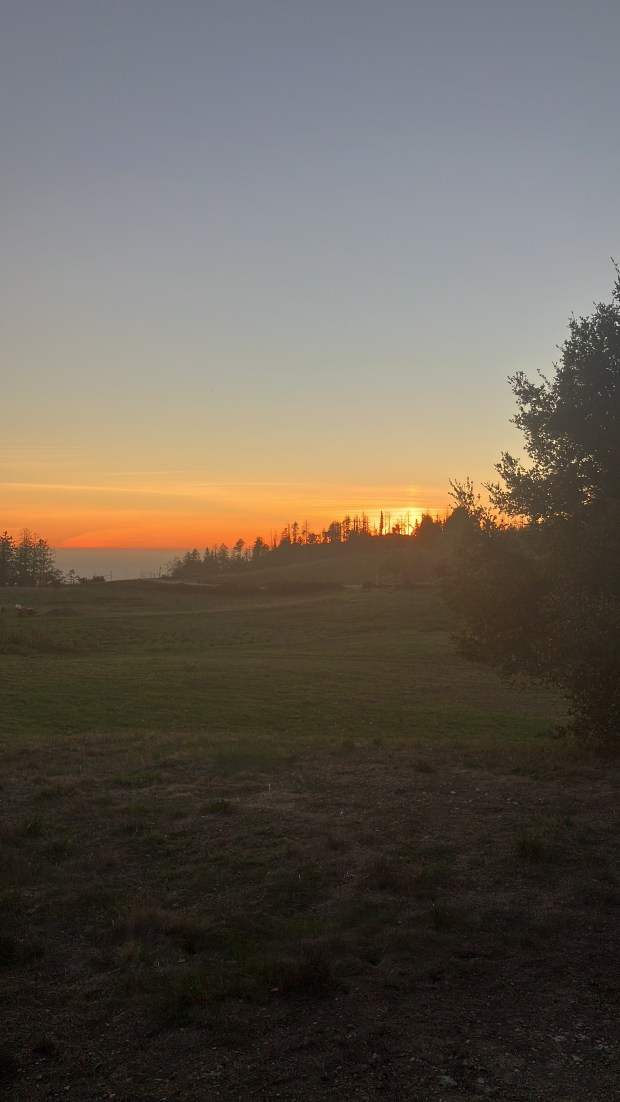
A recent sunset from Molino Creek Farm

Deep Time Thanks

Molino Creek Farm lies within the unceded territory of the Awasawas, or Santa Cruz People, in the Cotoni tribe. They lived on and cared for our land. They left lots of artifacts. There are places where seashells are still coming out of the soil. There are lots and lots of chert and some obsidian flakes. We have found bowls, mortars, and cooking stones. They were the first human inhabitants of this land and they took care of the old growth redwoods and ancient oaks that we still enjoy. Their land management made our soil rich for the crops we still grow.

The Greek Ranch and Transition

Much more recently, us Molino Creek Farm folks have The Greek Ranch and then Kay Thornley, Harlow Dougherty, Jim Pepper, Steve Gliessman, and others to thank for being here. There were years of hippies living here, wild years as we understand back in the Greek Ranch days. As the Greek Ranch transitioned to Molino Creek Farm, this contingent from UC Santa Cruz managed to purchase the land and created the organization that we have now. Many thanks to the folks who had the patience and fortitude to wade through all sorts of issues in establishing this cooperative.

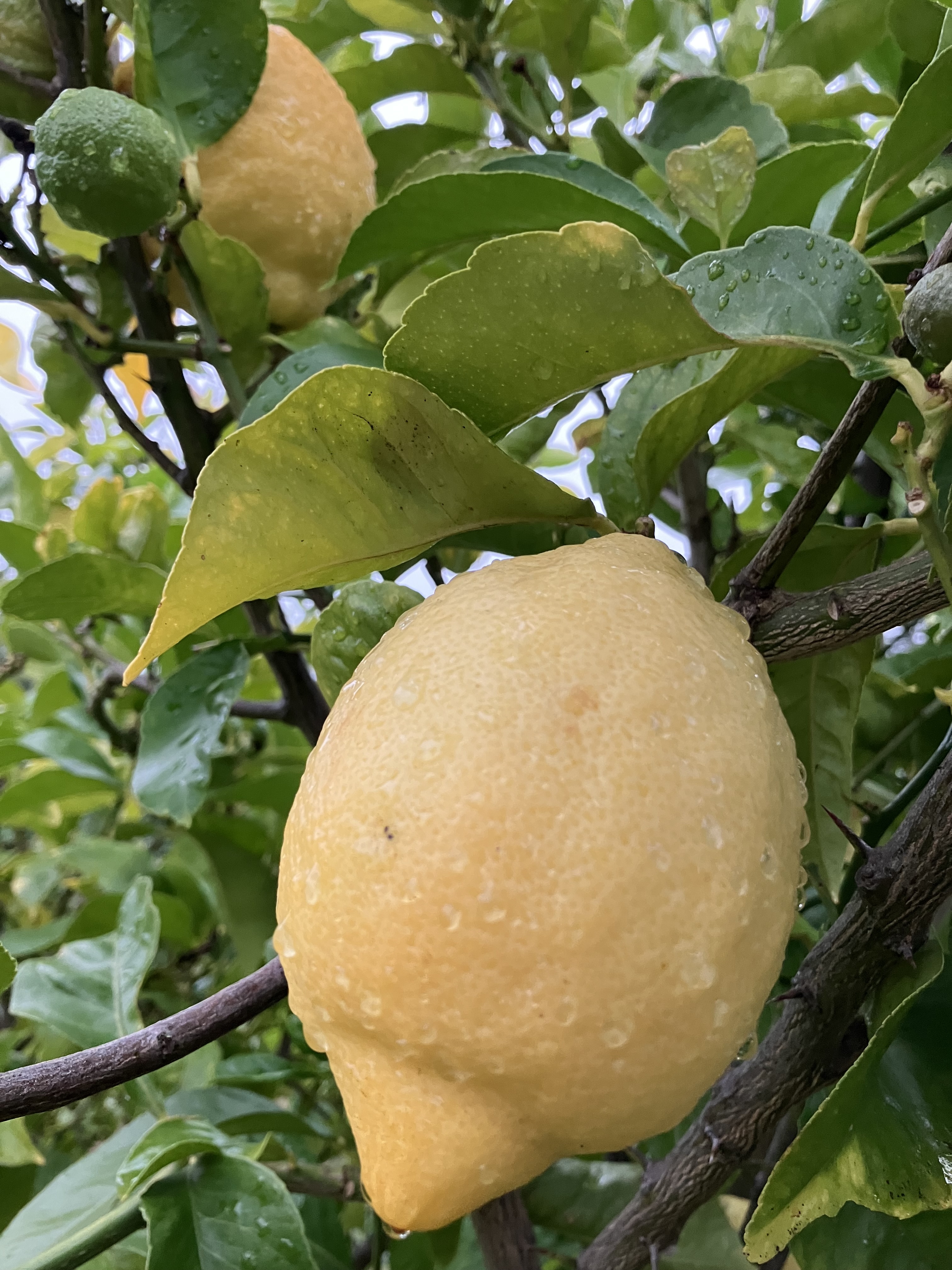
A few Lisbon lemons still left on the trees

Farming

Joe Curry, Judy Low, Mark and Nibby Bartle, and many others worked very hard to establish Molino Creek Farm, which became a legend for dry farmed tomato production. The early farmers made enough money and worked hard with piles of purchased materials to put up miles of deer fence, long stretches of irrigation, and a very good agricultural well. They bought equipment – tractors, fuel tanks, implements, generators…much of which we still rely on. These intrepid farmers taught many people how to grow dry farmed tomatoes and those people started their own businesses. The Farm was the 13th certified organic farm in California…there are hundreds now. We must thank these organic farming pioneers for showing how it’s done and inspiring others to give it a go.

Intentional Community

Other work deserving thanks is from the communal spirit and willingness of those who co-own this land. Living together in such a rural place takes work. The Farm is off grid and so produces its own power and water. We live 3.5 miles up a private road, which takes a lot of maintenance. They say people used to have to drive with chains to get up a muddy hill on the way in, and even then it wasn’t certain.

We have people who manage the finances, ‘the books,’ taxes, meeting facilitation, meeting notes, work party conveners, and so much more. Some of the group maintain the farmland, others maintain the wildlands, and others the water infrastructure. There is a legal committee, a road committee, and a neighbor committee – all very necessary. It takes great generosity to make these things work and we remain grateful to one another for the things we fit into our otherwise busy lives to help keep things together.

2020 Fire

The CZU Lightning Complex Fire devastated our farm. We lost two homes and a community garage workspace, fences, parts of our water system, many orchard trees, and much more. We put out word about what happened and an accompanying call for assistance. Within a short while, we raised $80,000 to help generally and a big portion of that to revitalize what was lost in the orchard. Such Huge Generosity!! We are still awed by that support. The financial support we received is just one indication of the strength and support of the social networks that the partners in this endeavor hold and tend.

We lost quite a few of our avocados in the 2020 fire, but they are just starting to fruit again

Land Stewardship

Since the fire, we have had amazing support for tending our land. The Prescribed Burn Association has poured support into teaching our cooperative about good fire and then leading a prescribed burn last year, reducing fuels over many acres, restoring coastal prairie. They brought people here to help and keep in touch, watching with us the effects of their management. Now CalFire is offering that same kind of help!

Neighbors

Our neighbors have always been helpful. For years, the folks at the cement plant helped keep our road in good shape, the gate secure, and even supplied us with road material, rocks, and spare cement. PG&E has chipped in lots of funding and work to keep the road repaired. 

The partners with the San Vicente Redwoods have also been unendingly great to us. Roadwork and weed work, fire and fuel management, security, and so much more have all been graciously a part of their contributions. We are learning together how to take better care of our lands, the non-human beings, and each other.

Community Orchardists

For 15 years, we have enjoyed the growth of our Community Orchard. We keep in touch with 225 people on email. 5 – 20 people show up to tend the orchard on many Saturday afternoons. Even though the fire took us backward a step, 5 years later we discover the orchard has surpassed that damage and is creating more and more amazing fruit, feeding more people. 

This year, we needed a tractor and the community orchard network donated funds that allowed us to buy one this past week. It is amazing how the generosity continues, born out of the relationships we build by tending a beautiful orchard, creating “Fruit for the People!”

In sum, we are very thankful. We have so much to be grateful for. Thank you, each and every one of you, for the various kinds of love and support you offer this amazing place, this greater community, which we steward together.

Agricultural Ecosystems

This is another reprint from my weekly column at BrattonOnline.com, to which I recommend you subscribe, especially if you live near or love Santa Cruz California and want to learn more about what’s happening.

I was going to write this week about a native plant community, but someone made a comment recently that led me to change course, to focus rather on a very dominant ecosystem in our area: row crop agriculture. They said, ‘There are no animals killed in making a meatless burger.’ The statement took my breath away. Apparently, it is time for me to put my thoughts into writing on this subject, long stewing on my back burner.

Sacrifices for Veggie Burgers

Meatless burgers contain agricultural products grown on farms that have killed and are killing animals as an inherent part of their practices. The original clearing of agricultural land caused the greatest outright slaughter of animals. Many animals were crushed by the first land-clearing bulldozers or burnt alive when the natural vegetation was ignited. Some furry critters fled at first only to starve later when they were driven from one already-occupied territory to the next. Perhaps a few lucky larger quick and mobile vertebrate refugees survived. The many smaller, less mobile animals not outright crushed or burned were eventually chopped up with the plough.

After the clearing, crops are planted every year thereafter, and farmers trap, poison, or shoot ‘pests.’ In some cases, farmers fence, net, or otherwise ‘deter’ pests…sometimes entangling animals but always driving wayward animals onto roads or into the mouths of smart predators that take advantage of deterrence methods with their hunting regimes. Farmland becomes a hazard for wildlife, effectively removing agricultural lands from anything classifiable as ‘wildlife habitat.’

Yummy Bananas

Many of us have heard the tropical horror stories related to agricultural expansion. Giant farms have been expanding, destroying tropical forests, the most diverse of ecosystems, especially to produce soybeans and palm oil. Many areas have already been cleared, and the ongoing tropical agriculture is regularly killing thousands of species that are dwindling by the day. A friend told me of his first job on a tropical banana farm in the 1970’s. As a teenager trying to earn money to support his family, he took the closest job he could find as a laborer on one of the giant banana farms in Central America. His supervisor gave him small plastic cups to suspend from the banana trees and told him to fill the cups with a viscous liquid poured from a large bottle he was told to carry with him. He was told to return each day to refill the cups. Returning to those cups, he clambered over piles of a diverse array of dead bats that had ingested the poison liquid he was placing in the cups. This method of reducing the fruit pollinating bat claw marks (just aesthetic damage) on the bunches of bananas has since been replaced by covering the bunches with protective plastic bags impregnated with pesticides. But banana farms are still sprayed with deadly chemicals and are devoid of even the shadow of the tropical life found in natural systems.

Shade Grown

Even though we might turn to purchasing organic bananas and even certified organic, fair trade locally roasted coffee, those organic crops are grown on lands where tropical wildlife is largely obliterated. Organic coffee and bananas are grown in full sun, the rainforest cleared to make way for the farms. “Shade grown” coffee certification is largely a sham without defensible standards for conserving tropical forests and associated birds, except for the Smithsonian’s bird friendly coffee certification which is effectively unavailable in stores in Santa Cruz and so must be ordered over the internet.

Ranching to Vineyards

Locally, the story is little different. Agriculture is expanding in our area mostly from conversion of grazing land to vineyards, a process that does not trigger environmental review because both activities are considered agricultural. Oak woodlands and old growth grasslands that supported free-roaming wildlife and sequestered carbon are being converted to vineyards where wildlife is commonly fenced out and wildlife inside the fences trapped and killed. Tilling the converted grazing land releases long-sequestered carbon, adding to global warming.

The Local Veggie Farming Slaughter

Once agricultural land is in production, routine practices actively kill or deter wildlife and passively degrade wildlife habitat. Driving through the Pajaro or Salinas Valleys, look for the upside-down white plastic Ts at the field edges: those are poison bait stations with poison designed to kill small animals that venture into the fields. Traps or poisons are used to kill any animals once they find their way further into fields. Organic farmers often use traps for gophers with regular trap patrols as part of their daily operations. Passive forms of wildlife killing may seem a little less aggressive. In both conventional and organic agriculture at any scale, the mowing and tilling of crop areas leaves mutilated (hopefully quickly killed) critters in the wake of tractors: snakes, toads, frogs, lizards, salamanders, birds, mice, moles, shrews, and voles are all decimated. Polluted runoff from both organic and conventional agriculture is another issue. Agricultural irrigation runoff into Elkhorn Slough has the highest levels of fertilizer in the US, equivalent to dumptruck load of fertilizer a day, causing terrible contamination of the state’s second largest estuary.

Ranching Conservationists

In contrast to the impacts of these cropping systems, I look to coastal prairie fed, pasture raised cattle that are managed in such a way to restore local ecosystems and provide food for those who would eat it. I’m not arguing against the need to reduce the amount of meat the world’s population eats: clearly, there is a lot of animal agriculture that is terrible. However, many ranchers locally are doing a world of good for wildlife and plant diversity with their coastal prairie stewardship. Globally, ‘abandonment’ of grazing in Spain, France, Britain, and other places with diverse grasslands has caused species loss and ecosystem degradation. Humans have been learning how to manage livestock to mimic evolutionary disturbance regimes that maintain wildlife and keep grasslands diverse and healthy. Most ranchers I know are enthusiastic about the wildlife they steward; many are working with conservationists to co-manage for biological diversity. This situation makes the contrast between veggie and beef burgers a little more interesting.

Wildlife Friendly

There is real potential for cropland management to be more sensitive to wildlife. One day our lettuce won’t come with such a legacy of wildlife displacement and death. There are only two wildlife-friendly food certifications that I know about: the Smithsonian’s certification of Bird Friendly Coffee and the relatively new Audubon Society’s certification for bird friendly beef. Taking its normal laudable step beyond the Federal guidelines for organic standards, Santa Cruz-based California Certified Organic Farmers (CCOF) requires its certified members to maintain a conservation plan to address habitat stewardship. But CCOF lacks an ecologist to review or advise on such plans, so this effort mostly falls quite short of what is needed. Let me know if you know other attempts to address these gaps! Meanwhile, what are we to do? 

Ask a Farmer

The thing to do is ask the farmer who you support about their conservation practices. Already you probably understand the importance of supporting farmers directly by shopping at a farmer’s market. When you buy from them, you might ask how they take care of wildlife on their farm. The answer should take longer than either you or the farmer wants to take; shorter answers are probably insufficient and will be quick evidence that the farmer isn’t practicing wildlife friendly agriculture. Sensitive management of irrigation, runoff, ponds, hedgerows, cover crops, fallow fields, roads, and non-crop areas should almost all be part of any wildlife-friendly farmer’s skill base. And, they would have to explain a little about what ‘sensitive management’ means in each case – the stories aren’t too complex if someone knows their stuff, but the telling will take a little time. We need those stories. We need those conversations. Future generations will depend on farmers who integrate nature with their crops.