Iceplant

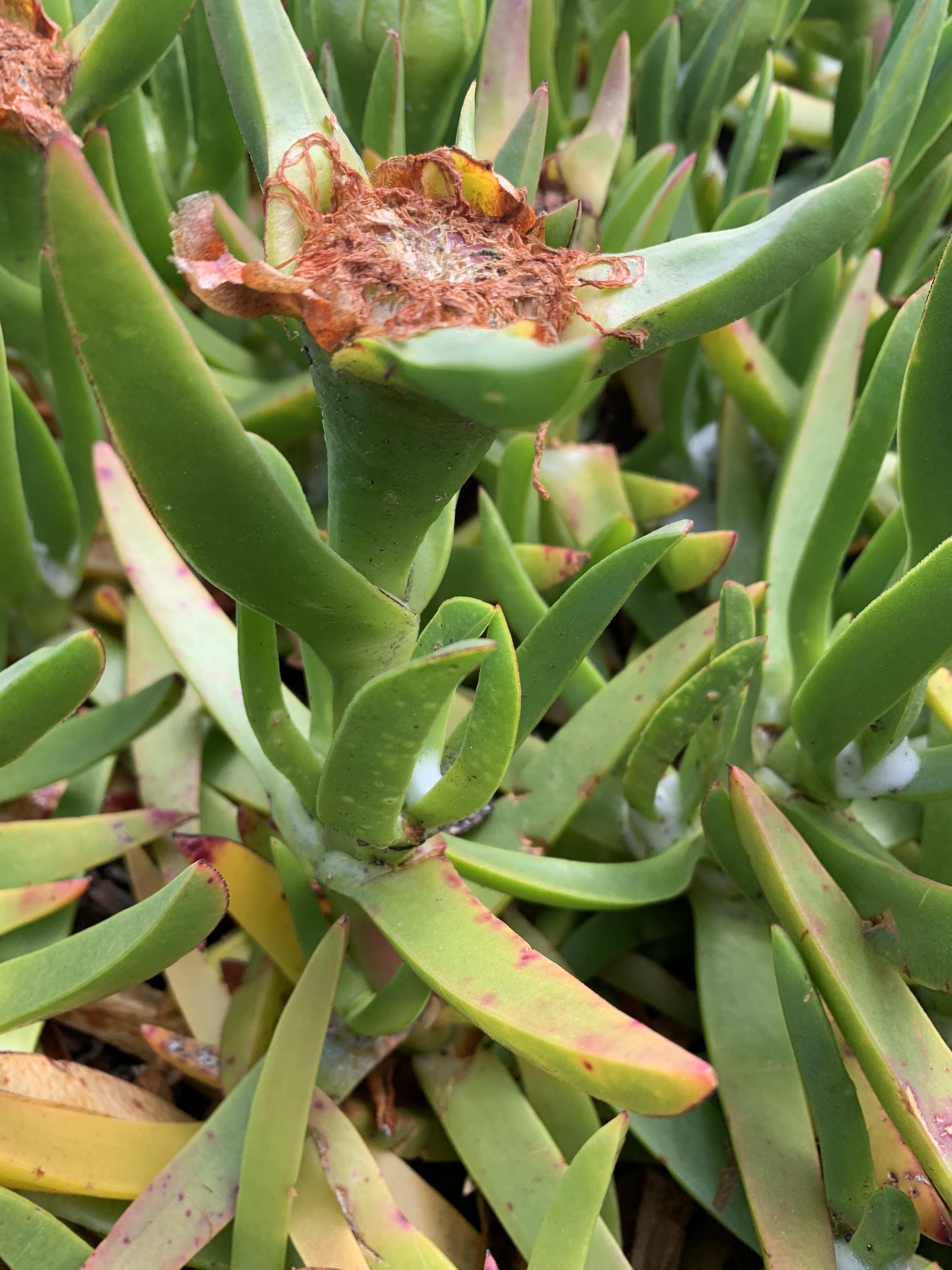
Succulent carpets sporting pale yellow, rich magenta, or light purple flowers blanket the bluffs and hang over the cliffs along the coast of California. Joining oleander and cotoneaster as historic roadside plants, ice plant has been dropped by public works landscapers for many good reasons. Several species of ice plants are quite invasive in parts of California, spreading 3’ a year, wiping out rich assemblages of native plants and changing wildlife communities.

Native Ice Plant??!

When my mentors taught me the native flora, they wanted me to recognize the difference between the ‘native’ and non-native ice plant species. However, the ‘native’ ice plant turned out not to be native, proven by a clever scientist who sleuthed for a pollen record in pond sediment from an ancient pond in Marina, California on the Monterey Bay. The trick is to find an old pond, drill into the sediment with a hollow tube, and pull out a long plug of mud: deeper muck is older. Scientists can reference ash layers from volcanoes in the sediment and use carbon dating of bits of organic matter to index the history in the sediment core. In that pond sediment, they discovered ice plant pollen beginning in the 1800’s and occurring steadily in the pond sediment ever since. That was the age of lots of Old World species’ arrival…a time when invasive grasses and herbs spread rapidly across the landscape. Some species spread faster than the invading people so that the first Old World botanists didn’t know whether something was native or not. How did ice plant get there?

South Africa: Iceplant Home

South Africa is home to many ice plant relatives. That Mediterranean region is a biodiversity hot spot for many interesting plants, including plants in the ice plant family. Many ice plant relatives have stunningly bright colors and thin, reflective petals. There might still be a patch of ice plant relatives in the South African collection at the UCSC Arboretum. When I worked there, I came across that patch on a sunny spring day and was mesmerized by the color, gazing at first one intensely bright color and then the next. Peeling my eyes away from those flowers, I was shocked to find a world of temporarily muted color (a world of gray!). Something in my eyes had been overloaded and it took a while to get normal colors back. Only a few of the South African ice plant relatives have become weedy in California- not to say that more won’t in the future, should they find their way via the nursery trade.

Limey!

Scurvy is a horrible disease of malnourishment caused by too little Vitamin C. Part of the ‘success’ of the Imperialist British Navy is due to the recognition of the need to pack limes on board ships, earning those sailors the name ‘limeys.’ Some sailors might have been better called ‘iceys’ but that term doesn’t appear in the history books. The term for ice plant seed pods was “Sea Fig,” and the fruit was packed aboard ships to combat scurvy the same way limes did.

Tasty Treats

Ice plant fruit is ripe when the pods are wrinkly and shriveled, having narrowed from their once plump shiny tautness just after the flower fades. If you try eating one too early, it is very disappointing. Wait a while and you get to enjoy sweet, tart, and salty fruit loop flavor. Like figs, ice plant seeds are on the inside of the fruit, suspended in a sticky, stretchy slightly slimy gelatinous goo- that’s the tasty stuff to harvest out of the pods. I am pretty picky about where to harvest the fruits because of what I’ve seen dogs do on ice plant carpets. The biggest flowering of ice plant is under way now, so you have to wait a while for the pods to ripen.

Rats!

Us bipeds aren’t the only ones who like the ice plant fruit- they are favored food for all sorts of small mammals. The moisture in the fruit might be attractive, but the protein-rich seeds are nutritious – so much so that all that food elevates small mammal populations above what might normally occur. Ground squirrel, rat, and rabbit numbers increase, and herds of these animals scurry into areas surrounding the ice plant patches and graze down native vegetation, making way for still more ice plant with seeds dispersed in the critters’ poop. Sit on some of the large cliff-erosion combating rock piles near West Cliff’s ice plant carpets some evening and watch the cracks between the rocks. You will probably get to see part of that ice-plant fed thriving rat population.

Salting the Earth

Feeding the ice plant gardening small animals is one way that the plant is clever, but there’s an even more genius method of invasion: salt. Ice plant is very salt tolerant. As it grows it concentrates salts in the soil under it, creating more saline conditions than much of the native ocean bluff flora can tolerate.

Biocontrol Story

As I mentioned above, there once was a fondness for ice plant for stabilizing soil along roads and railroads. Many older readers probably recall ice plant lined roads; CalTrans maintained at least 6,000 acres of ice plant in the 1970s. Native plant enthusiasts never really liked that ice plant landscaping, long recognizing the species’ invasibility, and so they rejoiced when an iceplant pest made it to the New World and started killing ice plant patches. The scale insect was taking a serious toll on highway and railroad plantings, and native plant conservationists were transporting sick ice plant to new areas to spread the pest. Others regarded the pest with disdain, and they ended up winning. Cal Trans funded and UC Berkeley launched a biological control program to fight the ice plant pest. UC researchers found a few species of wasps that controlled the scale insects and released those wasps in masses. The wasps established and now control the ice plant destroying pest.  

Removing Iceplant

Don’t worry: ice plant is controllable! Volunteers for the California Native Plant Society and other groups have embarked on ice plant pulling sprees to protect particularly rich areas of dunes and ocean bluffs. While the plants are quite heavy, they aren’t particularly well rooted, so are easy to yank. Pulled up parts of the plants are piled high and slowly decompose. You have to keep coming back to make sure some of the piled plants don’t re-root, but that follow up work isn’t very hard. And, one typically finds a few plants that were so small they got missed the first time pulling in an area. Ice plant is easy to recognize, so you might get to know it and pull it when it is out of place. Turn a pulled plant upside down, roots in the air, and it will probably die. After a while, the bare patches left from pulling ice plant might grow native plants. Often, old patches of ice plant leave behind a thick carpet of dead leaves and salty soil that takes some time to get back to something that can support native plant species. Hopefully, this essay will help prevent more people from planting ice plant in new places!

-post originally published at Bruce Bratton’s online weekly.

The Return of the Rain

HOT (85F), then cold and massively windy (wind damage!) … then drizzle…now gap (cold)…drizzle tomorrow gap…drizzle Saturday (cool): what an odd April! The April showers bring May flowers adage isn’t supposed to work here in California, or at least it hasn’t for a long time…but then again, it Does Work! Way back in March, the prairies were turning brown and the grass was stunted and dying. Ranchers were selling their cattle quickly to get in before the big sales rush later in the spring, when they would make even less money. Now, the grasses are growing again, and the prairies are mostly green where they were brown. Weird. The big lupine year here on the Farm will be prolonged maybe into May if this keeps up. If it keeps up, maybe we’ll have the plump tasty handfuls of native blackberry that we got last year with the late rains….that would be wonderful. Some nearby got an inch of rain this last round, where we were promised only two tenths. Roof runoff rainwater buckets filled entirely, which normally suggests a good soak.

No Chow

There is very little food on the farm, unless you like to eat lemons and limes or to harvest wild nettles. The cover crop pea shoots have been mowed and/or tilled in. It has been too dry for mushrooms, though the recent rains could promise morels if it warmed up and we looked hard. It is too early to harvest the very few Bacon avocados fattening on the trees. Very little of last season’s kale remains that hasn’t bolted. It’d be a good time to turn to eating bugs if you had to forage just on the farm. Canned food season continues. Oh, how we long for the produce of summer!

Wildlife Sightings

I saw as single deer running across the farm this past week, the first for a long time and too far away to know what sex. But it was nice sized and alone, very nervous…kept moving. A few fox barks emanated from the Vandenberg Field area one evening. Not much predator poo around. Gophers, though- very common! And the voles are starting to make a comeback. The Big Winners are the mice – the harvest and deer mouse populations are burgeoning right now. They leap and scurry in front of the mowers and hoes, and if you stand still too long in the grass they run over your shoes- it’s that kind of mouse year.

I spied on one of the bluebird boxes yesterday and watched a momma feed babies which were sticking their hungry maws out of the hole to get the dangly long caterpillar from her mouth. Cheep Cheep! Cheep Cheep!

The band tailed pigeons are the newest entertainment. Our big flock is back eating walnut catkins, an annual ritual. They sure are nervous, flapping noisily away when you approach a walnut tree. I am transported to the tropics when I see them- they trigger past parrot sightings in my memory, being a similar size and shape.

Farming

Adan is back on the tractor. So is Mark Bartle, who has been equally energetic with the big machines. The fields are mowed and a subset are getting tilled. Adan has rototilled the first field, so smoothly turned around, a special kind of soil beauty. Mark mowed the vineyard this past week and the vines opened their fresh light green delicate leaves; they are well trellised and starting to look like an established crop for the first time, their third spring of growth.

The orchard folks got caught up on watering and then with the drizzle can take a bit of a break. Soon the Maserati of Mulcharts will be going 185 with big piles of mowed up mulch to feed the trees.

The hay hauling mulch cart, a Molino Creek Farm invention- appropriate technology

Flowers

The blue, blue-blue native bulbs have burst into their small tight globes of flowers on the road into the farm, complimenting the other patches of white-and-blue lupines. Orange sticky monkeyflower subshrubs are getting towards full bloom, but Ceanothus are fading. French broom is scentfully blossoming, but we don’t like looking at it- what a scourge has been flushed after that fire! In the forest, it is peak iris time and the pale yellow flowered fat false Solomon’s seal is in full bloom (another scent sensation). Did I say iris time? Its really a big iris year! The poppies are in full regalia, meshing large patches of flame orange into the delightfully contrasting purple blue lupines.

We hope you enjoy some rainbows and perhaps the last rains of the season this next week. Our fruit trees will be in heaven.

Teach Your Children Well

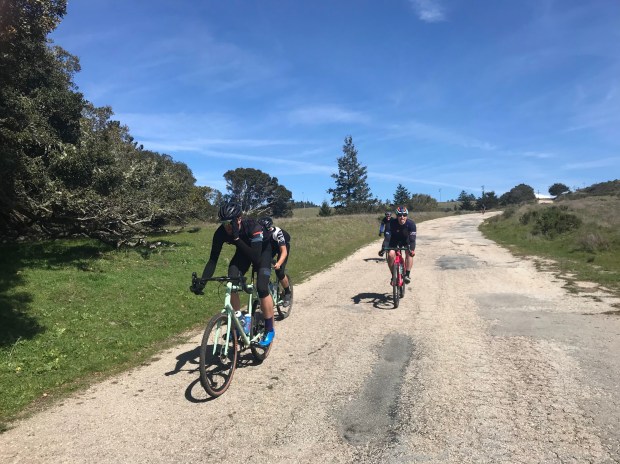
Five shovels, five rakes, and ten of us sweating and smiling as we worked to restore trails in UCSC’s Upper Campus Natural Reserve. For a few years in the mid-1990s, UCSC undergraduate volunteers joined me, Campus Reserve Steward, one Saturday a month to reverse the harm that hundreds of mountain bikes were causing. We spent the most time along 7 Springs Trail and the Interpretive Trail. Both trails were off limits to bicyclists and clearly signed; they still are. These are very sensitive ecological areas replete with wetlands, springs, and highly erosive soils. They have been set aside for teaching and research, visited by classes and sites of long-term forest research. While we worked, we frequently encountered bicyclist after bicyclist, some skidding to avoid hitting the volunteers. Our team was trained and eager to inform the bicyclists about the trails being closed and why. More than half of the bicyclists were aggressive and unfriendly, unwelcoming to such an interaction. We were yelled at, called all sorts of names, and there were occasional threats of violence, and even spitting. I was thrown to the ground and stepped on once by a particularly aggressive individual. Our work to close the trail was regularly and expertly vandalized and signs frequently defaced. This is a dominant culture of mountain biking. These instances are not outliers, the behavior far too common. I have been hearing similar stories from many people for years. Once, I told a person with his son that I would call a ranger if they jumped a gate headed into a closed, sensitive natural area. He responded, “I AM A RANGER!” And I recognized him as one of the head rangers for State Parks…and off he went, a fine example for his son.

Givers Vs. Takers

I recommend reading Daniel Quinn’s book Ishmael; one of the things I recall from the book is a characterization of humans as being either “givers” or “takers.” Santa Cruz County has been fortunate to have a historic giving culture. A very large percentage of the County has been set aside as parks or is stewarded by large private landowners who take very good care of their land. There is little area for urban sprawl, but now we are facing the next biggest threat: natural areas recreation, one of the top threats to biodiversity on the planet. Leading the assault are trails advocacy groups, some of which have been at this for decades. There will apparently never be enough new mountain bike trails for the funders of these groups. These groups and others like them around the world are being funded by industry through organizations such as the Outdoor Industry Association. Mountain biking trails-building volunteers working for these advocacy groups are spending their free time expanding corporate profits while repairing a small fraction of the damage they’ve collectively caused with their thrill-seeking sport. These are what Ishmael would call ‘takers.’ Together, mountain biking (aka ‘trails’) advocacy groups and the outdoor recreation industry are pressuring every public land management agency in the Bay Area to expand mountain biking trails in an apparent bid to turn every inch of natural area into a high-speed playground, maximizing profits at the expense of the wildlife and the quiet walks once enjoyed by families with small children, bird watchers, and contemplative hikers. On this subject, someone urged me to consider Hanlon’s razor: “Never attribute to malice that which is adequately explained by stupidity.”

The Corruptors’ Rule: Keep Them Stupid

I suspect that a fraction of those building new trails at Cotoni Coast Dairies innocently think they are doing the right thing. The groups organizing these events certainly won’t educate the volunteers about the dubious nature of their work. They won’t share with them the long and expertly crafted critiques of the park’s planning process by the region’s leading biologists. They won’t tell the volunteers already riding mountain bikes on the trails that a broad coalition of conservation groups oppose using the trails before a biological baseline is collected. They won’t tell the volunteers that their sponsoring group has, without expertise, testified in contradiction to conservationists during the planning process in an apparent bid to gain points, and a sole-source trail building contract, with the BLM. The volunteers, knowingly or not, have become active participants in the commodification of nature. So, they are “takers.”

Our Chance

Conservationists (aka “givers”) point out that we have a once-in-a-lifetime opportunity at Cotoni Coast Dairies to collect a biological baseline before trail use commences. With this baseline, we can better understand how trail use affects wildlife, plant communities, soils processes, and the spread of invasive species. The property has been very lightly visited by humans for more than 100 years. Because the property is designated as part of the California Coastal Monument and as part of the federal National Conservation Lands network, there are extensive policies that support and even require such a baseline…this level of policy support is absent with any other conservation land in the County. Do the trails building volunteers know that, through their work, they are supporting BLM in shirking critical land conservation responsibilities?

Snap!

I have put these arguments to volunteers of trails groups working at Cotoni Coast Dairies and have been reminded of a series of fallacious arguments that have been trotted out for decades. The most common statement is: “It’s a done deal, trails were approved and are under way, get over it!” This statement ignores the ongoing and active appeal to the planning process by a coalition of conservation groups. And, even without such an appeal, the statement overlooks the need to manage trails forever and land management agencies’ responsibility to adaptively manage trails to avoid impacts to protected natural resources and user conflicts that would favor certain user groups (such as mountain bikers).

Avoid the Trap

In a bid to trap the unwary, some of the leaders of the trails advocacy groups have suggested that their groups are ‘conservation’ groups. If you are confused, ask the leaders of these groups about what is ‘enough’ and what is ‘too much?’ For instance, when will there be ‘enough’ mountain bike trails? What specific metric would indicate too much soil erosion on a given stretch of trail? What, specifically, is too much user conflict- such as how much displacement of families with small children who fear their 3-year-olds getting hit by mountain bikes (like one person recently reported to me)? How specifically will we know when there has been too much wildlife loss due to natural areas recreation? If the trails advocacy group truly had a conservation platform, they would have answers, created through methods of carrying capacity analysis and they would be able to offer threshold limits of acceptable change (‘enough’ or ‘too much’). I have long interacted with these groups, and this is where I see evidence favoring ‘malice’ instead of Hanlon’s razor ‘stupidity.’ With this kind of experience, one might discover which groups are primarily interested in the commodification of nature, and are, thereby ‘takers.’

Past Evidence

In the 1990’s, one of these trails advocacy groups began their ugly but organized, well-funded campaigns to expand mountain biking trails in this region. I was at the table when the group negotiated the opening of the U-Con trail from UCSC to Henry Cowell. They promised volunteers to close and keep closed the myriad of unsanctioned trails bleeding tons of sediment into the San Lorenzo River; they said that they would post volunteers at trail heads to “self-enforce” closure. They did no such thing. I was also there when mountain biking representatives showed up at the first Gray Whale Advisory Committee meeting, having worked with State Parks for a year to prepare detailed plans for an extensive network of new trails through that property (now part of Wilder Ranch State Park) without any understanding of/interest in the extensive areas with sensitive ecology and erosive soils. Because of their intransigence at coming to agreement with Parks and the Committee, there is still no long term trails management plan and no plan for protecting critical sensitive species. A group consulted with me when Nisene Marks State Park General Plan was being drafted and mountain biking advocates were aggressively advocating for more mountain bike trails, in contradiction to permanent deed restrictions against such use….wasting extensive State and private resources and, once again, needlessly dividing our community. More recently, I countered a mountain biking group publicity campaign that sought to educate the public falsely about the ‘need’ for more mountain bike trails because of the purported paucity of such in the County. After correction, they walked back the campaign and it subsequently disappeared. These situations are, in my opinion, more evidence of ‘malice’ rather than ‘stupidity.’

We are Winning

Despite all of this, the ‘givers’ are winning, pushing forward protections for Nature in parks around Santa Cruz. We realize that the vast majority of us want healthy wildlife AND access to natural areas where we can recreate without fear. We reject the politics of division that those whose object is the commodification of nature so enjoy. Together, we won protections for Nisene Marks State Park. We expanded protections prohibiting mountain bikes in extensive wilderness areas of Castle Rock State Park. We created extensive Natural Preserves at Wilder Ranch State Park, thwarting miles of new mountain bike trails. We have (thus far) maintained prohibitions against mountain biking on single track trails at UCSC. A coalition of conservation groups has recently made great headway in improving the poor recreational planning at Cotoni Coast Dairies. With community support, the San Vicente Redwoods conservation coalition is enacting the most progressive recreation and conservation adaptive management regime our region has ever seen. Expanding awareness even forced one mountain biking advocacy group to change their name to seem more PC. And soon, we may have Congressional representative Jimmy Panetta instead of Anna Eshoo- a massive step forward in leadership to better manage the impacts of natural areas visitors to our communities and to wildlife. I have been fielding so many requests to help on these issues that I can’t keep up. Together, we are turning the tide: there is hope that future generations will be able to enjoy peaceful strolls and see sensitive wildlife in our natural areas, after all.

Your Time

Meanwhile, when you consider how to spend your outdoor volunteer time, focus your attention on groups that know how to help you to truly become a ‘giver’– groups like the Peninsula Open Space Trust, the Land Trust of Santa Cruz County, and the California Native Plant Society.

-this essay originally published in Bruce Bratton’s weekly blog BrattonOnline.com

Warm Spring Days

From blustery and cool to only slightly breezy and hot. Today might have been 80F and tomorrow will be, too, but the nights will cool down so we can open the windows and cool the houses. Big big waves blown in from some massive storm way way out there; the beaches were swarming with daring surfers this evening at sundown.

Farm Critters

The crickets have been chirping for the last week or so. As usual, the black field cricket is the first to sing. Their brethren the grasshoppers have an early start with fat large adults flying around already.

On the land at Swanton Pacific Ranch today, just over the hill from Molino, I saw a 18” terrestrial garter snake, a 2’ gopher snake, and a 15” yellow bellied racer as well as fence lizards galore. Alligator lizards are around, too. April is always reptile month- and this time around is no exception. Time to see snakes! The gopher snake’s body was bulging in three locations- well fed and recently shed- very shiny new skin.

Real, honest to gosh birders are surveying the Farm these days. Storey La Montagne and Martha Brown were roaming around this morning when I woke up. They reported yellow rumped warblers (“getting ready to leave”) and had good words to say about the numbers of western blue birds. Storey’s been owling here and confirmed our regular farm friend the pygmy owl. When they were here this morning, there were just barn swallows. And then, when I went down to Swanton the day saw increasing numbers of violet green and maybe other types of swallows- from 5 to 50 over the course of the morning. Welcome back swallows, almost goodbye yellow rumped warblers and golden crowned sparrows! I neglected to discuss with them Maw and Caw who curiously had one of last year’s offspring visit them this evening: and then there were three, all friendly as can be.

Little to no predator poop- few bobcats, coyotes, or fox. Only very rare sightings of deer. A bunny here, a bunny there- not many. Dead woodrat in my yard- neck strangled, dropped…gone to the turkey vultures a couple (stinky) days later. Mowing is revealing a plethora of mice, including many of those most tiny and cute harvest mice- must be having a good year. Field mice are probably having a particularly good year for all of the gophers that erupted through the last year, after the population crash of voles. The voles are coming back- beware gophers! The first vole trails are getting mowed and populations are on the rise again.

Apple orchard in full bloom; still recovering from 2020 wildfire…how will they do?

Forage and Fruit

The apples are in peak bloom right now, as of the last 2 days- there’s a few more days of peak bloom left, including this Saturday’s gathering. Pink! White! And, if you get there early or late in the day, you can be tricked into thinking the apple blossoms smell like lupine as that scent settles through the orchard from not far away. Limes are getting ripe and the Orchard Collective members are up to their eyeballs in lime-i-ness: lime juice frozen in ice cube trays…limes peeled and sucked on by Milo…lime drinks…what more?? And, we’re eating pea shoots from the cover crop, but nothing really much more coming in from the fields just yet. In the eternal irony of farm life, the Spring is the time of food shortage, the longest time since the last meaningful harvest of Most Things. And so, we eat the canned things and forage on Spring Greens like miner’s lettuce and baby this and that volunteering from last year’s greens seed crops. Oh, and arugula.

Its not your eyes…the flowers are blurry and the foliage in focus! Sticky monkeyflower. Trippy monkeyflower

It All Happens At Once

On the hillsides around the tilled fields, the normally staggered blossoms of shrubs are all happening right now. Bush lupines, California lilac, sticky monkeyflower, lizard tail, oso berry…all blooming now. There’re not many lilacs of blooming age, just yet- most burned- but, the few missed by fire are weighted down with big wads of blue flower clusters that are quite magnificent. The bush lupines, too- what magnificent lavender displays! It would be delightful to be a bee right now- food everywhere.

California lilac aka Ceanothus thrysiflorus in bloom right now, if you can find a mature bush left by the wildfire

The Work

Farm work means mowing and irrigating right now. All the fields are shorn except the orchard areas, which we are hitting post haste most days. In the vein of ‘it all happens at once’ we had to fix up irrigation a month early and just finished our first full pass of watering trees. It takes ~7 hours of microsprinklers to rehydrate the soil this year…it dried down too much before we started the watering. The solar pump is running constantly for the first time since last October. Soon, the farmers will put hoe to ground and start planting seedlings…

-this post copied from the original location at my blog on Molino Creek Farm’s website

It’s Lupine Time

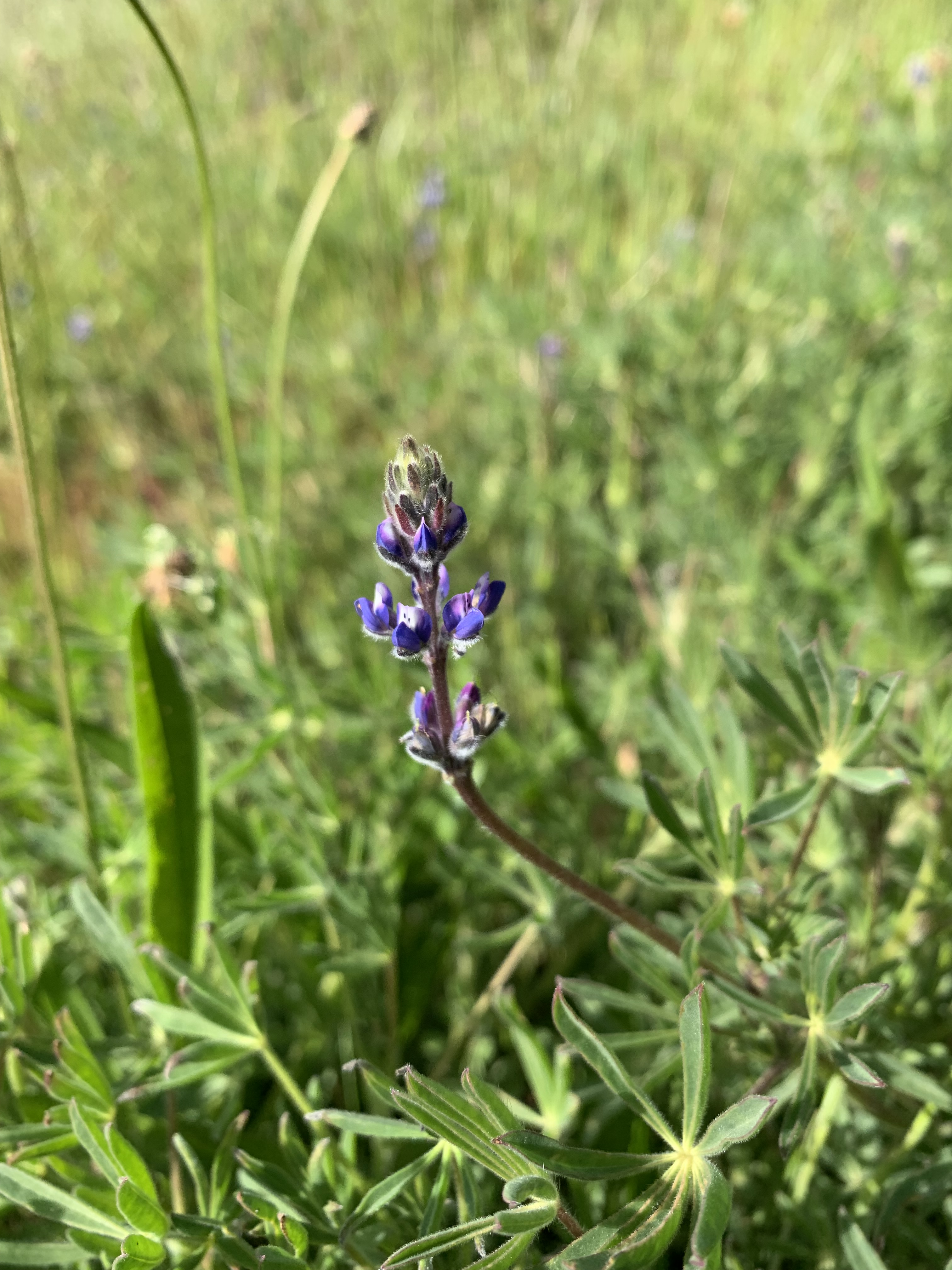
In the local prairies, it is an especially prolific lupine blossoming year. Do you have a favorite place to visit lupines? The most prolific, bright, large flowered annual lupine in our area is called sky lupine, because when it is in full bloom in large fields, it looks like someone turned the world upside down. The scent is heady- it smells purple. For those of us who grew up smelling purple in grape Kool Aid or various artificially flavored grape bubble gums, it makes sense that sky lupine smell purple. In good years, I am able to go to my favorite lupine patches at just the right time when acre upon acre are giving off that scent and making extensive mats of lupine colors.

Lupinus nanus, aka sky lupine, an annual native wildflower that grows best without grassy competition

Lupine Diversity

Lupines are pea family plants. Look carefully, and you’ll recognize that sweet pea shaped flower. Lupines typically have flowers in a spike of tightly packed whorls with older flowers turning to seed pods at the bottom and new flowers opening at the top. Lupine seed pods look like pea pods. Sky lupine pods explode on warm days pitching seeds far from the mother plant.

Sky lupine flowers and seed pods

Sky lupine isn’t the only lupine around, there are many lupine species in Santa Cruz County. It might make a good treasure hunt to try to see them all. According to Dylan Neubauer’s Annotated Checklist of the Vascular Plants of Santa Cruz County, California (every naturalist in the County should have this), there are sixteen lupine species in our tiny county. Sky lupine is the only one to make a big show in the grasslands.

A very modest lupine, Lupinus bicolor, aka ‘miniature lupine’ another of the 16 species of lupines in Santa Cruz County, California

Who Eats Lupines?

Italians eat lupines! Strains of white lupine, Lupinus albus, have been cultivated for food throughout Europe. But you have to grow the right strain- some strains are very toxic! In fact, most lupines are toxic…

Here’s a challenge: find sky lupine leaves that are being eaten by a butterfly or moth caterpillar! In researching this essay, I explored the possibility that some beautiful butterfly larva fed on sky lupine. Nope! Lupines famously have some potent toxins. Some species of lupines poison cattle, though I’ve not heard that livestock owners are concerned about sky lupine around here. There are some butterflies and moths that feed on perennial lupine bushes locally, but none that we know of that feed on sky lupine.

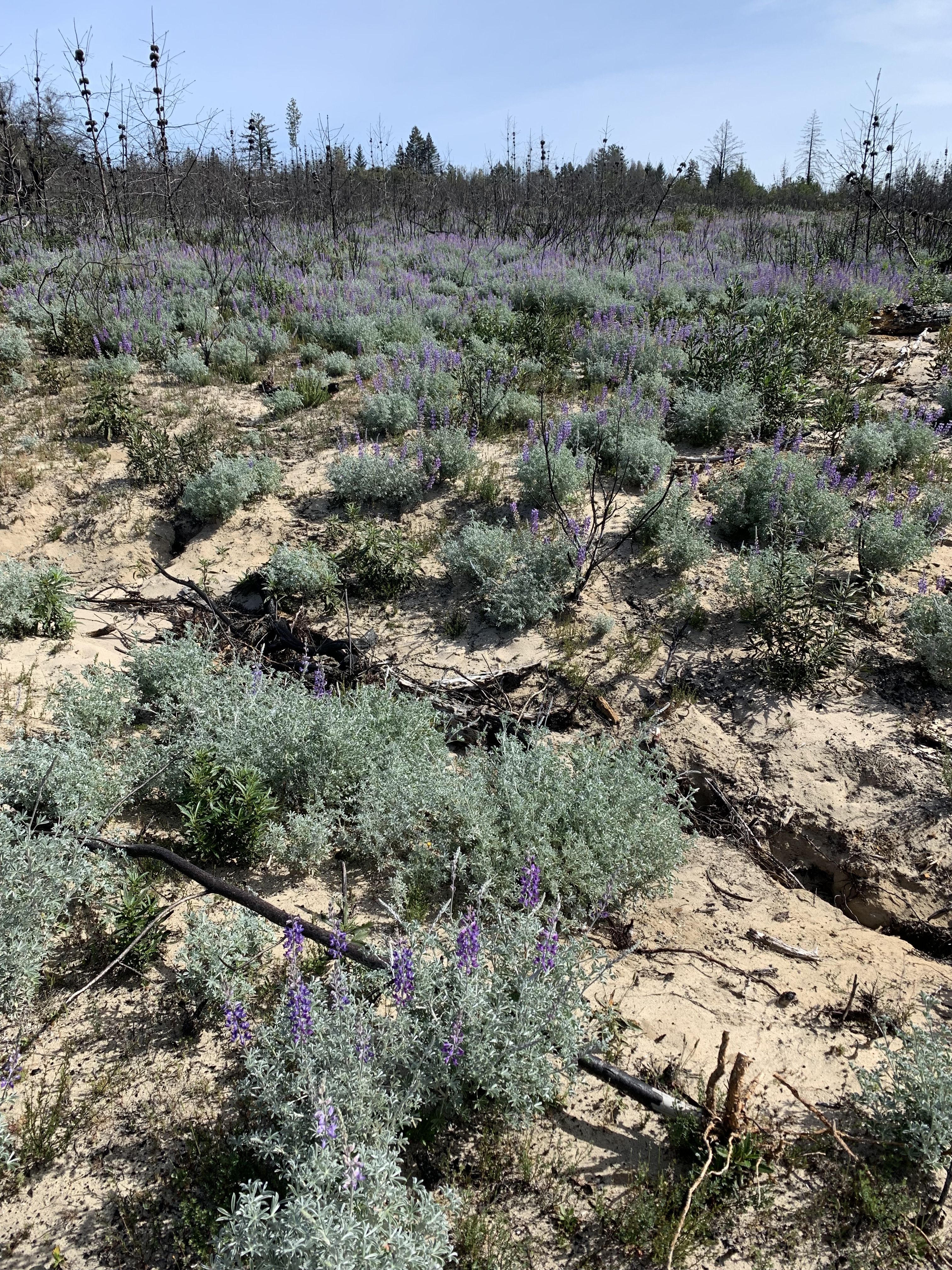
Masses of Lupine propinquus popped up after the 2020 CZU Lightning Complex Fire at Molino Creek Farm

Lupine Pollinators

It isn’t a burden to sit in a sky lupine patch to watch for pollinators. You’ll quickly realize that bumble bees love lupine flowers. And, if you look at those bumblebee legs, you’ll see the distinct yellow orange sky lupine pollen color – they collect big globs of it.

And yet, sky lupine doesn’t need a pollinator, it can self-pollinate. But sky lupine flowers make more seed if they get pollinated by bees. The species has an interesting adaptation- some tiny hairs that prevent self-pollination at first; these hairs wilt with time, allowing self-pollination if all else fails.

Sky lupine mixing it up with California poppy- a common combination and always lovely

Planting Lupines

You might be tempted to plant sky lupine- certainly expensive wildflower mixes contain this species and display its color on the fancy seed packets. However, its not that easy. Sky lupine seeds are tough and unpredictable to germinate. Friends have been sending me pictures from places they’ve never seen sky lupines before- the seeds have been in the soil for decades waiting for the right year to germinate! Check out the seeds, sometime- they are beautifully marked with a shiny, waxy seed coat. The seeds are hard as rocks, meant to last years in the soil.

There are many different types of sky lupine, each adapted to its own microclimate. So, if you really really want to get some sky lupines growing, get to a patch nearby and get local seed- collect the pods as they start to dry. Place the drying pods in a paper bag in the sun and wait. Soon, you’ll get to hear the pods exploding in the bag and you’ll know that you got some good seed. Make sure that the pods and seeds are nice and dry before storing them until next fall. As the first rain storm is predicted, cast the seeds around where you want sky lupine…rake them into the soil if you can…and wait- sometimes for years!

Lupinus albifrons, silver bush lupine, in the Bonny Doon Ecological Reserve- post 2020 fire flush

Lupine Places

Back in the early 1900’s, many regular Santa Cruz citizens would enjoy Spring wildflower trips to the North Coast grasslands to collect wildflowers. They would bring bouquets home with them and garland their hair and clothes with colorful displays. Now, with long mismanagement of many of those grasslands, there are few wildflower patches left. Anyway, if you do find wildflowers, you’re not supposed to pick them anymore. We ought to leave them for whatever remnant populations of rare pollinators might be around, waiting for us to figure out how to better manage the prairies.

Locally, two places to visit sky lupines come to mind. It used to be that the Glenwood Preserve in Scotts Valley had good sky lupine displays, but I haven’t had a report this year. A little drive to the south, and spring always brings great sky lupine displays in the grasslands and oak savannas of Fort Ord National Monument. There’s something particularly appealing to me about the large patches of sandy grasslands full of lupines surrounded by gnarly short coast live oaks at Ft. Ord. Those sky lupine patches are frequently large enough to get that lupine smell, experience that upside down world with the sky on the ground, and thousands of bumble bees bopping around the flowers.

-I originally published this post at Bruce Bratton’s weekly blog BrattonOnline.com

Luscious Late Rain

After the driest first quarter of the year on record, rain sweet rain fell like no one had predicted this past Sunday. Mark Lipson recorded 1.18” of rain – enough to saturate the first foot of our kind of soil. Maybe some water leaked below that, but it was very dry much deeper than that recently, so the water helps the cover crop, which will quickly drink it up while growing a few extra inches.

The recent nights have been chilly. The breezes have been blustery. We had spring a while back but it then returned to winter, and then the fog today seemed like summer. Atmospheric mayhem.

Field Management

We are mowing. Field after field is getting treated to different mowers, flail or rotary, grinding up cover crop to a sweet-smelling pulp that is already getting eaten by earthworm and sow bug to soon enter the soil food web or at least somewhat cover the soil through the coming dry hot summer. We are retiring fields long farmed as Molino Creek Farm scales down for the first time in decades while we re-envision the next generation of farming the best of our deeper soiled flat land. How shall we manage fallowed fields? This, too, we must contemplate.  

Mowing commences – a freshly shorn field in the foreground of two of Molino’s Giant Mother Oaks

Orchard Haps

In the orchard, we are struggling to drop the irrigation lines, test the pressure, flush the pipes, and start up the long process of re-wetting the dry soil before the trees get thirsty. We had to set up irrigation in tall grass that we normally mow first- we must act quickly so trees don’t dry out as they burst into bloom and unfurl their sun-loving leaves.

Orchard understory cover crops, which were so disappointingly tiny, will now grow a bit more. The rain and irrigation spur the more lush growth of purple-flowered vetch, floppy bell beans, and pointy-leaved, thick stemmed oats. Before the rain and before the irrigation, the cover crop canopy was around 6”. Now we can hoo-ray and dance as it grows to more than a foot of valuable green manure to feed the pollinators and fertilize the earth.

Vetch with a Big Bumble Bee – cover crop doing double duty on Cherry Hill at Molino Creek Farm

Critters

The cold and rainy times chilled the turkey vultures or perhaps they were doing something more. Out there in one freshly mown cover crop field two vultures faced the freshly emerging early afternoon sun, lifted their lovely red fleshy heads and spread their giant wings out as if to soak in the rays. It always seems like such an effort to keep those huge wings held out parallel to the ground. Later, there were four vultures struggling to get altitude in the intermittent gentle breeze. Up and up they went and then there was an unusual sight- one after the other they folded their wings and jetted downwards at one another. Swoosh! You could hear the air cutting across their giant wings a hundred yards away. Playing? Mating rituals? Wow.

Speaking of turkeys, our road intersection hen was so fat with eggs 10 days ago that she could hardly walk fast. I patiently gave her berth as she walked up the Big Hill in front of my truck. Her feet seemed to hurt her, and she wobbled to and fro. After a long, long ways she (finally!) moved off the road towards her normal nesting spot. 4-17 eggs have been laid somewhere nearby. Expect the little ones to be fluffing around in about a month, just like every year for many. They are our welcoming party as you turn into the Farm.

A week ago this past Sunday, around 10 p.m., the slightly open window revealed the repeated bouts of screaming from a lioness not far from the house. That sound is always invigorating. She went on like that for an hour or so before quieting down. No noise since.

The golden crowned sparrows are still hanging around. Hummingbirds are diving and flashing. Quail coveys flock together.

Bright Spring Flowers

The rain will make the lupines even happier this Lupine Year. The bush lupines are in full bloom, big patches of green-blue velvety mounds with thick spired masses of checkered lavender and white flowers. There are two types of annual lupines- the tiny flowered bicolor lupine and the full flowered deep blue sky lupine (aka someone turned the world upside down lupine). These annual lupines are incredibly gorgeous. 10 a.m. in the North Orchard and you can bathe in the sweet scent of purple as lupine flower essence wafts downwards from 3 acres of flowers, floating towards Molino Creek Canyon.

Sky Lupines carpet acres this spring – very unusual profusion!

This post originally published in my regular blog at Molino Creek Farm’s website.

Recreation vs. Conservation in Natural Areas

We face a quandary for which there are many solutions: the northern region of Santa Cruz County is one of the nation’s top biodiversity hotspots which is increasingly facing one of the largest threats to biodiversity – recreation within conservation areas. Globally, the coast of California is recognized as one of the most important crisis areas where natural areas tourism impact overlaps with critical conservation areas called biodiversity hotspots.

Biodiversity Hotspots

Biodiversity hotspots have been scientifically catalogued in precise ways to direct conservation funding and activities. These areas have particularly high numbers of species limited to small geographic areas, correlating with large numbers of endangered species. Areas with numerous endangered species in different groups receive higher hotspot scores: Santa Cruz County has many endangered species in three groups: ‘herptiles, arthropods, and plants,’ and so is one of only two counties in the nation to receive the highest hotspot score. Similarly, with a larger lens than county boundaries, the San Francisco Bay Area, including northern Santa Cruz County, is recognized as one of the top three biodiversity hotspots in the country. The rationale for using biodiversity hotspot indices for conservation prioritization is so widely accepted that this measure has become the focus of the most funding of any other conservation initiative, a total of $750 million up to 2010. Our region has long benefited from such largesse, including the generous funding to set aside areas like the BLM’s Cotoni Coast Dairies and POST/Sempervirens Fund’s San Vicente Redwoods conservation areas. And yet, purchasing of land for conservation purposes only begins the process of conservation, which will last many lifetimes. Fortunately, there are many strong protections in place for these areas that help to guarantee that they will long be managed primarily for biodiversity protection.

Wildlife Protected at Cotoni Coast Dairies

There are a host of guarantees for biodiversity protection at the Cotoni Coast Dairies property. In 2017, Obama’s presidential proclamation making the property a part of the California Coastal Monument there are protections for such a breadth of ‘Objects of the Monument.’ Monument designation carries with it mandates for very careful planning, inventory, and adaptive management to assure natural resource protection. In addition, the property has been designated as part of the most protected lands in the Country: National Conservation Lands. In addition, BLM maintains and regularly updates lists of ‘special status’ plants and animals to guide protections on their lands. For those interested in mandates for BLM management for biodiversity on National Monuments, I encourage perusal of their Manual 6220. Using one ‘Object of the Monument’ as an example, the 6220 Manual requires that BLM inventory the dusky footed woodrat on the property and, in collaboration with experts at its National Conservation Lands Office, include in its property-wide science plan specifics about how managers will monitor and adaptively manage the property to assure the species’ protection. Regulations protecting biodiversity on the nation’s highest value conservation lands well reflect the majority of citizen’s interests in protecting wildlife, even if it means personal sacrifice. This is good news for conservation in natural areas because of the natural conflict between recreation and conservation.

Recreational Use is Contrary to Wildlife Protection

There has been much published about the negative impacts to wildlife of recreational use in natural areas, but here are a few illustrations of types of negative impacts. The following species are listed as “Objects of the Monument:” gray fox, bobcat, and mountain lion. Predators such as these three species are well recognized as extremely sensitive to recreational use in natural areas, leading to decreased density and abundance of these types of animals. Researchers working in the Santa Cruz area have noted that mountain lions are substantially sensitive to noises from humans, which reduce their use of recreational areas and lead to changes rippling through the rest of the wildlife community, including increased numbers of mice and potential increased frequency of Lyme disease. But, mammalian predators aren’t the only types of wildlife to be disturbed by recreational use.

The Monument Proclamation also calls out protection for Wilson’s and orange-crowned warblers, downy woodpecker, tree swallow, Cooper’s hawk, and American kestrel. Burrowing owl, golden eagle, tricolored blackbird, and white-tailed kite are also listed as protected on BLM’s special status animals list for California. Some bird species have been shown to be especially ‘flighty’ in the face of recreational use, requiring study and specific trail design to adequately buffer distances to avoid impacts. While the effects on specific species varies, some species can be negatively affected by the mere presence of humans, so, unless specific studies can ascertain effects, scientists suggest that avoiding new trails in natural areas is the best measure for conserving sensitive birds. Grassland birds, such as the burrowing owl, are particularly sensitive to recreational disturbance, perhaps because it is so difficult for these species to hide. There are also studies that would suggest care must be taken to avoid recreational disturbance to species like the California red-legged frog, deer, and native plants.

BLM’s Dilemma

BLM managers of Cotoni Coast Dairies face the many dilemmas of managing land for conflicting visitor uses alongside the conflict between recreational access and nature conservation in an especially sensitive ecological area.  The varying types of recreational users run the gamut from mountain bikers who use trails for the physical thrill of staying upright with speed and obstacles…to more scenery- and/or exercise-oriented mountain bikers and hikers…to more passive recreational users such as wildlife viewers…to photographers and painters…to restorationists…and scientists of natural history. Each user group conflicts with the next and the ones further apart with their expectations conflict even worse. I have not seen a plan by BLM to accommodate or monitor such conflicting uses, which will lead to what is called displacement, mainly of families with children and more passive natural areas users. Instead, BLM managers have shown a personal and strong affinity with the mountain biking community, which is also the agency’s closest ally in advocating for and developing recreational trails designed for their use on the property. On the other hand, BLM managers have turned away from engagement with passive users such as wildlife viewers, restorationists and scientists of natural history. Without welcoming this engagement which would have made up for their professed lack of such capacity, BLM managers are now moving forward with little understanding of the distribution and abundance of species, including those protected by statute. The evident BLM managerial-mountain biking community conflict of interest should be a great concern of those of the public who are concerned with biological conservation.

The Collaborative Management Solution

We should be advocating for an alternate way forward where BLM public engagement staff serve as facilitators of solutions-based approaches to the conflicts between users and between recreational use and natural resource conservation. The first step would be for BLM to adhere to its policy requiring a science plan informed by a baseline inventory of the Objects of the Monument and other special status species; this plan would include a carrying capacity analysis and an adaptive management framework to assure protection of the resources. All of those steps could be done collaboratively with scientists and volunteers as is outlined in BLM’s policy guidance. There have been offers for substantive financial resources to assist with this planning. Instead of hiding its scientific studies as it does now, BLM would proudly share what science it has gathered on a public interactive website. Once completed, the science plan could then be the focus of collaborative management of the property including all interested parties working together with the common goal of conservation of biological diversity while providing recreational access to the maximum extent possible. We are lucky to have a coalition of many groups working to make this vision real, including: Rural Bonny Doon Association, Friends of the North Coast, Sempervirens Fund, and Davenport North Coast Association. Your support of those organizations will help greatly.

-this post originally appeared last week in my weekly column at Bruce Bratton’s weekly BrattonOnline.com

Diffuse Blackbirds

The Big Show around the Farm is the bicolored blackbirds. Instead of trees full of blackbird song, they have become diffuse- a few here and there….everywhere. Everywhere trilling song. The males are so pumped up with Spring, they are squaring off with moving car tires to show the others who is the toughest. As I walk around, the nearest male will keep its bill pointed at me, following my passage, squeetling and chipping and flashing its red shoulders- so tough! Not far away, other blackbird brethren fret and squeak and dance around the showiness, everyone eyeing the complex interactionists and goings-on. The bicoloreds have definitely started investing in nesting, so it is time to mow the cover crops before it is too late.

Green Manure

The orchard cover crop never amounted to much, only reaching a foot or so on average. The vetch has barely sprawled, but will bloom its purple blossoms soon. Bell beans are so thirsty as to be folding their wee leaves- will they make flowers? What will the 6” tall oats do? Us organic farmers rely on cover crops to capture atmospheric nitrogen and put it in the soil to fertilize our crops. It’s a beautiful thing when there’s a rainy winter, because Nature is watering the cover crop, making fertilizer for the next season. When its dry…not so much! But, we plan for that- we’ve been building up organic matter for years and that helps hold the nutrients in the soil, so we have a fertilizer bank- at least for a little while.

Lupine Shows

Out in the more wild places of the farm, the lupine show is Out-Rageous! There used to be much more grassland at Molino Creek Farm. Back in the 1980’s the hillsides were grasses but the coyote bush invaded and then closed ranks and it has been shrubland ever since. Then there was fire. Decades of lupine seedbank erupted in the newly sunny spots and they were celebrating yesteryear. Sheets of knee-high blue and wafting grape bubble gum smells are so delightful. And, its not just us: shout out to Tommy Williams who has also noticed lupines where lupines had not been- in other grasslands, closer to town. Lupine seeds can last many, many years in the soil, waiting for the right time to germinate.

Lupinus nanus, sky lupine, a native annual wildflower- one of the many species brightening Molino Creek Farm’s natural areas.

Oak Branches Bolt

It is time for coast live oaks to grow. Their branch tips are bursting with new growth after having lost many of their old leaves. Some of the trees are blossoming, long catkins dangling and dancing in the wind. Its when these new leaves emerge that you start noticing the individual nature of each tree- some are more yellow, some a deeper green. The new shoots are the yummiest of delicacies for the dusky footed wood rats who are saying ‘Ooh! Ahh!’ and ‘schreeumfst’ (the sound they make when they are tickled to have a mouth full of branchlets filling their craw as they scamper through the oak canopy towards their homes).

Quercus agrifolia, coast live oak, with splendid new growth

Orchard Blossoms

The first apple trees are coming into bloom. The quince bushes are already towards the end of their blossoms. The sweet smell of stone fruit flowers fills the orchard atmosphere. Citrus flowers are so, so sweet and numerous. The avocado blossoms are just starting to open. And, the cherry trees are mid bloom. All of this is a month early, but nevermind: it’s beautiful.

-this is shared over from the site I normally post for Molino Creek Farming Collective

Sudden Springliness

Meteorologists are echoing what we feel in our bones: the rainy season is over and we are onto another year of drought. The vibrant grassland greens are fading into echoes of verdancy, patches in huge fields of growing tawny gray. Cow tongues reach far, pulling at the remaining food previously protected along fencelines and hard to reach places. Poppies pop out and lupines poke up from the short stubble and rocky places. The springs and creeks still flow but will soon be slowing. The redwoods are in for another sorry year and are collectively crossing their needles for a bounty of fog should a warm summer ever arrive. The days are breezy and cool, the nights downright chilly.

Birds

During my short walk at dusk, I startled a big covey of quail- at least 50 whirring out of the cover crop and bumbling  into the brush then taking off again and packing into the thick foliage of a fencline oak where they will bundle up for the night. Quail are ‘chi-ca-go’ -ing again but are wanting for drinking water.

A hawk wheeled overhead.

We missed the ‘chock’ -ing of hundreds of robins or the whistling wings of hundreds of mourning doves- both downhill progression patterns at dusk, but of previous seasons. Dusk tonight was less momentous.

Early Spring(like) Flowers

The cover crop is blooming a good bit early. We plant mustard as a quick growing cover crop that captures nutrients that would otherwise leave the system. Mustard plants produce compounds that clear the soil from pathogens. The flowers are bright yellow and support many early season pollinators, helping to spur their population growth in anticipation of the many crop flowers that will follow.

Radish is related to mustard, both being in the cabbage family. Radish is in full bloom in the fallow areas and hayfields; it is starting to seed. The onset of radish seeding is the trigger for the ‘first mow’ of the hay fields: mowing with the first radish seeds is the right time to keep songbirds from investing in nesting where we want to harvest mulch.

Radish flowers are open, and some have gone to seed

I originally published this post at my blog on Molino Creek Farm’s webpage.