Changes Slowly Emerging

The calendar says it is almost fall, just a couple of weeks away. But, the temperatures and dryness suggest it is more like midsummer. The days wake up mostly sleepy, fog having rolled in during the night. Everything glistens with dew in morning’s first light. Sunrises are muted with tones of gray and silver across the shadowless and chill landscape. There is no dawn chorus, only a few peeps when the birds warm, late. The morning crawls on as the fog slowly breaks. It brightens more, bit by bit, until there is mostly blue sky by about noon. Then, barn swallows take noisily to the sky. The afternoons slowly warm until the sun gradually fades, a shadow line edging across the fields as the sun disappears behind the ridge to the west. This past Friday, the fog was so heavy and long lasting that it drizzled enough moisture to wet and settle the road dust.

Pattern Recognition

Last year, we would have been about to get our first inch of rain. That September storm produced what we call the germinating rain, and the early timing was extremely unusual. After that, there was another Big Storm in October – more expected timing. A bit later, all heck broke loose in December through January when we got atmospheric river after atmospheric river. None of that was predicted. In fact, as late as October, our national weather service climate scientists were saying it was going to be a dry winter, a La Niña situation! Right now, those same experts are saying there are strong El Niño conditions and that there is a 95% chance of those continuing through February of 2024. Compared to the last 12 years of data, this year looks comparable only to 2015, a year that brought some hefty rains to our part of California. With last winter’s deluges fresh in memory, it is easier to prepare though the really rainy times should be months away. So, we are able to chip away at the chores: an armload of firewood here, a bit of road drainage improvement there.

Nature’s Patient Changes

The nature around us also patiently transitions. The monkeyflower bushes leaves fade from top to bottom from their sticky dark glossy green to a crisp and withered black. This year, even those drying bushes still sport flowers feeding hummingbirds and bumblebees as they make their daily rounds. Madrone leaves and shreds of bark fall bit by bit, day by day, refreshing a layer to keep the footpaths only a bit crunchy. The grass, once shiny golden as it started to dry, is now almost gray with age, falling over and covered with dust. It will bend still until it is all in broad arcs and pillows in the unmown areas. The mounds of dry grass resist herbivory in that elevated state. In areas we mowed and the chopped grass touches the ground, herbivores feast on hay: insects, mice, and gophers are fast eliminating this year’s productive crop. Crickets in particular are having a good year.

Cricket Families

The night walks reveal new generations of crickets alongside the older, bigger adults. There are many sizes of crickets from the tiniest of young to sub-adult adolescents to honking adults. The adults are surprisingly large, especially the black field crickets which are the bravest, barely moving from the examining beam of my flashlight. One large adult sings from every 3 square yards, and I haven’t seen two of those large adults more in proximity, so from whence the young? Ah, something more to learn…

One of our many odd comice varietie- all ripening differently though contiguous

Abundant Life

Life’s young are growing in other species. Coyote parents follow their adolescents’ lead for the yelping chorus. Judging from their plentiful and frequent scat, they are enjoying scavenging lots of farm fruit. Momma deer has two growing young in tow; they might not realize that she is pregnant again and so will share the space with a new sibling or two before very long. It has been a few weeks since I saw the latest puffball young quail, and there are currently huge groups with lots of curious nearly grown young learning the techniques to avoid being the meal of so many predators. Those quail groups are so large as to seem to flow like liquid from bush to bush as they shuffle and scuttle through their days. Tiny fence/blue bellied lizards have recently emerged, inch long babies that are much more energetic and jumpy than their older counterparts. They leap impossible distances and dart down holes at the slightest movement. There are no intermediate sizes, so a simultaneous hatching seems logical. Medium sized snakes, now that’s a thing! Foot or so long gopher snakes share paths with similarly sized yellow bellied racers. I wouldn’t want to be a mouse right now given the snake abundance.

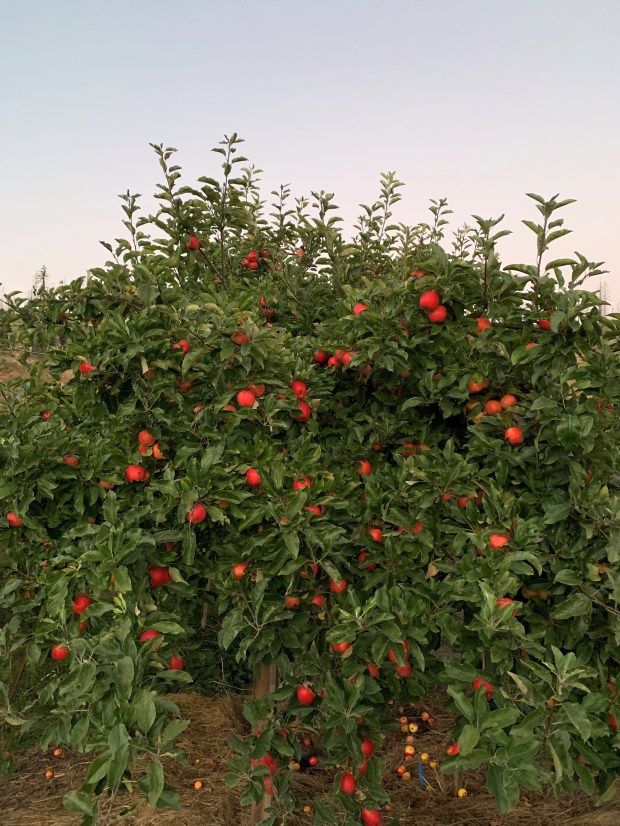
Organic Gala Apples Hanging Heavy, Soon to Pick

Fruit Developing

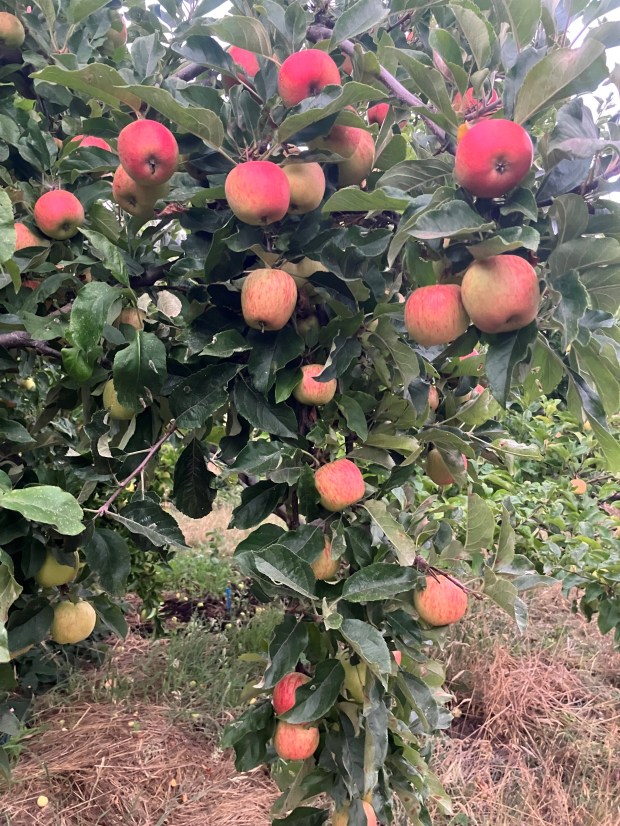
The fruit are also growing up. This past week, we reached the saturation point for pears: there are 60 pounds of pears sitting under one comice pear tree waiting to be scavenged; more pears are on their way with boughs bending under the weight of so many fruit. The Gala apple crop hangs heavy, too, and has just started gaining its peachy blush that indicates ripeness. Fuji apples are farther behind, still green with the slightest of red blush just appearing where the sun hits the fruit.

Organic Fuji Apples, a ways off… until ripe!

Noticing

Fog, then sun, then night…fog ebbs and flows. The recent super blue moon fades gradually, night by night. The Milky Way gains prominence. The roar of waves crashing creates the baritone and bass notes of the cricket-filled soundscape of Molino Creek Farm. Long still nights beckon sleep. The first subtle light of dawn is the call to chores abounding. Each day flows into the next, an unending cycle of light and dark, coolness and warmth, and the chance to curiously glance up to see who else is watching the play of light as the sun travels the sky’s glorious arc.

I hope you are.

For Fruit’s Sake!

Humanity

Compassion for others in a political setting is a challenge that, as citizens, we must all ponder. As citizens in a democracy, we are active participants in the global experiment on Nature and how future generations will fare based on our individual decisions in the moment. We purchase things, we vote, and we make thousands of choices that each has an impact on other species. Each of us has our way and our reasons. A compassionate approach to others may open the many stuck doors to create a more lasting environmental conservation movement. And, we must ponder how institutions and individuals interact to enact that compassion.

The Government

Our style of democratic government reflects the will of the Nation’s people, over time. We vote directly for one of the three branches of government – the Legislative branch – and the House directly reflects representation of the majority of the population. The Senate changes the ‘majority rules’ notion to evenness of geographic representation, no matter the population, giving small numbers in sparsely populated geographies more power. Election of the Executive branch has a system of election using delegates, which also reflects an intention to create more even geographic distribution of power, but also has aspects that embed extra-democratic power relationships including freedom of delegate choice into the equation. Judicial branch members are appointed by that Executive branch and seated when confirmed by the Senate and so also reflect the problems associated with the elections of those two portions of the government.

In short, we have a system of government designed to amalgamate the geographies, popular opinions, and existing power relations in order to make choices that we are meant to respect as ‘representative.’ The way this works is particularly challenging to issues that do not raise to prominence for voters. When votes matter, politicians and the power network that supports them sway government actions. Environmental conservation is one of those issues that the power structure never wants to see come to the fore, and citizens are easily swayed in other directions. News media and social media, which are easily manipulated, herd citizens towards issues that are both divisive and convenient for those in power. Environmental conservation threatens all members of those in power, no matter what the political persuasion.

The top issues that sway US citizens’ votes are the ones that the media focus on: the economy (always first), healthcare, and safety – e.g., police (local), military (global). Environmental concerns always rank Way Down the list, despite being the single greatest element to having a sustainable economy, healthy humans, and a safe society.

When considering environmental conservation, it is the will of those in power and the government they manifest that creates the challenges to having compassion on two factions of our society: your fellow citizen, who is in some way responsible for the government, and the employees of government institutions, who act within governmental decision frameworks.

The Citizen

How do we approach compassion, to see the humanity in our fellow citizens when the government does so little for environmental conservation? It is easy to blame governmental actions on the citizens of the country, but is it fair?

It is also easy to understand why your neighbors, friends, and relatives do not prioritize environmental conservation with their actions. We are creatures of habit living in a difficult world. It is difficult to change our behaviors, even if they negatively affect the environment. It is difficult to see our individual choices as mattering and easier to blame the impacts on the environment on other people, other nations, or even evolution, fate, or a Deity. We all do these things. When we listen to the news or tune into social media, the messages there do not help us to understand elements of environmental conservation and what we can do about them. Even the supposed ‘neutral’ (really ‘centrist’) NPR rarely covers much of the breadth of environmental conservation import and then mostly with disempowering messages. Because the US has become so expensive and the pace so breakneck, citizens are afforded almost no leisure time to learn about environmental issues. And, with the decline in broad, critical thinking education, environmental conservation has become a tiny part of anything students are exposed to, favored by Science, Technology, Engineering, and Math (STEM) focus. The term ‘Science’ in STEM doesn’t mean organismal biology nor does it include any conservation elements. Highlighting this STEM education is a real success of the power structure in the US as they hope to create a (somewhat) skilled workforce.

In sum, citizens do not know, and cannot find a way to know, about environmental conservation and without such knowledge they act innocently and ignorantly in ways that collectively negatively impact the environment. Aren’t we all like that? Let’s have a little compassion for everyone and figure out where to go from there.

The Government Worker

Government workers are citizens who have even more burdens on their environmental conservation actions. Those people who work for governmental institutions that are supposed to protect the environment face all the challenges of the average citizen described above. While it is true that the government requires some of those workers to have higher levels of education to qualify for their jobs, the required bachelor’s or master’s degrees never train them for the environmental conservation elements of their jobs. The most relevant field is called ‘conservation biology.’ There are very few institutions of higher education that offer this focus, and the combined top ten programs in the US graduate fewer than 100 undergraduates, and far fewer graduate students, each year. Once out of school, these individuals have a high incentive to work in a lucrative field, environmental consulting where they can earn 5 times more than a government employee. And so, government institution personnel that are responsible for environmental conservation have not received the education they need for their jobs, have not been raised in a culture that supports inquiry, and are strained by economic and social situations that make it difficult to prioritize environmental conservation. And then they go to work in institutions with similar individuals under conditions of extreme political pressure exerted in contravention to environmental conservation.

Governmental Institutions

The government institutions that have responsibility for environmental conservation have never been designed to be effective with that responsibility. Because conservation rarely and briefly rises to the fore for politicians, consistent oversight and policy development is lacking. Instead, environmental conservation frameworks are weak and up to the interpretation of the agency. Locally, State Parks is required to have General Plans for all of their lands, but there is no required timeline for creating them, no mandate to update them (ever), and little guidance on key features of those plans such as what a ‘carrying capacity’ analysis might be. Locally, County and City Parks have no guidance at all about environmental conservation and there is none in the making. Locally, the Bureau of Land Management has guidance documents for environmental conservation, again with no timelines for enacting them and insufficient guidance to maintain the scientific integrity of those efforts.

Workers are Human, Too!

Even if they don’t recognize it and can’t hear it, the too few employees charged with environmental conservation at governmental institutions find themselves without sufficient means and support for substantive, science-based environmental conservation action. And so, they go about their jobs doing what little they can to try to make a difference. Most of them are proud of their accomplishments. Being social humans, they form bonds with their workmates and take their personal pride and form institutional pride. They are proud of the work of State Parks, they are proud of City and County Parks Department accomplishments, and they are proud to be part of the BLM team.

Many of us can relate. Many people find themselves in institutions that have elements of good and elements of bad (which sometimes we don’t want to see!); we choose to focus on the good work we are doing within those institutions. We make friendships at work and want to support those friends. Some of us work for institutions where the public believes that our work is good and just, and so it is easy to become proud of our institution and even to defend our institution when challenged. Let’s have a little compassion for the people we see who have ended up like that and figure out where to go from there so that there is better environmental conservation even by governmental institutions.

This post originally appeared in the important blog published by Bruce Bratton at BrattonOnline.com Subscribe Today!

The Storms Passed

Hurricane Hillary made national news. Many people have little idea of the geographic scope of California, so they assume all Californians are in trouble. The last Big Fire here, part of a state-wide tangle of epic lightning-sparked fires in 2020, was from half of a hurricane that peeled off our direction from landfall in Baja Mexico. A Pacific Ocean guardian low pressure gyre nudged Hurricane Hillary eastward. So, Molino Creek farm was cloudy with the tiniest of sprinkles and some brief gusts of wind, but that was that. Oh yeah, and it was muggy: weird! And the smell of rain, so delicious after months of nothing, just dust. Still, the anticipation of another hurricane was awful.

Solanaceous Aftermath

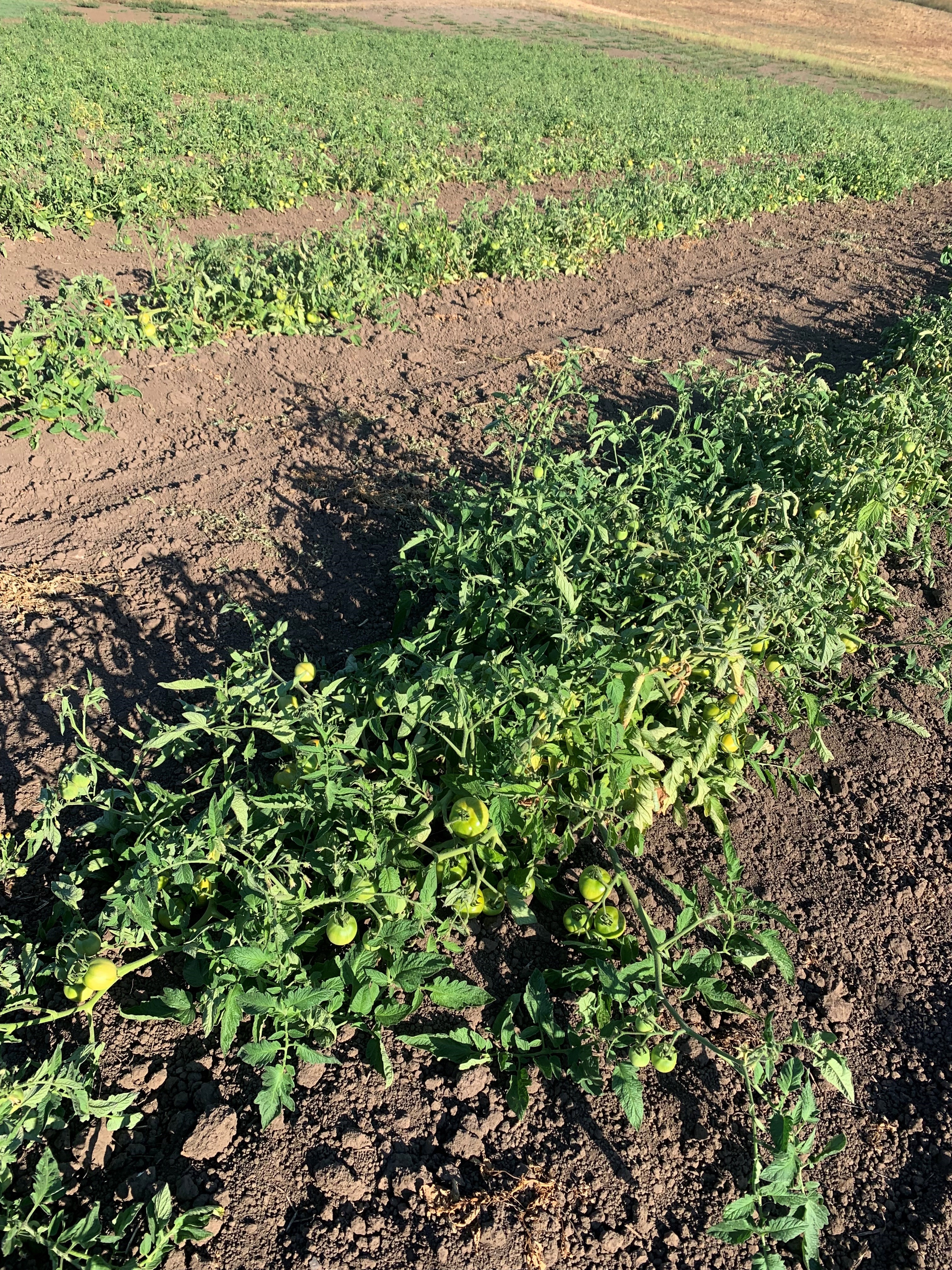
Post post-Hurricane Hillary, the farm is warm, awaiting the restarting of the upwelling and onshore breezes due in a few days. The warmth is perfect for tomatoes and the lack of much rainfall helps a lot too: they hate wet leaves! The sprawling tomato vines are loaded with big, pale green fruit. Soon, there will be so many tomatoes that it will be difficult to keep them harvested fast enough. For now, we eye each ripening fruit with glee: there aren’t that many! It is also the time when Maw and Caw, our big black farm ravens, are frequently seen carrying red, cast off tomatoes happily to some perch where they feast with gusto.

Molino Creek Farm’s dry farmed tomatoes…for the first time Not On Trellis!

Night Walks

This part of the year takes me on night walks to turn off the orchard irrigation. It is too hot during the day to run micro-sprinklers, an invention that gently eeks out water at a rate so that it soaks well into the soil without waste. The micro-sprinkled amounts would mostly evaporate in the heat of the day, so we wait until the cooler evenings and nights. That takes me abroad just before bed time on a stroll that is always full of discovery. Each year, on the warmer summer nights, I am delighted to experience the return of the Night Ants. These are big, glossy, dark brown ants which hang out in families, venturing just a few square yards from their hole. They have several morphs- some are large and powerful looking, some are more dainty, and some in between. I’ve seen them carrying their dead, so they’ve got at least one social ceremony. I don’t know what they do for a living. I’m seeking the black widow spiders I spied last summer at the mouth of some colonies of roadside gopher burrows. A few nights ago, I started a harvest mouse who decided to crouch in the grass until I passed, allowing me a good look at that tiniest of rodents. The prettiest of things on night walks: the spectacularly silver-sparkly eyes of wolf spiders, which dazzle and spark from just about everywhere. They are so very numerous. I like to check out the biggest more closely in hopes of finding a female with a hundred of her young on her back: extra creepy! The headlamp isn’t so much fun these evenings because of some flies and moths that want to crash into my glasses constantly, attracted to the light. So, the headlamp goes down to waist level, but the spider eyes don’t reflect quite so nicely from there. Owls hoot, coyotes yip, and the beautiful crescent moon barely lights the fields and ridges. Yes, it’s a chore to turn those late-night valves, but I’m happy for the motivation to get out of doors.

OH PEARS!

They won’t take care of your children for more than a few moments, but they sure are tasty. It’s pear time! Pears precede apples in our harvest cycle and the comice pears are dropping and juicy and irresistible. You can’t stand under the old pear tree or you are going to get bonked in the head by a falling pear: dangerous! I still don’t quite know when to harvest pears from the tree, but I do know that the fallen ones ripen quickly, like within a day or so. Soon, there will be 300 pounds for the orchard volunteers and Molineros to gather. The dehydrators start humming and the pots of pear butter will soon be bubbling. Yum!

What’s that Smell?

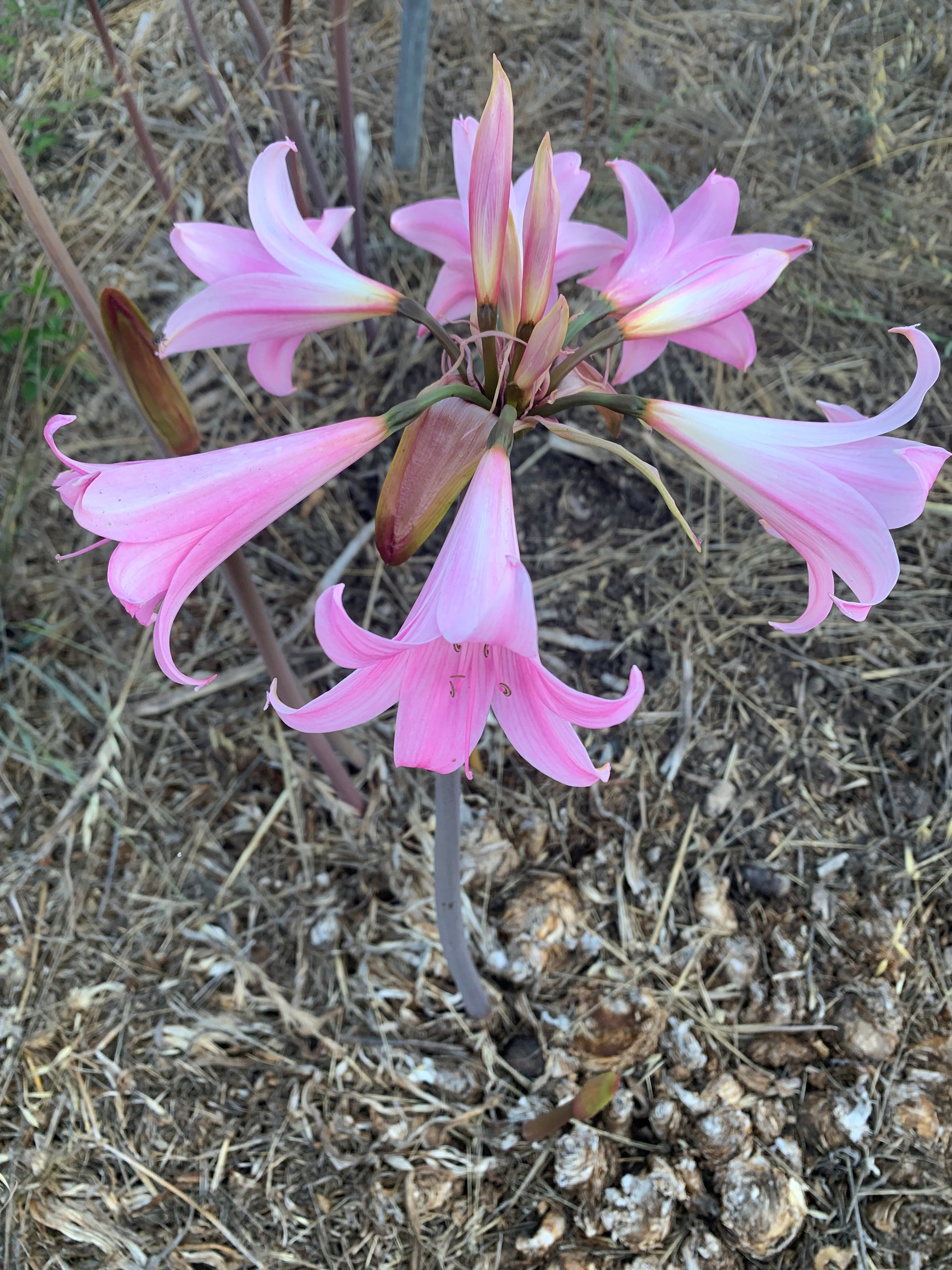
The farm is full of scent. With the storm’s weird warm winds from odd directions (east!), came the resinous, sweet smell of ceanothus…but only briefly. The orchard smells of damp earth with hints of fungus. Passing the vineyard, the smell of the devil: sulfur! Then, there are occasional sweet smells…surprising sweet smells. The latest nose candy is emanating from the Surprise Lillies aka ‘naked ladies.’ Some prior farm denizens took a liking to these Amaryllis and planted them hither and yon. They are impossible to get rid of and they smell of pink candy. But, they make striking cut flowers if you don’t mind the sweet, sweet smell.

Naked Ladies are named such because of the lack of leaves when they bloom

-this post also simultaneously posted at Molino Creek Farm’s equally amazing website.

Migrating Butterflies

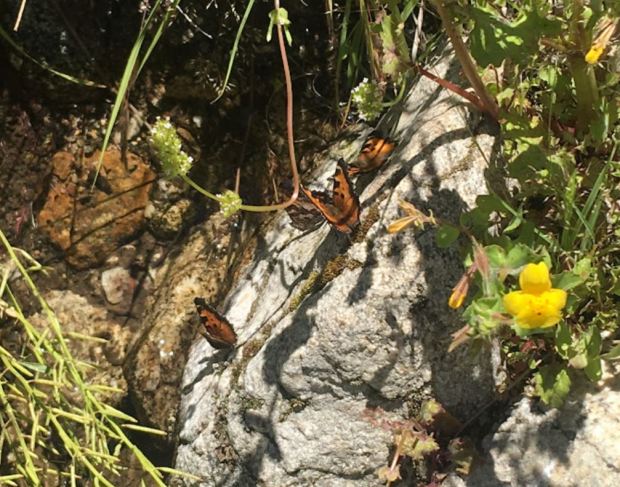
Monarchs, painted ladies, and tortoise shell butterflies are three kinds of butterflies that migrate to and from the Monterey Bay area. Each has its own story.

Butterfly Life History, Reviewed

To understand the rest of what I have to tell you, you’ll have to recall some basics about butterflies. The flying creatures you see are just one of the life history stages of these insects. These flying ones are called ‘adults’ because they are the ones that are reproductive. They mate and the females attach eggs to just the right plant where their hatchlings will want to feed. The eggs sit a while before hatching. When they hatch, out comes what is called a larva, or caterpillar. The caterpillar feeds on certain kinds of plant leaves,  gets bigger, and one day finds itself yearning to change. At that miraculous point, the caterpillar morphs into an entirely different-looking thing: a chrysalis. The chrysalis hangs apparently doing nothing, but actually it is using stored food to change into an adult. A chrysalis can move a little. Once the chrysalis has developed it morphs once again, this time emerging as an adult.

Co-Evolution

Plants and butterfly larvae co-evolve, plant genetic diversity creates new generations increasingly well-guarded against caterpillars that eat them. Plants evolve caterpillar toxins, better hairs to clog the mouths or throats of larvae, changed leaf shapes or colors so that they are less recognizable to ovipositing female butterflies, and modifications for food and homes for ants that guard against caterpillars. There are countless other evolutionary strategies to avoid what is called predation by caterpillars. On the other side of the playing field, butterfly species also evolve so that new generations are better adapted to those strategies.

Food Plants

Each of the butterflies I focus on in this essay have co-evolved with plants as outlined above. Monarchs eat milkweed, a highly toxic plant that a few other closely co-evolved species can eat. Painted ladies eat a wide variety of plants with many complex adaptations to herbivory – they are super-eaters! California tortoiseshell butterflies eat Ceanothus, a widespread shrub genus with its own chemistry to ward off herbivores.

Butterfly Maps

Monarch butterflies travel west to the Monterey Bay area in large numbers for the winter to avoid inland frost. Painted ladies travel north as their food dries up in the desert and new food is still edible further north. Tortoiseshell butterflies travel west from high elevations in the Sierra Nevada, also to over winter in our more temperate clime. Those are the simple overviews, but the details are much more complex.

Monarch Life History

In Spring through Fall, four generations of monarch butterflies enjoy life across much of the US before returning to their overwintering spots in Mexico or coastal California. That means there are four batches of fattening caterpillars munching away on milkweed, metamorphosing into chrysalises, and emerging again as those beautiful orange and black, big butterflies to move north. That last generation somehow knows that it must move south (or West to CA), where to avoid the frosts that would kill them if they didn’t leave their succulent patches of milkweed.

Many monarch butterflies have been traveling to high elevation northern Mexico where the climate has been just right for their winter respite. People have been harvesting wood from those forests, reducing habitat. Also, climate change is creating hotter, drier conditions, which might be negatively impacting the quality of that habitat. The only other place that monarch butterflies know to go is coastal California.

On California’s coast, there have been approximately 400 historic overwintering locations from Mendocino County to San Diego County. Only a small subset of these overwintering spots are on land managed by conservation organizations. Most people around here know to check out Natural Bridges State Beach, but there are other spots, as well. The UCSC Arboretum’s Eucalyptus Grove has been home to large numbers of overwintering monarch butterflies in the past. And, overwintering sites #3009 and #3010 are in groves of eucalyptus near Davenport on BLM’s Cotoni Coast Dairies property.

Painted Lady Life History

Painted lady butterflies have a slightly more complex life history and some populations travel much farther than monarch butterflies. The African population flies back and forth 9,000 miles! That’s twice the monarch butterfly migration length.

One late spring, I watched as thousands of painted ladies flew by me, moving south to north in the high elevations of Big Sur’s wildlands. They had originated in the deserts near California’s border with Mexico and were headed as far as they could fly, with an ability to fly most of the length of California in about a week. When one uses up their body fat, which they made as caterpillars, they stop, mate, and lay eggs. The next generation hatches, caterpillars eat as much as they can, then they metamorphose through to chrysalis and adults, which then fly, fly, fly, towards the Pacific Northwest. Come August, wherever an adult painted lady might be, they turn to fly south again. You can see painted lady butterflies all summer long here, but they are more numerous in the Spring when you, if you are lucky and it’s a good year for this species, you can spy hundreds moving north.

California Tortoiseshell Life History

8 years after the Lockheed Fire, California lilac was head-high and abundant in the footprint of that fire. As I led a University field trip in late June, the students were tittering and I couldn’t get their attention. They gleefully pointed out that the shrubs around me were twitching and dancing. I was astonished to see the frantically wiggling chrysalises of hundreds of California tortoiseshell butterflies shaking denuded Ceanothus shrubs all around us. Above the shrubs, clouds of newly emerged California tortoiseshell butterflies were sailing about. Soon, they would be taking flight to the mid-elevation Sierra Nevada to lay eggs on a different species of Ceanothus; they’d run out of tasty leaves here on the coast! After that generation similarly denuded those patches of Ceanothus and made that same wiggle-frenzy of excited chrysalises, those adults fly to the highest elevations in the Sierra Nevada to eat yet a different species of Ceanothus. Running out of Ceanothus and elevation, it is that generation that flies all the way back to Monterey Bay to lay eggs on our Ceanothus and start the cycle again.

Originally published by Bruce Bratton in his famous BrattonOnline.com blog

Regular Summer

There’s a certain relaxation that sets in when everything is going as ‘normal.’ Late at night, the fog rolls up the valley and we awaken to the silver tongue of fog lapping at the edge of the lowest points of the farm. Down there, redwoods drip and it smells piney and dank. The fog pulses in further and then back out in a morning battle against the heat, but always the fog lowers just below our elevation; but, we can feel the coolness even as the sun’s warmth prickles our skin and begs for long sleeves. At ten o’clock, a slight breeze picks up onshore with the cool ocean air. The days are sunny and in the 70s. It is dry and dust wells up when we walk, work, or drive, big or small clouds blowing predictably towards the southeast. Everything has become dusty. For many weeks, it has been a regular summer.

It has been a regular summer except very recently when high clouds streamed in from the (!) East. Other places in California have been experiencing Zeus’ playfulness, but we haven’t heard a single thunder clap, though a few large raindrops at one point, briefly. Those clouds make for spectacular sunsets.

Molino Creek Farm’s dry farmed tomatoes are getting ready!

The Ripening

Apples, tomatoes, winter squash, peppers, zucchini, pears, prune plums, hazelnuts…they are all ripening. As with the cherries recently, we must pace ourselves with the pear intake.

Looking down the long rows of lush, half-grown tomato ‘vines,’ we see the first ripening tomatoes blowing orange-red among the green boughs. One day soon, there will be so many ripe tomatoes that it will be difficult to keep up with the harvest. For now, we bide our time for the first batch of vine ripened, dry farmed tomatoes, a point where the farmers are as happy as the consumers. “Oh Boy!” people exclaim when they first see our tomatoes at the market. Sometimes, we have to limit the pounds purchased so that more of our loyal customers are pleased. It won’t be long now.

Gala apples growing and glowing

Gravenstein then Gala

We have only one large and one small Gravenstein apple tree, the first apples to get ripe each year. Sylvie reports ‘not quite ripe’ this morning, so we will wait another week to try again.

Next up, Gala apples. They aren’t half the size that they should be, but are the quickest growing apples on the block. They are catching up and will be ready to harvest the second half of September. We’ve had another round of thinning the fruit on those trees, thinning from the highest points of ladders. Propping, too!

Maw or Caw, who can tell? (Still Life with a Bird and Tree)

Wild Things

When the days are warm enough and the nights not too cool, we can listen for the night noises. There’s the rough repeated bark-yowl of a fox. There’s the odd sweet whistling call of a great horned owl along with the more normal hoots. There are also the calls of thousands of crickets. The black cricket rough sawing has been going for a while and was recently joined by the less raspy song of brown crickets; both are easy to spot at night along the farm’s many roads at night. The high twirring of the green tree cricket has joined the chorus only this past week; that’s the one you can tell the temperature from if you count the chirps right.

A walking around the farm reveals other wild visitors. Big piles of coyote poo is the most frequent scat. They rarely sing, but they sometimes do. Turkey tracks and feathers are another common sight, though the birds themselves aren’t frequently evident. Reports of a herd of deer seen frequently – no bucks but a few does and young.

And then there are the quail! Bumper crop of quail with many more being born. Clouds of quail, a profusion of quail, lots and lots of quail. I was wondering where the Cooper’s hawk was when it appeared for the first time in months this morning. Then again, the red-tailed hawks have moved on with their young one, a great relief to the wealth of bunnies also being born.

The large gopher snakes are a frequent sight. Mark Jones reports a 5 foot long fatty near the Hayfield gate. There’s one that lost the tip of its tail near the Yard water tanks. There are eerily large tracks in the dusty roadbeds. The temperature has been such that large snakes have to sun themselves to keep warm enough to hunt in the shade. I picked one up to move it off the road, and it was shivering.

Small family groups of band-tailed pigeons are feasting on elderberries, which have been ripening while still in blossom. Those large pigeons are clumsy out at the branch tips where the elderberries reside…clumsy and nervous. Those are generally pretty nervous birds, which makes sense since they narrowly escaped extinction due to overhunting not that many generations ago.

Maw and Caw are around, but not so sure about their kids, who may have flown the coop. These parents may have the literal empty nest syndrome. We don’t hear the screaming adolescents. Mostly, Maw and Caw are in proximity, poking at the ground and occasionally finding something- what? They might be eating mice…maybe Jerusalem crickets?

Our native elderberries in a hedgerow. Imagine big pigeons trying to balance and eat them

Fire Preparations

As we hear news of fires starting up around the state, we redouble our efforts for fuel management. CAL FIRE has been sending up an engine from Swanton to inspect how we are doing, encouraging us and guiding us in little ways to do a better job. Many thanks to their Captains for inspiring us to do better! They say we’re doing good jobs with the mowing, and mowing we continue to do. There never seems to be enough time for mowing….or weedeating…or hauling cut brush (or burning that cut stuff in the winter). This week, Mark Bartle jumped on his tractor and mowed some of our fallow fields, so suddenly we’re minus more acres of bad fuel: yay!

Perfect Days, Slowing Down

We keep busy, to be sure, but the hecticness of earlier is slowly slipping by. ‘When the crops close in so much that you can’t get a tractor by them to do weeding…’ things slow down. When the grass dries and dies in the field margins, slopes, and areas around our infrastructure…and we do the last mowing of the year….things slow down. When the apples fruits are thinned and the canopy is so shady that the weeds don’t grow (much)…things slow down. Before the harvest…things slow down.

Dry, Flammable, and Gorgeous

For now, on windy hot days, we turn our heads to gaze north, fearing the sight of plumes of smoke. The quality of light has returned to a deep golden-tinged spectrum, which is beautiful AND dangerous. The late summer is fire weather. Nothing so far, and nothing too likely, but that could all change in any given 24 hours. The patient waiting for the fall rains, months away, is what our deep subconscious is doing – for a return to safety from wildfire.

Meanwhile, the skies are clear and blue, the breeze gentle, the days warm and the nights cool. Open the windows in the evening to cool the house down, and the next day is like air conditioning…until the early evening when it is hotter in than out. Repeat this exercise each evening or cook in your own house if you don’t pay attention.

Birds sing and feed their young, bunnies procreate – little ones and big ones scampering about, the fog parades down coast and downslope. There is a record number of bunnies along the road suddenly. Everything shimmers with life.

Satsuma plum – starting to ripen….loaded (needs propping!)

Early Fruit

The earliest of fruit is starting to happen. Two Dog farmers report a dozen ripe tomatoes in their field: the earliest of Early Girls. The birds are eating, or have already eaten, whole trees of plums. Soon, we may overwhelm the birds with plums and get a few ourselves…or maybe we should net them! The cherries are almost all gone, a few left for the orchard tenders if they haven’t had enough already.

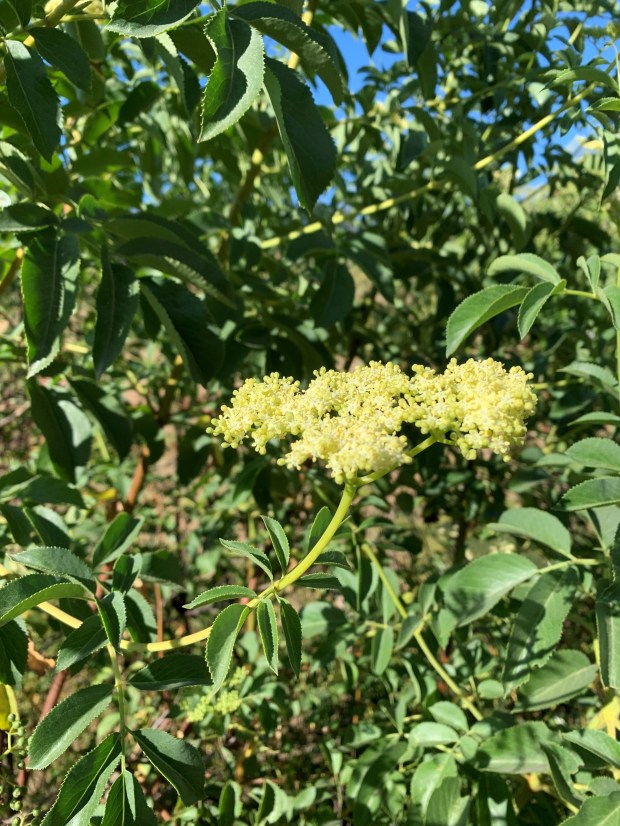
In the Hedgerow, resprouted from the Fire, the many native elderberries…donated by George Work years ago…are both flowering and fruiting. Elderberry flowers are the most beautiful cream color, the dark blue berries blushed pectin white.

Our native blue elderberry, in fruit!

Tree Swallows

During the glorious bright, golden evening light and my walk-around the farm, I glanced at the big rounded canopy of the walnut tree next to our solar panel-driven well and saw something marvelous: a cloud of tree swallows foraging on something. Round and round they darted, encircling the entire edge of the walnut canopy. High squeaking, they chattered a conversational song of play or feasting or both. Some arched a little higher and then wheeled rapidly down, picking at the surface of the leaves, sucking up unseen insects. There were easily 50, perhaps many more. I stood for 15 minutes, but wasn’t there at the beginning- how long had it been going on? The flock soon moved off to some other place, but not before several individuals soared so close to me that I could see their tiny cheerful eyes glistening. They seemed to smile back at me. I suspect that they were after honeydew eating yellow jacket vespid wasps, which must have lost legions of their kin during that brief swallow feast.

The SMELL

This time of year, each year, the night air is heavy with scent. The winds calm and moisture, eased by the cooling night air, forms a shallow layer over the entire farm. Flashlight beams aimed upward reveal the 10’-20’ depth of scant haze. Throughout that dark and steamy air, a distinct scent wafts from the surrounding forests. Tanoak! Big, fat tassels of male flowers poke up from tanoak canopies giving the trees an almost silvery appearance. The tassels are grouped in many-fingered clusters at the branch ends. This is where the smell is coming from. Seminal smell. Almost too much! People feel obliged to ask, “How long will it last?” Who knows. Too long. But, it is a small price to pay for the acorns that will be produced: this promises a carpet of giant tasty nuts later this year. The smell is gone by morning, but you can get up early, close the windows, and seal the smell in your house if you really want to.

WE DON’T HAVE BUGS!

How often have I heard a Proud Coastal Californian exclaim, ‘We don’t have bugs!’ as they attempt to further glorify their admittedly lovely region. These folks must not go out much, or venture far from their urban abodes. There was a brief respite between the Spring Mosquitoes and what is currently headed to Flymaggedon. Face flies…legions of face flies…’eye, ear, nose and throat specialists’ are starting to appear. The first one explored my face this past week. Soon, they will be unbearable: no more sunbathing! Instead, the conversational wave will be the norm. You stand still, talking, and wave your hand back and forth in front of your face to be able to discuss anything while standing still outdoors.

A rare large rattlesnake!

Dangerous Animals

This past little while- two good reports. One: at the odd hour of 2 a.m., Bodhi got a good look at a small mountain lion by our downhill spring. Two: Sylvie just spotted an 8-buttoned rattler on the dirt road near the pavement – it was 2.5’ long…a fatty for our area! I tried looking for the black widow spiders at the mouths of gopher holes during one nighttime foray, but either I was too early in the night or too early in the summer for the population to have grown. Zero blackwidows! Schwew! There used to be hundreds, just last year, in every gopher hole along every road.

-also simultaneously published on the Molino Creek Farm website- check it out!

Abandon Hope

Pema Chodron suggests we put the statement “Abandon Hope” on our refrigerator doors as a reminder. She shares the teaching that hope and fear are two sides of the same coin and reflect feelings that we lack something essential. I sense that those of us who care about the Monterey Bay’s environment are unnecessarily burdened by a philosophy of resource limitation, of lacking what we need.

Presidential Hope

You may recall that “HOPE” was the meme used in Barack Obama’s presidential campaign. When Sarah Palin ridiculed that slogan with ‘How’s that hopey-changey thing working out for ya?’ it turned my stomach. More than a decade later, it is ironic that the political left wing uses similar ridicule for the ‘thoughts and prayers’ refrain used after mass shootings.

Obama once emphasized the ‘reality’ of his ‘Hope’ slogan by saying, “Over the past 2 and a half years, the hope poster starts fading. But I tell you what, you travel around the country and talk to the American people, that spirit’s still there.” According to the wisdom of Chodron, Obama was reinforcing the widespread notion of powerlessness. In dealing with environmental issues locally, I see clearly what Obama meant. The feeling of hope is a terrible affliction around the Monterey Bay.

Thoughts and Prayers

As each new environmental battle unfolds around us, as too few of my community does anything to help, I keep hearing the response: ‘Thoughts and Prayers!’ When UCSC moves forward with bulldozing Santa Cruz’ iconic East Meadow, folks who claim to care for the environment seem to be saying, ‘Thoughts and Prayers!’ As the Bureau of Land Management plows ahead with slipshod management of Santa Cruz County’s only part of the California Coastal Monument, people seem to be saying, ‘Thoughts and Prayers!’ As the Coastal Commission pushes maximum public access on every beach and coastal open space despite dwindling wildlife impacted by poorly managed recreation, the refrain ‘Thoughts and Prayers!’ seems to emanate from so many beatifically smiling, caring people who ‘Love Our Coast!’

Louder Paralysis

Action is louder than words, but what prevents action? The most common response I get from folks who are so full of hope but don’t do anything for our local environmental crises is that they don’t have time. To be sure, the bills need paying and we are all So Very Busy. “How are you doing?” someone asks. The reply so frequently is “Busy!” to the point of being funny (peculiar). When the conversation runs longer and one of the many environmental plights gets discussed, the conversation ends when the ‘hope’ word gets trotted out: “I hope it turns out well!”

Seeding Confusion

Greed lies at the root of all seven deadly sins, and that greed is working well with cultivating confusion across the world, resulting in environmental degradation. Let’s examine how each of the following statements has been used to sow confusion in our community. “UCSC needs to house more of its students!” “Cotoni Coast Dairies should be open to the public!” “Our beaches should be for everyone to enjoy!”

Thoughtful, pro-environmental Monterey Bay citizens want to better understand situations before taking action, even if that action is speaking out, talking to their friends or workmates, or voting for the right candidate. To them, they lack the time…they say that having enough understanding costs time, and they don’t have that time. Time is lacking! Maybe the only thing to do is to hope for the best!

There is Enough Time

We don’t have to know more to be engaged citizens and there is enough time to act now. It takes a fraction of a fraction of a second for your neurons to arrive at your personal most pressing question about environmental conservation in the Monterey Bay area. It takes a similarly miniscule amount of time to place that question on your mental checklist of cherished treasures. With those two in place, you will find the moment to ask that question until you arrive at a well-informed conclusion. Asking the questions, sharing your conclusions: you will not notice the time that it takes to do these. These are the easiest, essential actions that go beyond the empty, lacking things notion of ‘hope.’

Working Together, We Are Successful

The list of accomplishments is long: Lighthouse Field, Gray Whale Ranch, Cotoni Coast Dairies, Upper UCSC Campus, the Glenwood Preserve, Arana Gulch, Monterey Bay National Marine Sanctuary, State Parks Ecologist positions, City Parks lands managers, pesticide bans…None of those would have taken place by hope alone. We have resources. Our community is strong and capable. There is no need for hope, but there is a need for action. Local history shows that when we take action, we can do great things. When we don’t take action, priceless environmental resources are lost. Already, there are no more breeding local badgers, burrowing owls, or roadrunners. Santa Cruz kangaroo rat, Santa Cruz tarplant, Ohlone tiger beetle, and Point Reyes Horkelia, are slipping towards extinction (on our watch!).

Start by Asking

Recently, I urged readers to write an email to California Bureau of Land Management’s Director Karen Mouritsen and to cc me for my records. Guess how many notes I got? Let’s see…population of Monterey Bay what- 100,000 (+)? Readership via BrattonOnline, my website, Facebook, and shares…maybe 2,000?

I got four notes! Four. 4. (Loud sigh)

Its not too late, folks. Your very brief to create email would still be timely- see the link above.

But, as usual, I heard praise from many people about my writing. I am compassionate about the root of people’s “hope” – that it seems we lack time, understanding, or focus.

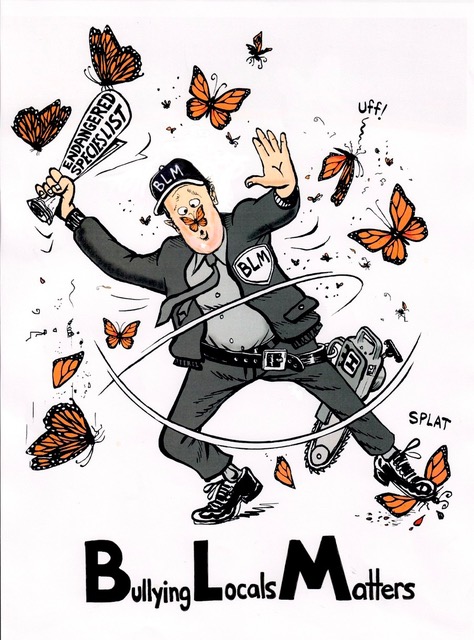
I want to cultivate curiosity and see where that leads. What does this political cartoon make you wonder about? Why not ask? I know enough not to hope; I know that, together, we are making a difference. Thanks Friends of the North Coast!

-this post originally published by Bruce Bratton at his weekly blog BrattonOnline.com – I updated it slightly to account for the FOUR letters I got from my recent call for environmental assistance. (sigh again)

Balmy Days, Cool Ocean Breezes

The days have been perfectly warm with a light breeze off the ocean – we have not been smited by the heat so famously noted in inland California and 5. The cool upwelling ocean has been our nearby friend.

Some odd clouds have been streaming overhead, making for glorious sunsets. One sunset this past week was (briefly) completely Pure Lucious Purple.

Cherries Cherries and more Cherries.

In the past two weeks, we’ve harvested 75 pounds off of the 18 trees. There are another 60 pounds at least ripe right now; those we’ll pick for Two Dog Farm to take to the Alemany Farmer’s Market in San Francisco on this Saturday. The heat is making them get ripe in a hurry! Family, friends, and Community Orchardists are thick in cherry fruit, the very best anyone has experienced. Yum.

In the depths of the night, occasionally we get fog. Rarely now, we wake up to a brief patch of fog, but its not too drippy.

Yip Yip Horray!

Also in the deep dark night: coyote chorus. High squeaky notes of coyote song ring out across the farm. At least three animals are celebrating and almost every night, late-late at night.

Giant gopher snakes are out sunning themselves on the road, frequently.

The second, or third, batch of new bunnies has arrived. There are also big batches of new quail everywhere- not still fluffy, but young enough to be Very entertaining to watch in their barely coordinated flights, weaving willy-nilly much to their parents’ chagrin. After such a flush, it must take hours to regather the covey. Another successful reproductive situation: The Deer! A mother deer is trailing a single fawn around the property.

Here’s a confirmation that Maw and Caw have been quite successful again with two adolescent yelling and demanding offspring. They are good parents, watching carefully after the kids.

In a tall tree near the Brush Field, a pair of red tailed hawks have fledged a talkative young one. This is the first pair and the first offspring I’ve seen since my arrival in 2008. We could use more hawk action with the burgeoning bunnies, gophers, and mice.

Hay There

The grass has dried. All of the grass has dried. So, it is time to make the Last Mowing, dust and all. There are three ways to get rid of the hay this late in the season: 1) pile the hay in the field and let it moulder; hope to apply at the onset of rains before it becomes too heavy to move…2) compost it, layered with dirt and weeds, kept moist…3) put it on the dirt roads for dust control. After the CZU fire burned up the freshly applied understory hay, we won’t be fooled again. Wait for more mulch application! Otherwise, we grind up the hay and leave it be in the roadsides and fields where it won’t be harvested. The mice will like it there. I saw a bunny eating such ‘stored’ hay recently.

-this post also shared via Molino Creek Farm’s webpage, see this link.

The US Bureau of Land Management-  Species Conservationists?

The California division of the Bureau of Land Management suggests that it is concerned about rare species, but what evidence is there for those of us considering their management of Cotoni Coast Dairies? It is crucial that public land managers take care of rare wildlife and plants – doesn’t it seem like public lands are the right place for species conservation? Let’s consider what we’ve seen…

Background

The BLM has some great policies to guide its management of rare species. It has a guidance manual, Manual 6840 “Special Status Species Management,” that says that BLM will manage not only for species on the USA’s list of threatened and endangered species, but also for species that are candidates for listing as well as those which State wildlife agencies consider priorities for conservation. The manual directs each BLM State office to keep a list of State Sensitive Species (both wildlife and plants) and to update those lists every 5 years in collaboration with State wildlife agencies.

BLM California has published the following lists of sensitive plants and wildlife.

California BLM’s Sensitive Species: Problems

Although BLM’s policies are good, somehow their implementation at Cotoni Coast Dairies, designated as one of  5 onshore units of California’s Coastal National Monument, has been faulty. For instance, plant species listed by the State as rare (Rank 1B) are automatically considered sensitive according to BLM policy, but the BLM California sensitive plant list is missing three of the California rare plant Rank 1B species that have been documented at Cotoni Coast Dairies: Choris’ popcornflower, Santa Cruz manzanita, and Monterey pine. In addition, although BLM’s State Sensitive Plant List has Point Reyes Horkelia, it is not noted as occurring under the management of the Central Coast Field Office, which oversees Cotoni Coast Dairies. Moreover, the last time BLM’s sensitive wildlife list was updated was 2009; it is missing many species recognized by California Department of Fish and Wildlife as rare, including some that occur at Cotoni Coast Dairies. Here are the Cotoni Coast Dairies’ wildlife species that would have been included on BLM’s sensitive wildlife list if the BLM California State Director Karen Mouritsen were following her mandated actions under Manual 6840:

Common nameLatin nameRarity Status
   
Grasshopper sparrowAmmodramus savannarumCA Species of Special Concern (nesting)  
Northern harrierCircus cyaneus  CA Species of Special Concern (nesting)  
Olive-sided flycatcher  Contopus cooperiCA Species of Special Concern (nesting)  
American badgerTaxidea taxusCA Species of Special Concern  
San Francisco dusky-footed woodratNeotoma fuscipes annectens  CA Species of Special Concern

BLM Central Coast Field Office: Problems

 The staff at BLM’s Central Coast Field Office have described themselves as being ‘conservationists.’ If this is so, then they are prevented from carrying out their self-professed ideology by someone higher up in BLM, perhaps at the State BLM level under Director Mouritsen’s oversight. In 2021, Michael Powers is listed as the author of the “Biological Monitoring Plan, Cotoni-Coast Dairies unit of the California Coastal National Monument, Updated December 2021.” It is odd that there is a monitoring plan in absence of the science plan mandated by the 6220 Manual, which provides policy for managing units of National Monuments under BLM’s stewardship. This oddness continues when one more closely peruses Mr. Powers’ monitoring plan.

Section V of the monitoring plan is titled “Special Status Species,” but the section fails to mention the majority of wildlife and plants on California BLM’s sensitive species lists. The only species listed in this section are the California red-legged frog, steelhead trout, and coho salmon – these noted as ‘Federally Listed’ at the top of that section.  The section of the monitoring plan fails to list the monarch butterfly, which was published by the US Fish and Wildlife Service as a candidate for listing as endangered a year before the monitoring plan, in 2020. According to BLM policy in the 6840 manual, federally published candidate species are to be considered sensitive species with such monitoring plans.

BLM Natural Resource Impacts

Some would suggest that plans are just plans and lists are just lists, but how do these things really matter? Someone in one of the California BLM offices ordered candidate species monarch butterfly habitat to be destroyed at Cotoni Coast Dairies (one day, we’ll know who!). Destroying that habitat makes it more difficult to restore healthy populations of monarch butterflies on Planet Earth. The increasing rarity of monarch butterflies that BLM has created places more burden on other landowners, both public and private to help monarchs not become extinct.

More broadly, someone evidently told BLM’s Mr. Powers not to consider the entirety of California State BLM-listed sensitive species in the monitoring and, presumably, management of Cotoni Coast Dairies. Since BLM State or local officials have not asked for help with budget, there must be some other issue, but political issues don’t seem logical. BLM’s policy states the following reason for analyzing, monitoring, and planning for the conservation of sensitive species: “to promote their conservation and reduce the likelihood and need for future listing under the ESA.” The majority of Americans on either side of the political divide support wildlife conservation. It is in everyone’s interest for species not to qualify for listing under the Endangered Species Act.

Without concerted collaborative effort, it is likely that at least one of the sensitive plants or animals at Cotoni Coast Dairies will face listing under the Endangered Species Act (ESA) in the next 30 years. The Point Reyes Horkelia is probably the most likely species, but the Monarch butterfly is also quite likely. The BLM has no plans to monitor those species, so the agency won’t know if its management of Cotoni Coast Dairies is helping or hurting those species.

What You Can Do

Would you please help? Please write State Director Mouritsen and ask her to protect sensitive species at Cotoni Coast Dairies as well as throughout California. You might mention that she should:

  • Order the Central Coast Field Office to consider BLM California’s sensitive plants and wildlife at Cotoni Coast Dairies as required by BLM’s 6840 Special Status Species Manual.
  • Publish an updated State BLM sensitive wildlife list in collaboration with the California Department of Fish and Wildlife, as mandated by the BLM’s 6840 Special Status Species Manual.
  • Publish an updated State BLM sensitive plant list to include the State ranked 1B plant species documented at Cotoni Coast Dairies, as mandated by the 6840 Manual.
  • Respect those who care about natural resource protection as much as she respects those clamoring for access for mountain bikes at Cotoni Coast Dairies.
  • Publish a Science Plan for Cotoni Coast Dairies as required by BLM’s 6220 National Monuments, National Conservation Areas, and Similar Designations (Public) Manual

That could be a short email note….it would be fast to write! It could even be a cut-and-paste of the those bullets. What we need is numbers of notes to show the Director that there are lots of people who care. Here’s her email address: kmourits@blm.gov It would be great if you could cc me, so I have a record of the communications: coastalprairie@aol.com

-this article originally published in Bruce Bratton’s impactful weekly blog BrattonOnline.com

Fattening Apples, Impending Heat

The tension of summer is upon us. We relish the beautiful days, like today, with an ocean breeze and high temperatures in the upper 70s to low 80s. The nights are cool enough to be our air conditioning. We awake to cool houses that slowly warm as the day progresses until the (welcome) onset of cooler evenings. The crickets are loud, the birds silent in the midday warmth, and cicadas fill the heat of the day with their one note, incessant, high metallic-whining song.

The magnificent pulse of pleasantly warm days and cool nights used to be normal, for decades it was normal. Recently, there is a prickle of worry that the HEAT will arrive: days of above 90s when the night never cool. We’ve had 4 of those in the last 3 years, 1 right before the 2020 fire and one just after. Those are tough. We might get one of those this weekend. The Weather Service can’t say. While they predict 110F inland, ”readings along the coast are a bit more tricky.” Sigh. All we can do is get the irrigated ground as wet as possible to buffer our poor crops against what might be wilting, damaging heat.

Molino Community Orchardists produce this beauty…a gala apple tree perfectly thinned

Pomelogically Speaking

Meanwhile, in the cool shade of apples trees…We gaze across a lush and happy orchard filled with quarter-sized fruit peaking out from beneath the protective cover of deep green leaves. The many hands of orchard collective workers have thinned almost the entire orchard to well-spaced fruit that is gaining girth expeditiously. By taking off most of the fruit and leaving a few, we relieve the mother trees of too much work. You can almost hear them sigh and relax.

The apple trees are growing so well that their bark is splitting, the first furrows appear on our aging tree trunks. So, this is how trees show their wrinkles. We are only a month away from the first apples ripening: The Gravensteins. We will have just two of those types of apple trees bearing this time around, but there are many more small ones getting bigger – 3 more years and the crop will begin to burgeon. After that, the Gala apples will be on hand in 2 months, and that’s the beginning of the big apple party. Apple trees do not like warm roots, but this spring saw the canopies grow so much that there is good shade across most of the orchard floor. The edge trees suffer more, but we’ll dispense thick mulch over their tender roots soon enough.

Plum Nothing!

Soon, there will be plums but none right now. The challenge with plums is netting them. We need to create an easy-to-deploy single tree netting system, so we can get plums this year. There is a promising fruit set.

Maw and Caw Update

Taking my morning stroll this morning, I heard a raven scream from down near the netted cherry grove. ‘Oh NO!’ I thought…’What’s wrong?!’ Perched on the cherry net structure were 4 ravens, not just our farm pair, Maw and Caw. Did they have twins this year? Was that single scream an obnoxious raven yell, so typical of their adolescent young? More study is needed.

Other Wildlife Observations

Foxes and coyotes calling, fledged barn swallows, frequent Lazuli song. It sounds like someone is strangling a cat, but its just a gray fox calling. It was very startling, though. It’s the first sign I’ve had in a long time that the foxes are still around. Uh-oh for the fruit, though.

Sylvie woke one night to the pitched song of coyotes.

One of the 4 fledged barn swallows from my porch hung upside down like a bat for an hour yesterday. What’s up with that. I worried that it was sick, but then saw it idly preening itself while hanging upside down. Odd bird! It seems to the smallest and is quite a rebel. The other three fly one way, it tilts its head at them going that way, chips, and flies a different way.

The laughing calls of lazuli bunting are very common on the farm. They well compliment the high giggling peeps of the many lesser goldfinches that are feasting on Madia seed happily.

Molino Creek Farm’s dryfarmed tomatoes

Farming

Dusty clouds billow in the wake of mowing tractors, weed-tilling tractors. Bent forms slowly hoe their way down the rows in the morning heat. Shimmering waves of warmth bend the images of quickly growing crops, not yet covering the ground, but soon! This is the time of cash outlay, the gamble that the harvest will bring the returns to pay back all the labor going into the crops right now. Killing gophers, weeding, watering…repeating…over and over, the harvest weeks away.

Black walnut – we have a lot of them on the farm!

Walnuts

We have a lot of black walnuts growing on our farm, never harvested. Still, they are beautiful trees!

-this post also placed at the Molino Creek Farm web space.